SKT teams up with Arm, Rebellions to develop AI inference server

By James Pearce
Apr 10, 2026
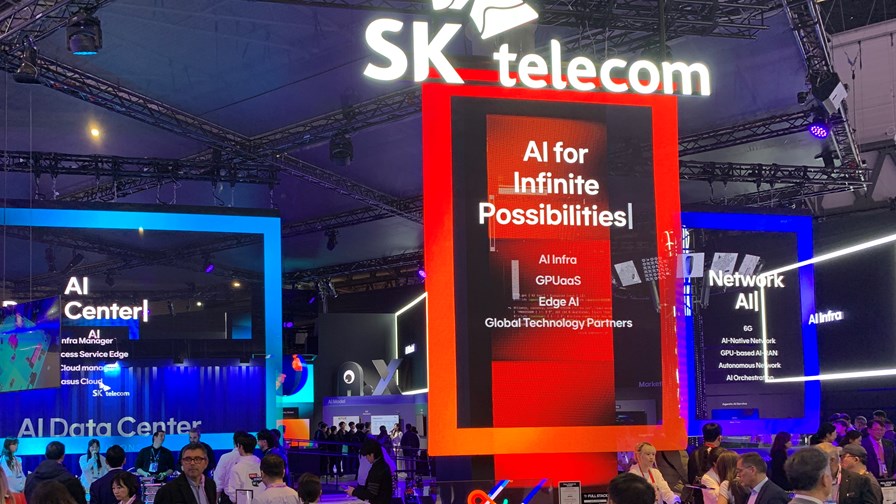
SK Telecom's MWC26 booth is dominated by AI messaging.
- SK Telecom is to jointly develop inference servers with chip firms Arm and Rebellions that are suited for sovereign AI and telco datacentre deployments
- The servers will combine Arm’s recently announced AGI CPU and RebelCard AI accelerator tech from South Korea’s Rebellions
- SK Telecom will trial the resulting server solution in its datacentres and might run its own large language model (LLM)
SK Telecom (SKT) has struck a partnership with semiconductor firms Arm and Rebellions to build AI inference solutions combining CPU and AI accelerator chip technologies.
The memorandum of understanding will see the three companies jointly develop a solution that combines Arm’s AGI CPU with a new Rebellions solution, RebelCard, which is set to launch in Q3. The combined solution will then be tested and verified by SKT in its AI datacentres.
Arm’s AGI CPU, launched a few weeks ago, is co-designed with Meta for agentic AI infrastructure and is the first datacentre chip that the UK-based semiconductor firm has built itself, putting it in direct competition with the likes of Intel and AMD.
Arm will work with Korea-based Rebellions to develop a high-performance server infrastructure and the software stack, including firmware, which will be deployed in SKT’s live datacentre environments. This will allow the partners to verify performance and stability for sovereign AI models, while building telco-specific large-scale data processing solutions.
SKT said it also has plans to operate its sovereign AI foundation model, A.X K1 on these servers once they have been built. This, according to the Korean telco, will allow it to secure low-power, high-efficiency AI inference infrastructure to make it more competitive in the AI datacentre space.
Lee Jae-shin, head of AI business development at SK Telecom, said: “By offering a full package that combines infrastructure optimised for inference with our sovereign AI foundation model A.X K1, we will further enhance the competitiveness of our AI datacentres.”
For SoftBank-owned Arm, the partnership is a quick win for its AGI CPU, which was only announced last month. Arm claims its debut product offers “more than 2x performance per rack compared with x86 platforms, enabling up to $10bn in capex [capital expenditure] savings per GW of AI datacentre capacity” according to its own estimates.
Arm has already agreed a partnership with Meta to deploy the chip in some AI projects, and has partnerships in place with the likes of Cerebras, Cloudflare, F5, OpenAI, Positron and SAP.
Korea-based Rebellions will provide its RebelCard solution, featuring its next-generation AI semiconductor Rebel 100, which it claims can secure performance comparable with current flagship GPUs while “exceeding them in power efficiency”.
Last year, Rebellions – which as well as SKT also has links with KT Corp. – raised $250m in series C funding, valuing the company at $1.4bn, including backing from Arm and the likes of Samsung Ventures.
Jinwook Oh, CTO of Rebellions, said: “We expect this ‘one-team’ collaboration of experts to serve as a significant precedent in the industry for building AI-specialised infrastructure.”
The partners also mentioned the opportunity to address surging demand in the inference market and set standards for high-performance, energy-efficient sovereign AI infrastructure.
Sovereign AI was recently identified as a major opportunity for telcos across the globe. A document published by Morningstar DBRS, the world’s fourth-largest credit rating agency, noted that “most developed economies have announced sovereign AI plans” in recent years and that “there is ample scope for [telcos] to contribute to building sovereign AI ecosystems and participate in the development and application of AI technologies… given their technological expertise, resources and reputation as trusted partners for mission-critical applications.”
SKT is one of those telcos looking to capitalise on this opportunity. Last year, it announced the launch of its new sovereign AI infrastructure, providing GPU-as-a-service (GPUaaS) based on the Nvidia Blackwell GPUs.
The platform – announced in July – features one of Korea’s largest GPU clusters, consisting of over 1,000 Nvidia BlackwellGPUs integrated into a single cluster.
- James Pearce, Editor, TelecomTV
Email Newsletters
Sign up to receive TelecomTV's top news and videos, plus exclusive subscriber-only content direct to your inbox.