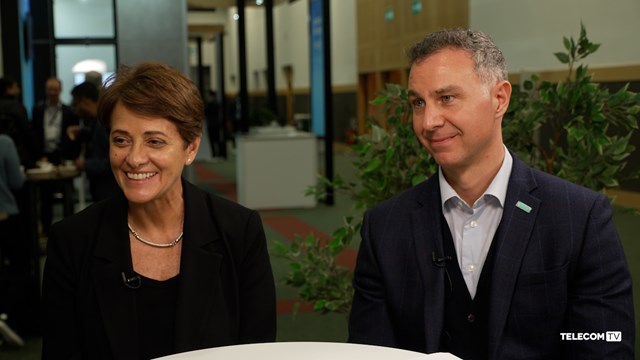
Christel Heydemann, CEO, Orange.
- Without doubt, AI will once again dominate strategic thinking in the telecom sector in 2026
- Orange CEO Christel Heydemann ended 2025 by posing some key AI-related questions that all telcos will need to consider
It’s hard to imagine that AI will be anything but the key trend impacting strategic thinking in the telecom sector this year, just as it was in 2025. But what are the key questions telcos need to ask themselves this year and the key AI considerations driving their strategic thinking?
There are lots of different angles, of course, from the way AI can be used for all manner of processes, such as customer care, network operations and energy management, to the impact it has on staff, such as training, skills and the (still) elephant in the room – whether jobs will be cut as more widespread, AI-enabled automation becomes a day-to-day reality.
One of the big unknowns, though, and something the network operators need to plan for, is how the use of AI by customers will impact data traffic trends and volumes, and what impact that will have on network capacity and architectures.
This is something the telcos have been considering ever since ChatGPT became a generative AI sensation in late 2023, but as the AI action starts to shift from large language model (LLM) development to inferencing and the use of AI tools by consumers and (likely more importantly) enterprises, the shape and nature of telco network data traffic is going to change.
The big questions are – in what way(s) and by how much? The vendors want telcos to believe their networks will be flooded with traffic in an effort to encourage greater capacity investments and to a certain extent this might be true in the case of metro and long-distance data transport networks that connect datacentres and other major hubs – a topic we covered late last year – but that is a very particular use case for a subset of the telco community.
But it’s clear that at least some network operators are bracing themselves for major traffic pattern shifts.
Orange CEO Christel Heydemann, for example, ended 2025 by sharing, on a couple of separate occasions, that the operator expects two-thirds of the traffic running across its networks to be “AI driven” by as soon as 2030.
That was something she noted at the Adopt AI – Grand Palais event in Paris in December, when she was interviewed on stage by BBC journalist Samantha Simmonds.
Heydemann noted: “There’s still a lot of question marks on what’s going to be the impact of AI on our networks. We believe that more than two-thirds of the traffic on our networks in 2030 will be AI driven. Now the real question is – will that be bad bots only? Will it be secured? Will it be human generated? Or will it be completely out of control? We are working actively to measure, to understand, but there’s no doubt that having next-generation networks with the ability to be agile, and to make sure that we can provide the best experience… that’s going to be a must for AI adoption. It’s not going to be enough, but it will be a must for sure.”
Those next-generation networks are, of course, cloud-native in nature, something that Orange has been working towards and has been an evangelist and pioneer of for years already – see How Orange is pioneering the cloud-native shift in telecommunications and Orange’s CTIO on the cloud-enabled ‘awakening’ for telcos.
And when asked about the biggest challenges associated with AI, Heydemann highlighted the issue of trust and security. “As a company that operates critical infrastructure and serves millions of customers, trust is something that takes time to get and [which] you can lose overnight… When we think about AI and we think about responsible AI, that’s really the thing that keeps us excited, because we have a mission there – but that’s also the threat that we want to make sure we tackle.”
The CEO also addressed the issue of the impact that AI will have on telco networks in an interview with the research team at CapGemini that was published towards the end of 2025.
She noted that “AI will have a massive impact on telecom networks, both in how they’re used and how they’re run. From an infrastructure point of view, AI applications are going to generate huge amounts of data traffic. Whether the AI is running in the cloud or out at the edge (in a factory or on a smartphone, say), it needs to send data back and forth. That means networks will carry a lot more data, and different kinds of data, than they do today. We anticipate that, by 2030, around two-thirds of all network traffic could be related to AI in some way. When you think about it, that’s enormous.”
Enormous indeed, but the ‘could’ in that sentence suggests that is the top-end estimate and, of course, there are lots of different networks to consider (long-haul, fixed broadband, mobile), but there’s no doubt that Orange is expecting major shifts in the traffic it carries during the next five years.
And as this is something that all operators need to consider, it’s a topic worth tracking and analysing on an ongoing basis, in terms of what’s already happened and what’s expected.
Nokia, for example, recently published its latest Global network traffic report (for some reason without great fanfare…), which included some coverage of what the networking tech company expects in terms of AI-related traffic generation and, it’s fair to say, the projections are by no means hyperbolic. The vendor’s research team expects wide area network (WAN) AI traffic volumes to grow over the next eight years for sure, but even by 2034 it expects the majority of network traffic to be driven by non-AI consumer and enterprise services.
Nokia’s forecast is anything to go by, telcos might need to focus more on how to build and manage their networks for the ever-increasing volumes of streaming video content rather than anything related to AI.
Whatever the outcome, the impact of AI on network plans, configurations and investments is going to be a fascinating one to watch in the coming few years.
- Ray Le Maistre, Editorial Director, TelecomTV
Email Newsletters
Sign up to receive TelecomTV's top news and videos, plus exclusive subscriber-only content direct to your inbox.