- AT&T is gearing up for its D2D launch
- Operators suffer Baltic subsea cable cuts
- BT sells another international unit
In today’s industry news roundup: AT&T is set to launch its beta and commercial satellite-enabled direct-to-device (D2D) service this year and has plans to move its headquarters across Texas; subsea cables have been severed in the Baltic Sea in Northern Europe; BT has offloaded yet another part of its international operations; and much more!
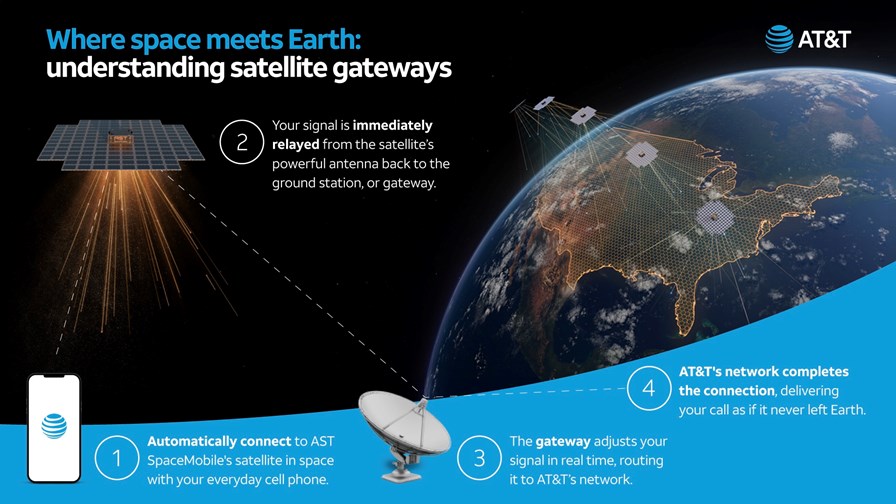
AT&T is gearing up for the launch of its satellite-enabled direct-to-device (D2D) cellular services with a beta service planned for the first half of this year, followed by a commercial service launch later in 2026. The operator is playing catch-up with T-Mobile US, which already has its service up and running in partnership with SpaceX’s Starlink, and has teamed up with AST SpaceMobile for the satellite connectivity, as previously reported: AT&T is also an investor in AST SpaceMobile. In a recent blog penned by AT&T’s senior VP of network planning, construction and engineering, Robert Walters, he noted: ”AST SpaceMobile successfully launched its first next-generation satellite, BlueBird 6, bringing us one step closer to making broadband satellite connectivity available to our customers. AST SpaceMobile has announced they’re on track to complete four more launches by March 2026, building out a robust constellation.” In addition, AT&T has “successfully brought our fourth ground gateway online. These gateways connect the satellite service to the AT&T terrestrial network, and we’ve strategically positioned them to maximise coverage and performance... We plan to offer a select number of AT&T customers and public safety on FirstNet beta satellite service in the first half of [2026], with commercial launch to follow.” Verizon is also an AST SpaceMobile partner, having expanded its relationship with the low-earth orbit (LEO) satellite company in September last year, and is also on course for a 2026 service launch.
Still with AT&T… The giant US telco is set to relocate its headquarters from Dallas to Plano, Texas, in the next three years, reported CBS News.
And one more from ‘Ma Bell’.... The telco ended last year with a blog about its network traffic volumes, noting that it now carries 1 exabyte (1 billion gigabytes) of data each day, “an increase of more than 1,000% over the past decade”. To put that figure into perspective, AT&T noted that 1 exabyte of data is the “equivalent of streaming billions of hours of video or trillions of songs. It’s like stacking 20 billion filing cabinets on top of each other or downloading every book ever written, thousands of times over, every single day. If you streamed HD video 24/7, it would take you over 32,000 years to watch 1 exabyte of movies!” So, it’s a lot… and that’s before AI makes its mark – see Orange CEO poses major AI questions for telcos.
Tensions are high in the Baltic subsea sector following a number of recent cable cuts that have impacted Finnish telco Elisa and international data network operator Arelion, Reuters has reported. Cables connecting Latvia to Lithuania and others linking Estonia with Finland and Sweden have been affected. The security of submarine communications network infrastructure in northern European waters has come into sharper focus since Russia started waging war against Ukraine and, in April last year, a coalition of operators and vendors published an open letter to European Union, UK and NATO decision-makers calling for closer collaboration and greater harmonisation in Europe’s subsea cables ecosystem. Physical network security was one of the topics covered when TelecomTV interviewed Arelion’s CEO Daniel Kurgan in November last year – see Arelion’s role in the sovereign AI era.
BT has completed the sale of its US government contracting arm, BT Federal, to 22nd Century Technologies for an undisclosed fee. The sale of the specialised government unit comes as part of BT’s strategy to focus on its core UK market, a strategy that leaves its BT International arm looking for partners and/or M&A opportunities. BT Federal will operate as 22nd Century Networks, offering integrated solutions “from enterprise to edge” across all 50 US states. BT International, which is a standalone unit after it was separated from BT Business, will continue to have a presence in the US with regional offices in New York, Dallas and Reston. BT Federal is the latest asset to be offloaded from its International arm following divestment deals for its secure networking arm Radianz, its Italian unit, which has been sold to Retelit, and its operations in Ireland (in two separate transactions – to Equinix and to Speed Fibre Group). Bas Burger, CEO of BT International, said: “Today’s announcement is another milestone in delivering on our strategy to focus our international business on what it does best: Providing secure multi-cloud connectivity to large organisations globally.”
The new year has brought news of a casualty in the overcrowded UK fibre broadband altnet sector, which still boasts dozens of small specialist operators. London-based G.network, which has been building out its fibre-to-the-home (FTTH) network in various parts of the capital city, has been sold by its investors for an undisclosed sum to distressed debt firm FitzWalter Capital. G.network is believed to have only about 25,000 customers but debts of about £300m, according to this ISPreview report. Let’s hope the inevitable consolidation that will impact the UK altnet sector this year will be more positive and result in company combinations that can create viable businesses.
Portuguese cement and industrial materials multinational Cimpor has teamed up with Vodafone Portugal and Ericsson for the deployment of a private 5G network, according to this Ericsson press release. The company has deployed Ericsson’s Private 5G tech across its three cement production units in Portugal. “The multi-site deployment delivers comprehensive private 5G coverage with high reliability and extremely low latency – less than 10 milliseconds,” noted the vendor. “The networks support simultaneous operation of IoT [internet of things] sensors, autonomous vehicles and other connected systems, enabling more precise asset monitoring, improved operational efficiency and enhanced safety, even under challenging conditions such as dust, vibrations and large metal structures,” added Ericsson. Private 5G is a sector that still has plenty of growth to come, according to a recent report.
– The staff, TelecomTV
Email Newsletters
Sign up to receive TelecomTV's top news and videos, plus exclusive subscriber-only content direct to your inbox.