‘Shared DNA’ key to Orange’s new partnership with Telesat

By James Pearce
Sep 22, 2026
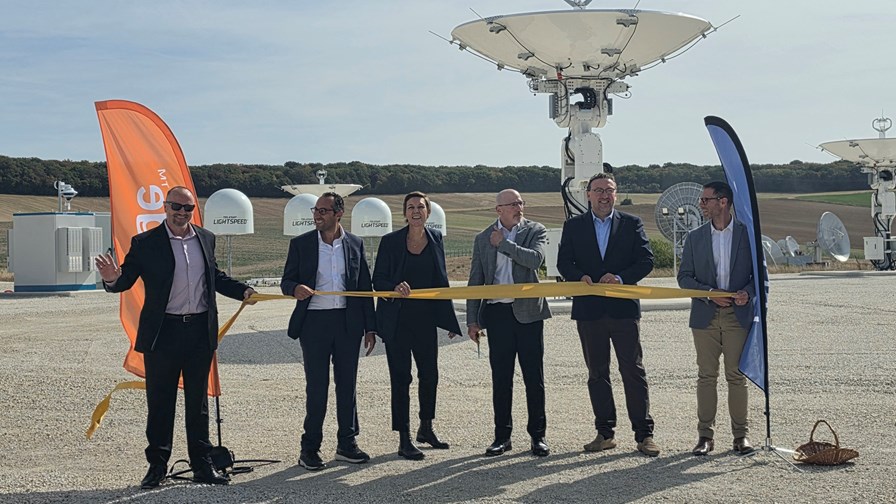
Telesat's Glenn Katz (fourth from the left) joins Orange's Jean-Louis Le Roux (second from the right) and colleagues to cut the Lightspeed gateway inauguration ribbon at the Bercenay-en-Othe site.
- Orange and Telesat have launched a new teleport gateway in France
- The Bercenay-en-Othe site will support Telesat’s Lightspeed LEO constellation
- Orange will integrate Lightspeed into its international wholesale offering
- The Partnership is built on the ‘shared DNA’ of the two companies, says Orange exec
Hidden in the rolling countryside of France’s Champagne region is a field of satellite dishes that has connected terrestrial communications networks with space for almost 50 years. And in this field, just a 30-minute car journey from the town of Troyes (itself an hour’s train ride from Paris), Orange’s Jean-Louis Le Roux and Telesat’s Glenn Katz are wielding a pair of large golden scissors to cut a ribbon, marking the inauguration of the satellite firm’s first European gateway for its Lightspeed low-earth orbit (LEO) constellation.
“Today, our teleport at Bercenay-en-Othe becomes a multi-technology site,” stated Le Roux, EVP for Orange International Networks, at the ceremony, which was held on 17 September. “This site was originally built for geostationary satellites, but with this partnership we move into a new era. Our plan is really to be the hub of space communication within Europe.”
The site at Bercenay-en-Othe is home to 46 antennas ranging from one metre to 32 metres in diameter, which are operated by 25 staff. The latest dish additions from Telesat were built by Intellian and will connect with the Canadian satellite firm’s LEO constellation when Lightspeed becomes operational at the beginning of 2028, with Orange’s teleport acting as a key connectivity hub and providing onward connectivity into Paris and the rest of Europe through the French firm’s fibre backbone.

To build the new antenna system, which comprises 10 antennas, Orange dismantled a much larger 32-metre out-of-service geostationary orbit antenna that was built in 1982 (watch this video, in French, to see how the giant dish was deconstructed).
“We removed a big ear and replaced it with 10 smaller ears,” says Le Roux. “We have changed the landscape in the region.”
The Bercenay-en-Othe site, which first opened in 1978, is “geographically important” due to its low electronic interference, which is beneficial for satellite communications, and its position relative to the orbits of many geostationary satellites. The site is certified Tier 4 by the World Teleport Association, which means it features: Comprehensive end-to-end redundancy in terms of power supply, HVAC (heating, ventilation and air conditioning) and terrestrial connectivity; advanced motorised antennas with full GEO [geostationary]-arc visibility; rigorous safety and 24/7 physical/information security programmes; and resilient automated network operations centres. Le Roux tells TelecomTV the site could run independently for up to one week if needed.
The new gateway will be used by Orange to serve its own wholesale and business customers, providing another form of connectivity, alongside its wider wholesale network, which includes more than 450,000km of submarine cables and 45,000km of terrestrial fibre.
“It is a very good fit because Telesat and Orange share the same DNA,” adds Le Roux. “We have a worldwide backbone with points of presence in over 200 countries, and six teleports. We have partners across LEO, GEO and medium-earth orbit (MEO) satellites, a full complement to our terrestrial and submarine networks. We will plug Telenet into this network with the same service-level agreements and obligations as our existing service. This collaboration aligns with our goal to host more satellite operators at Bercenay-en-Othe through our ground segment offerings, establishing the site as a European hub for the next generation of satellite networks.”
Shared DNA
For Telenet, the benefits of partnering with Orange are obvious, according to the Canadian firm’s chief operating officer, Glenn Katz, who was also in France for the inauguration of the teleport gateway.
Founded in 1969 as a Canadian Crown organisation, Telesat’s existing GEO constellation comprises 11 satellites. But its LEO play, Lightspeed, is seen as vital as it tries to pivot away from the direct-to-home broadcast business that makes up around 60% of its geostationary revenue, but which has been in decline due to the rise of streaming services.
Like many companies in the space communications business, Telesat realised that geostationary satellites carried too much latency, which Katz says is simply a physics problem – they are too far from the Earth’s surface.
Telesat officially announced the branding and formal manufacturing plans for Lightspeed on 9 February 2021, but take-off has not been entirely smooth. In 2023, it switched manufacturer from Thales Alenia Space to MDA Space, leading to delays that Katz blames primarily on pandemic-driven supply-chain failures.
Though Katz refused to rule out plans to launch direct-to-device (D2D) services in the future, Telesat is instead focusing on the enterprise and government sectors, having already signed a $2.3bn deal with the Canadian government to provide secure military Ka-band (Mil-Ka) Arctic connectivity for the Canadian Armed Forces.
It has also agreed deals with telecom firms, such as Vocus in Australia, Northwestel in Canada and fellow satellite companies like Arabsat and Viasat. And, of course, with Orange. Katz says it has more than $4bn of committed and arranged pre-launch funding from deals that have already been announced.
“When you step back and look at the partnership, we are really an extension of Orange,” Katz tells TelecomTV. “As far as customers are concerned, we are in the background. Orange is in the front. Their engineers connect to our network as if they are connecting into any other partner. And that guaranteed service is a big difference maker.”
One of the reasons Telesat was keen to partner with Orange is because “they understand satellites,” says Katz. “Not many telcos around the world have that experience.”
The initial Lightspeed constellation is planned to include 225 satellites and Telesat has already secured 14 launches with SpaceX as part of a $1bn deal to launch the satellites into orbit. This will see up to 18 satellites per launch using Falcon 9 rockets, and Katz admits this is vital to the company’s plan, given how competitive launch slots are – the European Space Agency recently warned that Europe will face a shortage of launchers around 2030.
“It is very competitive at the moment,” Katz acknowledges, “but we secured these launch slots several years ago and we are on the manifest.”
One notable feature of Telesat’s offering is its ability to connect its satellites via optical inter-satellite links (OISLs), with four 10 Gbit/s laser terminals per satellite to create a real-time, global mesh network in space.
“It is designed as a sort of mesh network, so a customer’s data can stay in space and they can select where they want it to land,” enthused La Roux.
This is vital for another area being targeted by Telesat and Orange – sovereign services.
Katz explains: “What this technology can allow is a sort of a fully private and secure dedicated line from one point, wherever it is in the world, to another point… no one can intercept [that transmission] because it’s fully physically dedicated. So that’s one of the key sovereign features.”
Telesat recently added Mil-Ka spectrum to the network to handle high-demand defence operations for NORAD (North American Aerospace Defense Command), NATO and the allied forces, and openly says it is targeting customers in the defence and government spaces.
The partnership between a European telco giant and a Canadian company comes at an interesting time geopolitically, as on the same day that Le Roux and Katz cut the ribbon on the new gateway, rumours in the international press claimed Canada is in talks to become an “associate member” of the European Union.
Katz was reluctant to be drawn into the politics of the situation, but said: “It’s a deliberate move by the Canadian government to become closer to the European Union and all the allies. So you see that close cooperation, which is being forced by the geopolitical situation, both on defence and the political side of things. We made this decision long before even Prime Minister Carney took office, but you can see how it all fits.”
It is “very important” for Orange to remain agnostic, concludes La Roux. “We want to work with several players, but Telesat is a big one. We share the same DNA.”
- James Pearce, Editor, TelecomTV
Email Newsletters
Sign up to receive TelecomTV's top news and videos, plus exclusive subscriber-only content direct to your inbox.