Satellite comms pioneer Skylo expands its D2D ecosystem

By Ray Le Maistre
Aug 21, 2025
- There’s a lot of excitement right now around the direct-to-device (D2D) capabilities of the low-earth orbit (LEO) satellite operators such as Starlink and AST Spacemobile
- But D2D services that connect smartphones and other devices via geostationary (GEO) satellite constellations are playing an increasingly important role in telco, device and chip vendor, and enterprise IoT strategies
- Skylo is already well established as a key player in this sector and has just expanded its ecosystem relationships with Qualcomm and Google
The direct-to-device (D2D) capabilities of the low-earth orbit (LEO) satellite operators such as Starlink and AST Spacemobile are currently generating a lot of headlines as services are launched and more satellites put into orbit, but satellite-enabled cellular connectivity comes in many forms and Skylo Technologies is already playing a key role in the D2D sector and is expanding its relationships with communications industry giants such as Qualcomm and Google.
Skylo has developed a narrowband IoT (NB-IoT) non-terrestrial network (NB-NTN) technology stack, based on 3GPP Release 17 cellular communications standards, to enable devices (smartphones, wearables, IoT modules, vehicles) to switch between terrestrial mobile networks and existing satellites (as long as they use supported chipsets). When the devices cannot connect with a terrestrial mobile network, the data stream is instead connected via the supporting satellites and Skylo’s NTN radio access network (NTN RAN), which is installed in 10 earth stations around the world. Skylo’s commercial D2D service was launched in April 2023 and covers more than 50 million square kilometers across five continents.
But Skylo isn’t putting its own constellation of ‘birds’ into orbit: Instead it partners with satellite operators including Viasat, which has an established geostationary earth orbit (GEO) satellite network, and other GEO network operators Echostar, Inmarsat and Terrestar. It also partners with multiple mobile network operators, including Deutsche Telekom, O2 Telefónica, KPN and Verizon, that use Skylo to offer connectivity services to their customers, giving the telcos extended reach beyond their own cellular networks.
Skylo also works closely with SoftBank Corp. on the Japanese telco’s NTN strategy: The operator’s parent company, SoftBank Group, is a major investor in Skylo, having led the $103m Series B round of funding in 2020. Skylo’s most recent funding round was in March this year when it raised $30m from multiple investors including Intel Capital, BMW i Ventures and the Samsung Catalyst Fund.
Skylo’s latest developments involve expanded relationships with Qualcomm Technologies and Google.
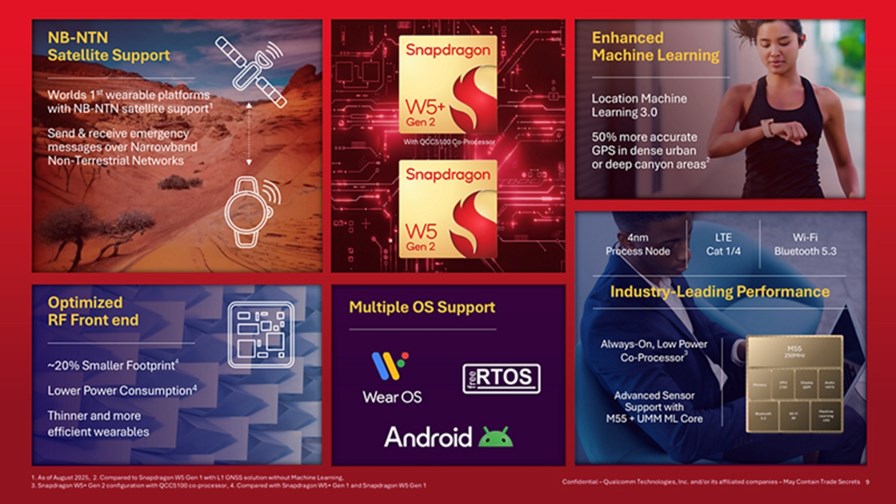
Qualcomm Technologies has just announced its Snapdragon W5+ Gen 2 and W5 Gen 2 Wearable Platforms, which, the wireless chip giant claims, are “the first to introduce satellite support to the wearable industry,” courtesy of Skylo’s NTN (see the graphic above). “This advancement enables two-way emergency messaging directly from the wearable device, helping to bring peace of mind to users in remote areas without cell connection. For instance, adventurers could use their wearable to send SOS messages in case of emergencies without worrying about mobile network coverage,” notes Qualcomm in this announcement.
Dino Bekis, VP and general manager of wearables and mixed signal solutions at Qualcomm Technologies, stated: “With Snapdragon W5+ and W5 Gen 2 platforms, we continue to be a leader in wearable technology by enabling Wear OS to become the first operating system to integrate NB-NTN. This technology can allow users to stay connected in the most remote locations, sending and receiving critical messages via satellite. This innovation underscores our commitment to ensure that users have more reliable communications and enhanced safety with the integration of advancing satellite technology capabilities in wearable platforms.”
Tarun Gupta, chief product officer and co-founder at Skylo, added: “We’re thrilled to expand our collaboration with Qualcomm Technologies beyond smartphones, automotive, and IoT to bring satellite connectivity to wearables. The Snapdragon W5+ Gen 2 ensures that small form factor wearable devices can maintain coverage even in areas outside of terrestrial service. This innovation fundamentally changes how consumers and enterprises view NTN connectivity as new devices and a wide range of use cases with optimized integrations that were previously unimaginable come to market.”
The Snapdragon W5 Gen 2 is integrated into the Pixel Watch 4 – the “first smartwatch with integrated, standards-based satellite communications”, according to Skylo – that has just been launched by Google and which “offers standalone emergency messaging – without a phone or cellular plan”, added Skylo.
That’s just part of the expanded relationship between the two companies.
As Skylo noted in this press release, it has teamed up with Google to offer satellite connectivity to the new Pixel 10 Series of smartphones – see this Google blog to learn more about those devices – as well as the Pixel Watch 4. (Skylo has been enabling satellite SOS connectivity to emergency services on Google Pixel 9 smartphones since August 2024.)
Parthsarathi Trivedi, Skylo’s CEO and co-founder, stated: "This launch isn't just a new feature – it redefines what's possible with satellite connectivity in everyday devices, including the one that's in your pocket or on your wrist. By embedding Skylo's service into phones and wearables, we're making coverage accessible to people in the moments that matter most."
On the Pixel 10 smartphones, Skylo enables “new features such as the first satellite-based location sharing in Android 16,” it noted. “Without cellular coverage, users can send their live location over Skylo's network. Recipients will see a satellite icon on the shared location pin, clearly indicating off-grid status… This new feature will be available on the Pixel 9 Series as well.”
Skylo's satellite capabilities across the Pixel lineup include: satellite SOS, for direct connection to emergency services in the US, Canada, Europe, and Australia, on Pixel 9 and 10 Series phones, and on Pixel Watch 4 in the continental US (with more regions to follow); location sharing via satellite, enabling users to send a live location from remote areas using Google Maps or Find Hub; and satellite messaging, though this service comes only as part of certain plans through mobile service providers that are Skylo partners.
- Ray Le Maistre, Editorial Director, TelecomTV
Email Newsletters
Sign up to receive TelecomTV's top news and videos, plus exclusive subscriber-only content direct to your inbox.