ITU unveils four-year plan to “bring connectivity to everyone around the world”

By Martyn Warwick
Dec 2, 2025
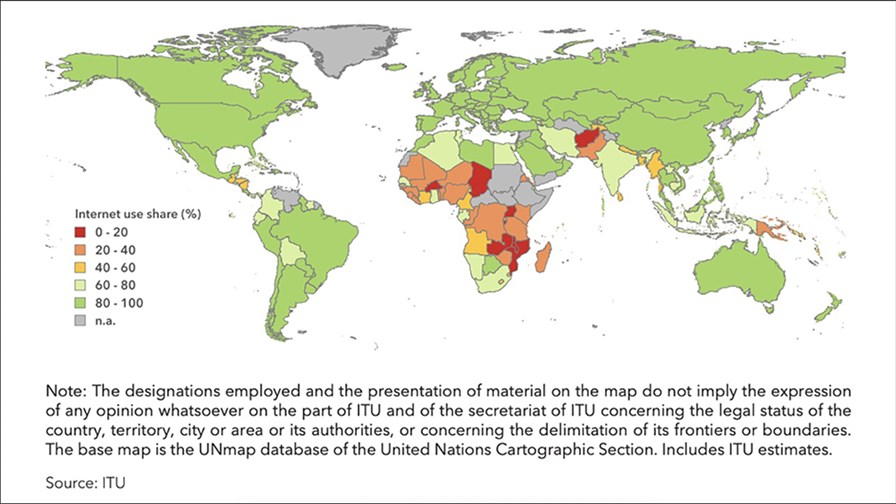
Percentage of the population using the internet, 2024 or latest year available. Source: ITU Global Connectivity Report 2025.
- More than 6 billion people now routinely use the internet…
- But 2.2 billion others are still offline
- Digital divides remain – a quarter of the world’s population still have no connectivity
- The Baku Declaration and Action Plan aims to achieve “universal, meaningful connectivity” but no timetable is given
The International Telecommunication Union (ITU)’s World Telecommunication Development Conference (WTDC-25) held in Baku, the capital city of Azerbaijan, has closed after two weeks of debate and deliberations. Its final communique, the Baku Declaration and Action Plan, reports that delegates agreed on a roadmap “to bring connectivity to everyone around the world”.
The United Nations body claims the action plan document “sets the agenda for human-centred digital development driven by telecommunications and information and communication technologies with focus on the needs of developing countries, unserved communities and vulnerable populations” via “universal, meaningful connectivity” (UMC).
The new four-year plan will run from 2026 until the end of 2029. It will support initiatives to spread global, meaningful and affordable digital connectivity to the remaining 2.2 billion people who, even after all the years devoted to attempt after attempt to finally bridge the digital divide, still have no broadband access and remain disenfranchised from the internet and the global digital economy.
Speaking at the WTDC-25 closing ceremony, Doreen Bogdan-Martin, the secretary general of the ITU, said: “WTDC-25 has brought us closer to our goal of making connectivity universal, meaningful and affordable for everyone, everywhere, in this decade.” She added, “The new plan is our roadmap towards human-centred digital development that leaves no one behind.”
WTDC-25 was hosted by the government of Azerbaijan and, as is par for the course for these events, it produced masses of wordy worthiness. Nonetheless, between them, the 2,000 delegates from the 153 member states of the ITU did reach a broad consensus on practical plans to map out a route to bring the benefits of sustainable broadband and digitisation to, and for, all.
The communique once again proves that the venerable organisation, founded back in 1865 as the International Telegraph Union and specialised agency of the United Nations (UN) since 1947, still has a major role to play in the era of AI and quantum computing. To this day, the ITU continues to coordinate the global use of the radio spectrum and satellite orbits, establishes international technology standards and strives to enable universal connectivity and access to digital services.
In addition to both new and revised resolutions to focus the agency’s digital development works, the Baku Declaration and Action Plan also includes recommendations on how the ITU’s Telecommunication Development Sector (ITU-D) unit might address key digital development priorities in ITU-D regions.
Cosmas Luckyson Zavazava, the director of the ITU’s Bureau of Telecommunication Development, commented: “The plan outlines the roadmap of action to bridge the remaining digital divides, while addressing the unique needs of [the] least-developed countries, landlocked developing countries and small-island developing states. We look forward to delivering tangible results and accelerating digital transformation by working with governments and regulators to create an enabling policy and regulatory framework that paves the way for industry and private sector to invest and contribute to our efforts to close infrastructural gaps so we may achieve meaningful connectivity and bring everyone online.”
During the course of WTDC-25, the ITU published its Global Connectivity Report 2025. It is based on the agency’s newly released Facts and Figures 2025 document and provides “policy guidance, measurement frameworks and detailed analysis across the key dimensions of universal and meaningful connectivity: Quality, availability, affordability, devices, skills and security.”
The WTDC also agreed on a two-year project to enhance the sustainability of national smart villages and smart islands programmes in the Asia Pacific region. This project, to be carried out in collaboration with Australia’s Department of Infrastructure, Transport, Regional Development, Communications, Sport and the Arts, is mooted as a model via which digital skills and access to digital services is enhanced in rural and remote communities, directly benefitting seven countries and 3,000 people. Not many, but not unimportant either – every little helps.
A further, rather vague, declaration to “promote capacity building and digital skills in the Commonwealth of Independent States (CIS), was also agreed. The CIS is a russophone Eurasian intergovernmental organisation that was formed after the Soviet Union ceased to exist in 1991. The CIS charter has it that all its members are “sovereign and independent nations”. The organisation “encourages cooperation in economic, political and military affairs”, which is both very dated and horribly ironic given that Ukraine has been illegally invaded by fellow-CIS member, Russia. Unsurprisingly Ukraine no longer participates in the CIS and another member country, Moldova, has announced that it will withdraw from the CIS.
Ongoing massive disparity between high-income and low-income nations
The ITU’s 129-page Global Connectivity Report 2025 (GCR) is jam-packed with facts, figures and statistics as it takes stock of the current state of connectivity worldwide and highlights the continuing divides between and within countries. It reports that broadband connectivity is now a defining feature of the global economy and a major driver of human development. What’s more, there is an ever-increasing body of evidence to show the correlation between broadband expansion, the availability of connectivity and improved socioeconomic performance.
However, the expansion of connectivity around the globe also throws up what the GCR calls “a connectivity paradox” whereby, although connectivity provides immense benefits, it also introduces new challenges and vulnerabilities. The fact is that unequal access, uneven quality, high costs and limited digital skills leave billions of people still unable to participate fully. What’s more, these digital divides often compound pre-existing ‘analogue’ socioeconomic inequalities.
Furthermore, affordability (or the lack of it) plays a decisive role in whether or not universal, meaningful connectivity can be achieved. ‘Digital poverty’ results in exclusion from digital opportunities. High costs for both ICT services and devices are constantly cited as barriers to internet access, especially among low-income households. In economies where the price of mobile broadband amounts to a significant share of monthly gross national income (GNI) per capita, not only is the share of internet users lower but so too is data usage per subscription.
In contrast, economies that meet the Broadband Commission’s target of ensuring that entry-level broadband services cost less than 2% of monthly GNI per capita have the highest shares of internet users in the population and benefit from much higher data traffic. (The Broadband Commission is a public/private partnership co-founded by the ITU and UNESCO to advance broadband technology for sustainable development.)
Where domestic subscriptions are concerned, spend on ICT services varies widely. In the richest countries, ICT services account for 2% to 3% of household expenditure, while in lower-income economies, this climbs to 9% higher. As has been the case for so long, rural populations generally spend a bigger part of their income for broadband connectivity than urban populations. Not only that, rural subscribers can, and often do, get lower-quality services than their urban counterparts because deploying broadband outside urban areas costs more and so the tariffs are higher.
Fortunately, as the Global Connectivity Report notes, between 2013 and 2025 global affordability eased, with the median price of entry-level mobile broadband falling by some 50% during those years. However, in nine out of ten low-income economies, a 5 gigabytes mobile broadband package costs more than 10% of the average monthly income, five times more than the Broadband Commission’s 2% target.
The report also reveals that the cost of connectivity for the lowest earners can be prohibitive. For at least 40% of earners in the least-developed countries (LDCs) and low-income economies, the cost of broadband services can be as high as 20% of their gross national income per capita. That’s 10 times the Broadband Commission’s target.
The ITU says achieving universal, meaningful connectivity will depend on sustained investment in the “statistical foundations of digital development”. Many countries still face gaps in data, capacity and financing that constrain evidence-based policy-making. Thus, the strengthening of national data ecosystems should be a central objective of the global digital agenda.
Governments need to treat ICT statistics as a strategic public good and integrate them into national development and statistical strategies. Strong institutional arrangements – linking national statistical offices, regulators and digital ministries – are essential to ensure regular data collection, stable financing and the effective use of statistics in policy design. At the international level, current support for data systems remains fragmented, and few mechanisms focus specifically on ICT and digital inclusion. Establishing a coordinated, multipartner financing facility could provide predictable resources, align donor efforts with national priorities, and promote sustained, comparable data production.
Innovation will also be key. The use of mobile phone, geospatial and other alternative data sources can complement traditional surveys, offering timelier and more granular insights. To harness these opportunities, countries must invest in data literacy, privacy safeguards and modern infrastructure.
The report also stresses that continued international cooperation and standardisation will be essential, and this is where the ITU emphasises its own pedigree and asserts that it will continue to “lead global efforts to harmonise definitions, methodologies and tools for ICT measurement, while supporting capacity development and providing technical assistance. Strengthened collaboration across the United Nations system, development partners and the private sector can ensure that all countries are equipped to produce and utilise high-quality digital-development statistics, establishing data as a cornerstone for inclusive and effective digital transformation,” it noted.
Meanwhile, the ITU’s Facts and Figures 2025 report shows that some 6 billion people around the world, about 75% of the global population, now routinely access the internet. That’s up from 5.68 billion in 2024.
However, 2.2 billion remain offline, and while user numbers continue to rise, the world remains split across several digital divides, defined by different factors including speed and reliability of connectivity and affordability. And, despite progress, significant divides continue to exist between high-income countries where internet penetration is now 94% and low-income countries where it is just 23%, between urban and rural areas (85% and 58% respectively), and between men and women (77% and 71% respectively).
As for 5G... some 55% of the global population can now access services enabled by the current cellular technology standard, but 84% of 5G users are in high-income countries and just 4% in low-income nations.
– Martyn Warwick, Editor in Chief, TelecomTV
Email Newsletters
Sign up to receive TelecomTV's top news and videos, plus exclusive subscriber-only content direct to your inbox.