Huawei still the one to catch in global telco tech sector

By Ray Le Maistre
Mar 16, 2026
- The global market for telecom network technology unexpectedly grew by 4% in 2025, according to research house Dell’Oro
- That growth was mainly driven by investments related to AI infrastructure deployments
- Huawei is still the undisputed leader of the global market
Here’s a reminder that, despite so many changes in the telco sector, there is a perennial constant – China’s Huawei Technologies is still the undisputed leading vendor of telecom network equipment and looks unlikely to be unseated any time soon.
That analysis is based on the very particular way that research firm Dell’Oro Group, which has just published its latest blog on trends in the global telecom equipment sector, looks at global telecom networking equipment revenues. The Dell’Oro team subdivides the market into six categories – broadband access, microwave transport, optical transport, mobile core network (MCN), radio access network (RAN), and service provider (SP) router and switch equipment.
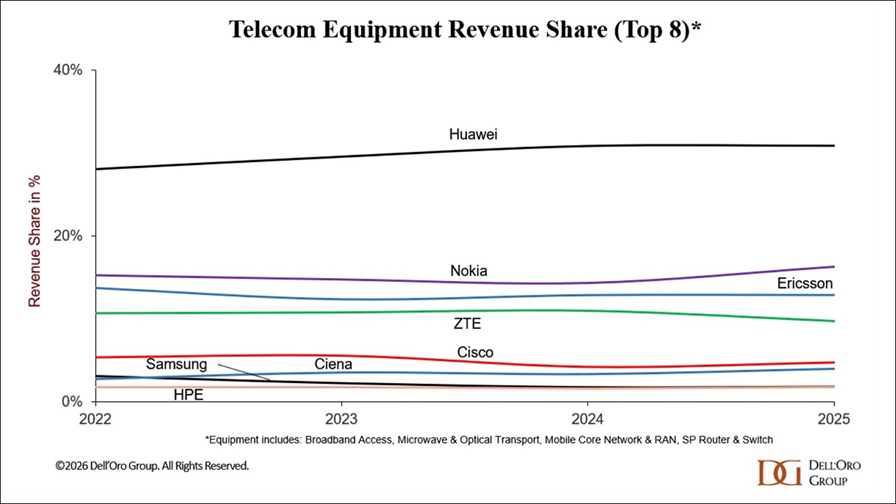
Whichever way you look at it, Huawei is the one to catch, as the chart above shows: Dell’Oro also notes in its commentary that, in the markets where it is permitted to compete, Huawei is the global leader in each of those six equipment categories.
And that’s not just because it has a massive captive market in China (though of course that helps massively) – it’s also because network operator executives rate the Chinese vendor’s technology very highly and, trade restrictions permitting, more often than not want to include Huawei as a key supplier (even if they don’t want to go on the record saying as much).
The only good news for its rivals is that Huawei’s market share is not growing – it’s stable but, with almost a third of the market, is way ahead of any other vendor.
There’s little change in the overall vendor rankings, though Nokia is gaining market share due, in part, to its $2.3bn acquisition of Infinera, which closed about a year ago, but also because of its major presence in the optical and routing equipment sectors, which grew by between 8% and 10% in 2025 due to demand from the companies investing in datacentre infrastructure, including AI factories, and the networks that connect those datacentres.
Ericsson’s market share was stable, while Cisco Systems and Ciena appear to be gaining as AI infrastructure investments grow.
What the chart above doesn’t show, and what Dell’Oro doesn’t mention in its latest analysis of the global market, is the total value of those telecom equipment revenues, but based on previous figures shared and some back-of-the-envelope calculations made during one of the TelecomTV team’s many coffee breaks, it looks like Dell’Oro is pegging the total at somewhere in the region of $87bn.
And the good, but unexpected, news is that 2025 saw an increase in the full year value of telecom equipment revenues, something that the Dell’Oro team had not been expecting at the start of 2025.
So what was behind the 4% year-on-year increase in value? Dell’Oro puts that down to a number of factors, including “inventory stabilisation, favourable currency movements, healthy demand for both wireless and wireline equipment, and robust investment from cloud providers, which contributed meaningfully to the overall growth of the telecom equipment market.”
That demand from the “cloud providers” (for optical and routing gear) isn’t going to disappear in 2026 and there are also signs that the broadband equipment sector is set to experience growth this year, as previously reported.
With those trends in mind, the Dell’Oro team expects “the positive momentum to extend into 2026. Global telecom equipment revenue across the six programmes is projected to grow 2% to 4% in 2026, though the outlook for wireless infrastructure remains more muted.”
- Ray Le Maistre, Editorial Director, TelecomTV
Email Newsletters
Sign up to receive TelecomTV's top news and videos, plus exclusive subscriber-only content direct to your inbox.