Source: RootMetrics
- EE once again claims the UK’s mobile crown
- MTN reports big hike in revenues and earnings
- Brightspeed raises further fibre rollout funds
In today’s industry news roundup: An extensive RootMetrics test campaign backs up the claims of BT Group’s EE that it is by far the best mobile network in the UK; pan-African telco MTN is growing quickly and has decided its time for a management team shuffle; US broadband operator is raising further funds to fuel its fibre access network rollout plans; and much more!
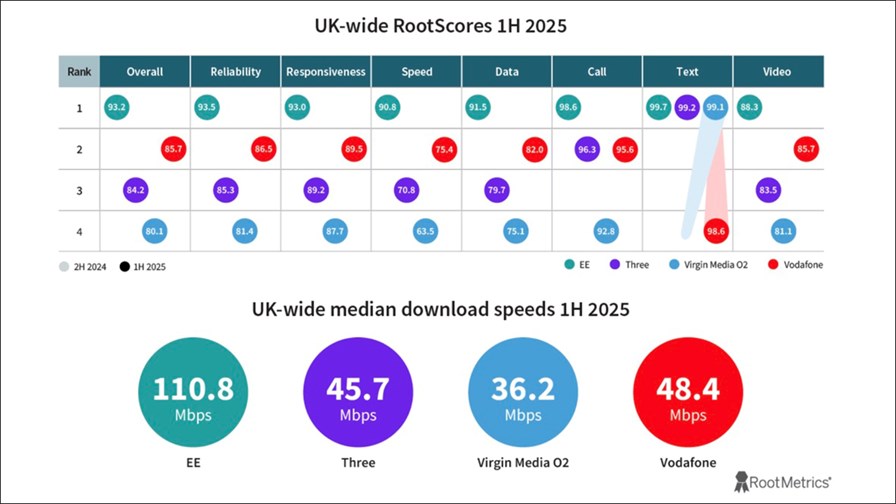
EE, the consumer operation of BT Group, is – by some distance and not for the first time – the best mobile service provider in the UK, according to the latest results from independent service testing specialist firm Rootmetrics (an Ookla company). The Rootmetrics team performed more than 625,000 tests during the first half of 2025 – comprising drive and walk tests in the UK’s largest 16 cities and rural communities in each of the four nations, as well as along more than 22,000 miles of roads and almost 800 indoor locations – and has published the results in its bi-annual United Kingdom State of the Mobile Union report. The report notes that EE won or shared every UK-wide RootScore Award in the first six months of this year, “including its twenty-fourth consecutive UK Overall RootScore Award, recognising the operator for delivering the best overall network performance across the UK for 12 years and counting,” noted the network test services firm. “EE also earned RootMetrics’ Best 5G award and led the way in both nation-level testing and in major metropolitan markets,” it added. As the chart above shows, EE isn’t just slightly ahead of its rivals – it’s way ahead. Vodafone is its main challenger in most categories, while Virgin Media O2 (VMO2) has a lot of work to do to catch up with its rivals, as it generated the worst scores in almost all categories. The next RootMetrics UK report will look slightly different because Vodafone UK and Three completed their merger to form VodafoneThree in early June, but that won’t make much difference to the ranking, other than to widen the gap between VMO2 and its peers. Naturally, the EE team is making the most of the results and issued a press release to highlight its dominance in the market.
Pan-African operator MTN Group, which has 297.7 million customers across 16 markets, has reported an increase in group service revenues for the first six months of 2025 of 22.4% (at constant currency exchange rates) to 105.1bn rand (ZAR) ($6bn), while group earnings before interest, taxes, depreciation and amortisation (EBITDA) (before one-time cost items) increased by 42.3% to ZAR 46.6bn ($2.65bn). MTN Nigeria, where service revenues grew by 54.1% to ZAR 28.23bn ($1.6bn) following the ruling that allowed service providers to increase their mobile tariffs by up to 50% starting in March, and MTN Ghana, where service revenues grew by 39.9% to ZAR 20.67bn ($1.17bn). As we highlighted earlier this year, Africa continues to offer strong growth potential for the operators, such as MTN, Airtel Africa and Orange, that have operations across the continent. As it reported its results, MTN also announced a shake-up in its management team responsibilities. As part of the shake-up, MTN has decided to ‘decouple’ the roles of group chief technology and information officer (GCTIO) and head of digital infrastructure. Mazen Mroué, currently GCTIO and CEO of digital infrastructure, will retain control of, and accelerate efforts to expand, the operator’s fibre and datacentre businesses, as well as liaise with MTN Group’s tower company partners, work to identify network sharing opportunities, and “lead the group’s partnerships with non-terrestrial networks, such as low-earth orbit [LEO] satellite operators”. MTN has been engaging with multiple LEO operators over the past couple of years, including AST SpaceMobile, SpaceX’s Starlink, Eutelsat’s OneWeb and Lynk Global (as reported previously): Earlier this year, MTN South Africa and Lynk Global conducted Africa’s first satellite-to-mobile device call during a technical trial. As a result of the decoupling, the GCTIO role will be taken on from November by Charles Molapisi, currently the CEO of MTN South Africa. Molapisi “has a strong background in network and IT and will remain on the group ExCo [executive committee] taking up his previous role as GCTIO. He will have additional responsibilities and focus on speeding up AI use case adoption and infusion across the business. We see a significant value-creation opportunity over the medium term in the leveraging of AI across the business in domains such as network, customer operations and workforce productivity,” added MTN.
Brightspeed, the US broadband service provider that acquired access network assets in 20 states in the mid-south and east last year from Lumen for US$7.5bn in 2022, and which describes itself as the US’s third-largest fibre broadband builder, is raising $1.65bn to help fund its ongoing fibre network rollout. The funding, which follows a $575m bond offering priced in June and $3.7bn raised in August 2024, “will support Brightspeed’s continued successful accelerated build programme with the ultimate goal of reaching more than five million homes and businesses with its state-of-the-art fibre network across its 20-state footprint,” the operator noted in this announcement. Brightspeed, which is majority-owned by Apollo Global Management, currently passes 2.3 million premises with fibre. “This infusion of new capital means we can continue to expand our fibre network to more homes, businesses and communities who need it,” stated Michel Combes, executive chairman and CEO of Brightspeed. “We’ve proven our ability to build at scale with solid economics, and the added funding underscores the market’s continued confidence in our track record and sustained execution,” he added.
On a smaller scale, Edinburgh-based UK broadband company, GoFibre, has completed a £125m funding round that will support its delivery of two Project Gigabit contracts in the south and north-east of Scotland, covering the Borders, East Lothian, Angus, Aberdeenshire and the Moray coast, the operator announced via an email update sent to the media. The round is led by a £45m debt facility from the Scottish National Investment Bank, alongside a further £80m from Hamburg Commercial Bank (HCOB). GoFibre’s network currently reaches 123,000 premises across the east of Scotland and north of England.
Kyivstar, the Ukraine operation of international telco Veon, is now a listed company on the Nasdaq stock exchange, having become a public company on the US stock exchange on 15 August. The stock is trading under the ticker symbol KYIV. “From today onwards, the ticker KYIV will symbolise the opportunity to invest in Ukraine and to be part of the country’s economic recovery,” stated Veon chairman Augie Fabela. “We are confident that the historic listing of Kyivstar will inspire both the American investors to be a part of Ukraine’s recovery and Ukrainian businesses to share their growth potential with [the] global community.” Kaan Terzioglu, Veon Group CEO and chairman of Kyivstar, which has about 23 million mobile customers, added: “With Kyivstar now trading on Nasdaq under the ticker KYIV, we are introducing a market-leading business on the world’s leading stock exchange for technology companies. This milestone reflects years of putting customers first, staying resilient through challenges and leading with innovation. We look forward to building a long-term partnership with investors as Kyivstar becomes the first Veon operating company to achieve its own listing.”
Having completed its acquisitions of Lumos and Metronet, T-Mobile US is adding to its fibre-to-the-home assets with the purchase of Minneapolis broadband network operator US Internet, reports Cordcutters. The US operator didn’t make an official announcement about the deal: Instead, US Internet customers were sent a letter to advise them they would become T-Mobile US customers in early September. For further insights, see this LinkedIn post from Ookla analyst Mike Dano.
Vivo, Telefónica’s operation in Brazil, has landed a massive internet of things (IoT) contract with Sabesp, the largest sanitation company in Brazil, Saneamento Ambiental has reported (in Portuguese). Sabesp, which provides water, sewage collection and treatment to almost 29 million people in 375 municipalities in the state of São Paulo, has awarded a contract worth 3.8bn reals ($701m) to Vivo to provide connected water meters in all properties covered by the sanitation firm: Vivo is to provide the meters, supporting infrastructure and an automated management system and have everything up and running by 2029. “This will be the largest internet of things project in the world and the largest smart water metering project on the planet,” stated Dênis Maia, executive director of customers and technology at Sabesp. Vivo is the one part of Telefónica’s Latin American portfolio that the giant Spanish telco plans to own in the future, CEO Marc Murtra noted earlier this year when he announced a major review of the company’s operations – see New Telefónica CEO preps massive overhaul.
– The staff, TelecomTV
Email Newsletters
Sign up to receive TelecomTV's top news and videos, plus exclusive subscriber-only content direct to your inbox.