Red Hat’s blueprint for an open, intelligent, efficient AI-RAN era

By Clarence Reynolds
Apr 2, 2026
To embed our video on your website copy and paste the code below:
<iframe src="https://www.youtube.com/embed/jslfctSNTe4?modestbranding=1&rel=0" width="970" height="546" frameborder="0" scrolling="auto" allowfullscreen></iframe>
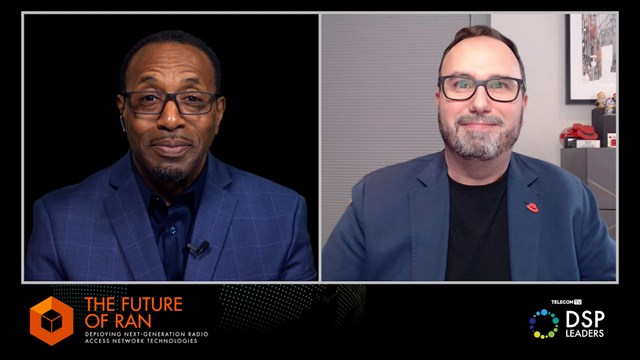
Radio access networks are no longer just pipes. They're becoming intelligent, software-defined platforms where the battle for performance, cost, and energy efficiency is won or lost in the architecture. Ignacio Gonzalez leads Red Hat's Telco Centre of Excellence for EMEA and he joins us to examine how operators can modernise their RAN without tearing up what already works and what AI is poised to change. Ignacio, welcome.
Ignacio Gonzalez, Red Hat (00:39):
Hey Clarence, good to be here.
Clarence Reynolds, TelecomTV (00:41):
Where are operators seeing the fastest measurable gains when working with Red Hat in RAN modernisation? Is it costs, performance, or energy efficiency?
Ignacio Gonzalez, Red Hat (00:52):
Okay. Operators working with Red Hat at least have a clear understanding of the benefits that OpenRAN or Cloud RAN can bring. By 2026 Cloud RAN developments are delivering immediate and measurable benefits primarily in energy efficiency and performance with cost reduction viewed as a long-term return on investment. And let me explain what I mean. In terms of energy efficiency, you know and we know RAN accounts for 60, 70% of the total power consumption for telco operators. So significant OPEX savings are possible. What we have seen lately is that operators are increasingly using the sleeping mode utilisation to drop the energy consumption. In terms of performance, we have seen a shift. Before it was more about increasing speed or throughput, and now it's more about maximising utilisation density. So telco operators are observing higher network utilisation without adding extra RAN resources.
(01:59):
This trend is also supported by the Intel Xeon 6 family, the Granite Rapids, which facilitates an increase in the number of carriers per core in the same server. And finally, in terms of cost, as I said, one of the biggest reasons why the TCO, the total cost of ownership between Cloud RAN and the traditional RAN is narrowing could be this new generation of hardware, but it's still too early. So that's why I say that we have to see what is going to be the picture in the mid-term. Meanwhile, in terms of OPEX, I mentioned the energy savings, so it is a good way, but also it's about increasing the operational efficiency and thanks to automation, zero-touch provisioning, and the next round of innovation like event-driven automation, AI agents, etc., it will happen.
Clarence Reynolds, TelecomTV (02:50):
So if an operator wants to improve an existing RAN without major replacement, what is the most practical first step that you would recommend and why?
Ignacio Gonzalez, Red Hat (03:01):
That is a good one, Clarence, because sometimes we talk about that the only way to improve is just replacing the network, but it's not always the case. So operators looking to enhance their RAN performance without ripping and replacing the existing network. From my point of view, they should initially concentrate on refining their operational model, and this can be achieved through two primary approaches. The first one is what we can call develop a data-driven operational model, focusing on leveraging AI tools to analyse network data beyond RAN. So it has to be RAN, but also transport core, etc. And with these insights that they will gain, it could help operators to boost performance, improve resource utilisation, and proactively prevent potential performance degradation. The second one is about increasing the level of automation, what I call the end-to-end automation umbrella. These frameworks should utilise and integrate new automation tools with existing tools provided by RAN vendors to move from patchy automation at the RAN to have a consistent end-to-end automation framework.
Clarence Reynolds, TelecomTV (04:08):
And with all of that in mind, what role does Red Hat play in AI RAN development?
Ignacio Gonzalez, Red Hat (04:13):
Well, at Red Hat, we see AI and AI RAN as key opportunities for telco operators. We are again focusing on providing telco operators what we call the freedom of choice, which is validating different RAN workloads on different infrastructures, let's say creating technology awareness and also validation. But at the same time, Red Hat wants to contribute to final products and tangible implementations becoming the preferred telco platform for AI. So recently in Barcelona during Mobile World Congress, we highlighted these two collaboration and partnership. The first one with Nokia on AI RAN. The second one was the joint development of what we call the AI factory with NVIDIA using GPUs and Aerial RAN software fully integrated with the Red Hat AI enterprise. At Red Hat, we are proud of what we achieved in 2024, creating a unified telco cloud platform for both RAN and AI applications. This was done with SoftBank, NTT, and Fujitsu utilising NVIDIA GPUs, SoftBank's AI-RAN orchestrator and Fujitsu's RAN over.
(05:25):
All of that integrated on Red Hat OpenShift AI, including LLM and MLOps capabilities, which are crucial to optimising performance. And at the end, the result was the industry's first fully software-defined AI RAN production environment. These activities, what we are doing also with the AI Alliance in the TM Forum, it's in a nutshell what we are focusing from Red Hat's point of view.
Clarence Reynolds, TelecomTV (05:48):
As AI begins to reshape radio access networks, what are Red Hat's main initiatives driving AI RAN innovation in 2026?
Ignacio Gonzalez, Red Hat (05:58):
Red Hat has moved beyond theoretical white papers. Since the second half of 2024, the company has been actively engaged in collaboration with major partners that I've mentioned, including NVIDIA, Nokia, and others that we cannot mention. Also with telecommunication operators, SoftBank, T-Mobile US, and again, others that right now we cannot mention. Red Hat has defined three key focus areas for 2026. The first one is the technical validation, as I mentioned before, of the GPUs and other architectures. The initial technical validation of the RAN workloads running on GPUs and other architectures has to be completed during the second half of 2026. The second one is monetisation and product development. It's not that we are going to develop extra products, it's about helping telco operators to create the necessary products and use cases to effectively monetise AI through their AI RAN implementation. And again, here we need to think about inference capabilities.
(06:55):
And the final one, speaking of AI RAN implementation is the support of them. So Red Hat is partnering with multiple telco operators for their AI RAN initiatives. These initiatives can include field trials, the deployment of AIOps frameworks, and the validation of operational AI frameworks.
Clarence Reynolds, TelecomTV (07:13):
Ignacio, thank you very much for those strategic and practical insights.
Ignacio Gonzalez, Red Hat (07:17):
Thank you.
Please note that video transcripts are provided for reference only – content may vary from the published video or contain inaccuracies.
Ignacio Gonzalez, Business Development Director EMEA, Red Hat
Ignacio Gonzalez of Red Hat Telco offers a ground-level EMEA perspective to one of the industry’s most pressing questions: Where are the real, measurable wins in RAN transformation, and what does a practical upgrade path actually look like? He discusses the fastest routes to cost savings, improved performance and energy efficiency, and explores Red Hat’s growing role in shaping how AI will be embedded into radio access networks.
Recorded March 2026
Email Newsletters
Sign up to receive TelecomTV's top news and videos, plus exclusive subscriber-only content direct to your inbox.