Powering 5G growth with HPE Gen12 and Intel Xeon 6

By Clarence Reynolds
Mar 12, 2026
To embed our video on your website copy and paste the code below:
<iframe src="https://www.youtube.com/embed/e9CW4csiLZA?modestbranding=1&rel=0" width="970" height="546" frameborder="0" scrolling="auto" allowfullscreen></iframe>
Clarence Reynolds, TelecomTV (00:01):
I'm Clarence Reynolds at MWC26. The explosive growth of 5G traffic is pushing network infrastructure to its limits, demanding platforms that can scale without compromising efficiency or reliability. As operators confront this challenge, the partnership between HPE and Intel is delivering next generation compute solutions tailored for the heaviest Telco workloads. And joining us to discuss these innovations are Shams Zakiuddin from HPE's Telco Infrastructure Compute Business Unit and Fernando Teston from Intel Corporation. Thank you both for being with us today.
Shams Zakiuddin, HPE (00:35):
You're welcome.
Clarence Reynolds, TelecomTV (00:35):
So one of the big problems that operators are having is the surge in 5G traffic. How are Intel and HPE working together to address this for our customers?
Shams Zakiuddin, HPE (00:46):
Yeah, this is indeed a very exciting time for us in the market with our customers. So with the rise of 5G capacity growth as well as AI, our focus at HP is really all about scale. So help our customers deploy higher capacities in their network for the growth in 5G and AI. In close partnership with Intel, we've been working to sort of develop a couple of new platforms, which will do exactly that. And once again, focuses on scale, efficiency of deployment, speed of deployment, and of course security.
Fernando Teston, Intel Corporation (01:24):
Right. Yeah, Intel have been seeing those market needs for the telco operators to help them. So on our Intel products, we have been increasing our core accounts for the products to address the market needs. So consolidate data capacity from the platform. So that's something that Intel have been working on. And that's what Intel, Xeon6, SOC brings in for that marketing. So we are talking about a consolidation server, asset core consolidation, and also increased core capacity. So today to the VRAN and FarEdge deployments, we are going up to 72 core. We've integrated accelerators like the VRAN boost, Intel AMX, getting ready for the inference on the network.
Clarence Reynolds, TelecomTV (02:06):
And you actually have the hardware here.
Fernando Teston, Intel Corporation (02:09):
Yes, exactly. So
Clarence Reynolds, TelecomTV (02:10):
What
Fernando Teston, Intel Corporation (02:11):
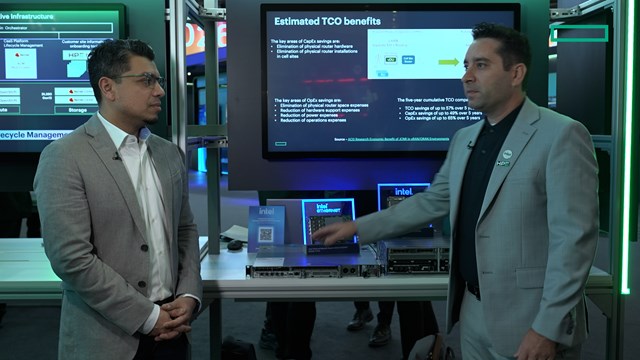
We are showing here is that brand new servers from HPE with partnership with Intel. Both of them are equipped with the Intel Z on six SOC. So on two different form factors or two different flavors. Here where we are seeing is the server consolidation, right? And I believe Shands can talk a little bit more about both servers here.
Shams Zakiuddin, HPE (02:30):
Yeah. So this is the third generation release of this platform. It's scaling quite well in the market, and this is our fourth generation product. So once again, the idea is to keep driving the scale with efficiency. We've obviously been here in this space for a while, gathered a lot of field experience with our customers. So yeah, we just want to move forward as fast as possible with these two new platforms. We've just released them, this one back in February. And then this one's basically part of MWC release here. So yeah, we're super excited.
Fernando Teston, Intel Corporation (03:07):
With those two platforms that HP put in the market here that increase the port density. So with the one uniform factor that's the proline to DL110 Gen12, this server can support up to 20 ports density, bring a 500 gigabits throughput to this box. And this server is capable to address different workloads that Chance will be describing in a moment. And this edge line, EL 9,000 shat that is occupied with the two servers, EL 140, Gen 12, they have a capability of up to 24 ports to address the network needs and different use case that Shands can talk about.
Clarence Reynolds, TelecomTV (03:50):
So with the surge in traffic, what are the use cases for this platform?
Shams Zakiuddin, HPE (03:55):
Yeah, so this is all about Cloud Run deployment at scale. So it doesn't matter what your deployment scenario is, starting from DRAN to ultra dense DRAN to CRAN deployments. We offer quite a few options for customers to deploy. So efficient deployment, as well as we're also bringing some new capability this generation that will allow customers to consolidate some workloads within the same platform that sort of further improves the total cost of ownership for sites. So that's where we're at.
Clarence Reynolds, TelecomTV (04:31):
Shams and Fernando, thank you very much for your insights today.
Fernando Teston, Intel Corporation (04:34):
Thanks for having us. Thank you, Shams. Thank you HPE for the long partnership.
I'm Clarence Reynolds at MWC26. The explosive growth of 5G traffic is pushing network infrastructure to its limits, demanding platforms that can scale without compromising efficiency or reliability. As operators confront this challenge, the partnership between HPE and Intel is delivering next generation compute solutions tailored for the heaviest Telco workloads. And joining us to discuss these innovations are Shams Zakiuddin from HPE's Telco Infrastructure Compute Business Unit and Fernando Teston from Intel Corporation. Thank you both for being with us today.
Shams Zakiuddin, HPE (00:35):
You're welcome.
Clarence Reynolds, TelecomTV (00:35):
So one of the big problems that operators are having is the surge in 5G traffic. How are Intel and HPE working together to address this for our customers?
Shams Zakiuddin, HPE (00:46):
Yeah, this is indeed a very exciting time for us in the market with our customers. So with the rise of 5G capacity growth as well as AI, our focus at HP is really all about scale. So help our customers deploy higher capacities in their network for the growth in 5G and AI. In close partnership with Intel, we've been working to sort of develop a couple of new platforms, which will do exactly that. And once again, focuses on scale, efficiency of deployment, speed of deployment, and of course security.
Fernando Teston, Intel Corporation (01:24):
Right. Yeah, Intel have been seeing those market needs for the telco operators to help them. So on our Intel products, we have been increasing our core accounts for the products to address the market needs. So consolidate data capacity from the platform. So that's something that Intel have been working on. And that's what Intel, Xeon6, SOC brings in for that marketing. So we are talking about a consolidation server, asset core consolidation, and also increased core capacity. So today to the VRAN and FarEdge deployments, we are going up to 72 core. We've integrated accelerators like the VRAN boost, Intel AMX, getting ready for the inference on the network.
Clarence Reynolds, TelecomTV (02:06):
And you actually have the hardware here.
Fernando Teston, Intel Corporation (02:09):
Yes, exactly. So
Clarence Reynolds, TelecomTV (02:10):
What
Fernando Teston, Intel Corporation (02:11):
We are showing here is that brand new servers from HPE with partnership with Intel. Both of them are equipped with the Intel Z on six SOC. So on two different form factors or two different flavors. Here where we are seeing is the server consolidation, right? And I believe Shands can talk a little bit more about both servers here.
Shams Zakiuddin, HPE (02:30):
Yeah. So this is the third generation release of this platform. It's scaling quite well in the market, and this is our fourth generation product. So once again, the idea is to keep driving the scale with efficiency. We've obviously been here in this space for a while, gathered a lot of field experience with our customers. So yeah, we just want to move forward as fast as possible with these two new platforms. We've just released them, this one back in February. And then this one's basically part of MWC release here. So yeah, we're super excited.
Fernando Teston, Intel Corporation (03:07):
With those two platforms that HP put in the market here that increase the port density. So with the one uniform factor that's the proline to DL110 Gen12, this server can support up to 20 ports density, bring a 500 gigabits throughput to this box. And this server is capable to address different workloads that Chance will be describing in a moment. And this edge line, EL 9,000 shat that is occupied with the two servers, EL 140, Gen 12, they have a capability of up to 24 ports to address the network needs and different use case that Shands can talk about.
Clarence Reynolds, TelecomTV (03:50):
So with the surge in traffic, what are the use cases for this platform?
Shams Zakiuddin, HPE (03:55):
Yeah, so this is all about Cloud Run deployment at scale. So it doesn't matter what your deployment scenario is, starting from DRAN to ultra dense DRAN to CRAN deployments. We offer quite a few options for customers to deploy. So efficient deployment, as well as we're also bringing some new capability this generation that will allow customers to consolidate some workloads within the same platform that sort of further improves the total cost of ownership for sites. So that's where we're at.
Clarence Reynolds, TelecomTV (04:31):
Shams and Fernando, thank you very much for your insights today.
Fernando Teston, Intel Corporation (04:34):
Thanks for having us. Thank you, Shams. Thank you HPE for the long partnership.
Please note that video transcripts are provided for reference only – content may vary from the published video or contain inaccuracies.
Fernando Teston, Intel Corporation & Shams Zakiuddin, HPE
Shams Zakiuddin, CTO of HPE’s Telco Infrastructure Compute business unit, and Fernando Teston, Intel sales application engineer, discuss how HPE and Intel are helping operators manage rapid 5G traffic growth. They explore the new HPE Gen12 platforms, Intel Xeon 6 system on chip (SoC) capabilities, key architectural differences, and the workloads each platform is designed to support.
Recorded March 2026
Email Newsletters
Sign up to receive TelecomTV's top news and videos, plus exclusive subscriber-only content direct to your inbox.