To embed our video on your website copy and paste the code below:
<iframe src="https://www.youtube.com/embed/quSnb3INOAw?modestbranding=1&rel=0" width="970" height="546" frameborder="0" scrolling="auto" allowfullscreen></iframe>
Nadine Fassbender, NGMN (00:08):
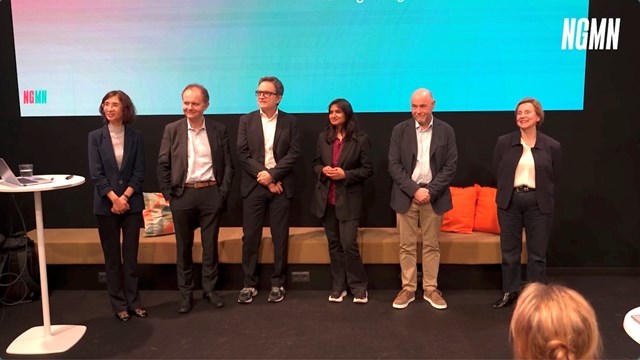
So good afternoon everybody. Welcome to our NGMN Press and Industry Briefing 2026 here at the MWC. We're glad to see so many of you joining us today. Let me start by introducing today's speakers to you. So first of all, I would like to introduce our current chairman of the NGMN Alliance. He is Laurent Laboucher. He's the Orange Group CTO and EVP Networks. Welcome, Laurent. And then in order of appearance, we have Anita Doehler. Anita is the CEO of the NGMN Alliance. Welcome, Anita. Then we have Andrea Calvi. He's Head of Technology, Evolution and Innovation at TIM. Bernard Bureau, VP Wireless Technology and Services at TELUS. Saima Ansari, Cluster Lead AI and Industry Alignment at DT, Eric Hardouin, VP Networks and Infrastructure Research at Orange. And also we warmly welcome Yuhong Huang, General Manager, China Mobile Research Institute, who will join us for the Q&A session.
Nadine Fassbender, NGMN (01:34):
So to give you structure of today's briefing, it will be split in two parts. So in the first half, we will focus on the key achievements of NGMN in the last year, and then we will give you an outlook on the work programme and what lies ahead. In the second half, we will open the floor to questions. So we strongly encourage you to make your questions and take your questions to the board directors here available for you today at the briefing. After the briefing, we also warmly invite you for continuing the discussions with a small networking event that starts directly after we close the session. Today's session will be recorded, as you can see. So the recording will be made available on our homepage shortly. And also the slides that you can see today will be made available directly after the session to download. So no need to take pictures in between.
Nadine Fassbender, NGMN (02:32):
We will share a QR code at the end of the presentation that you can access easily. And with this, I hand over to Anita Doehler. Thank you very much.
Anita Doehler, NGMN (02:45):
Thank you, Nadine, for the kind introduction.
Anita Doehler, NGMN (02:51):
So I would quickly recap what NGMN is about. We are an operator-driven alliance focusing on technology requirements level, embracing the entire value chain in our membership and focusing on the industry's main opportunities and challenges. The membership consists of operators who are full members. That's why we call it operator-driven. So it's about providing operator requirements to the industry and to standardisation. But we have, of course, also vendors, research institutes, system integrators with us. And it's important that in the discussions, especially at early stages of technology development and requirements, we have the dialogue with the entire ecosystem.
Anita Doehler, NGMN (03:52):
Since a couple of years, we are focusing on mainstream pillars and they are all interlinked with each other. So the first one is how to master the route to disaggregation. This is including cloud-native networks at the moment. So we will publish soon and present today also topics about moving into agentic AI-based operating models, network automation, green future networks, everything around sustainability. And then last but absolutely not least, our biggest focus, especially now in 2026, is providing requirements on 6G. And as you can imagine, the first two pillars, they build into 6G. So with this, I stop and we start with our main presentation, handing over to Laurent, our chairman of the board, to present the vision.
Laurent Laboucher, NGMN & Orange (04:45):
Thank you, Anita. And sorry. So good afternoon everyone and very happy to be with you. So I will share a few things in order to introduce the achievement of the previous year and also to prepare for what we'll do in NGMN in 2026. First observation I'd like to make is that for all of us, it's quite a challenging moment for our industry because we are facing significant disruptions in different places. I think one of them, and we'll have the opportunity to address it in more detail afterwards, is related to AI because AI will impact a lot the way we operate our networks, will impact a lot how we do operations in many areas in the company and will impact a lot of jobs within the company. But also we are an infrastructure. We are part of the ecosystem to support new workloads, new requirements for AI, and that will be also a significant part of the challenges and the requirements that we need to address.
Laurent Laboucher, NGMN & Orange (06:10):
The second point is that we are also facing a turning point where, because of geopolitical tensions, we start to see that it's not a discovery, it was always the case, but we start to see that sovereignty and security trust is really at the core of the value that we operators bring to the whole ecosystem and to the whole industry. And it's a very, very, very high responsibility that we have and we need to address several kinds of threats, cyber security, but also threats in terms of capacity to adapt to the climate. And also trust is also the way we address the impact on carbon emission and how we show that we are virtuous and that we have also a capacity to move to, let's say, a much better way to provide the services with much less energy, renewable energy, but also with the whole ecosystem, the vendors, to provide a supply chain which is really sustainable.
Laurent Laboucher, NGMN & Orange (07:50):
Among the challenges, perhaps the most important, and I think for 2026, it's reflected because it is really the beginning of the standard activities, the real standard activities on 6G. And there is a risk that the ecosystem could be potentially fragmented in different stacks, different technology stacks, and we need to avoid that. We need to make sure that we keep interoperability at the core, and I think it's one of the big, very strong requirements of NGMN. Coming back to AI, AI is coming with a lot of challenges and questions, so we don't have all the answers, but as you will see, both on AI for network, but also for network for AI, NGMN has worked and has worked in depth in order to understand more what is clear, but also what is not clear. And I think it's important not to say that typically on network for AI, we know everything because there is a lot of uncertainty and we need to be prepared to adjust dynamically to address those uncertainties.
Laurent Laboucher, NGMN & Orange (09:10):
Typically, as an example, we know that uplink may have a very important role, much more important than in the past, that our networks, our mobile networks used to be sized mostly for downlink and uplink will be very important. And it's not purely static. It will have also to be dynamic. We will need to provide uplink capacity in a very dynamic way. It's not easy. We don't know exactly what will be the size of the impact, but we need to be prepared for this kind of change.
Laurent Laboucher, NGMN & Orange (09:53):
So what is required? We need to, as a community and as a forum, our mission is to be vocal and to provide the voice, which is the voice of operators, leading operators, representing the whole operator community from different geographies, and we need to be vocal on the most important topics. So AI, of course, as I said, AI for network, but also network for AI, energy efficiency, but even more important than just energy efficiency, it's the whole CO2 impact, Scope 2, and Scope 3. Then the transformation of our operating model. AI will transform significantly our operating model, but also the cloud practices, the move to the cloud, how the network and all the software part of the network will leverage in the best way the cloud-native architecture and all the good practices that come from IT.
Laurent Laboucher, NGMN & Orange (11:05):
And of course, last but not least, as I said, 6G. We need to be extremely local to avoid technology push definition of the standards, but make sure that our standards are really driven by value, by use cases, by critical examples of situations where we can really make a difference for our customers, whether they are consumers or enterprise customers. And we need to always think of it more in a demand-driven fashion than just looking at it from a technology standpoint. And I think one of the important values of NGMN is really to bring that perspective as well.
Laurent Laboucher, NGMN & Orange (12:03):
And in order to do that, of course, we are not alone. NGMN is not a standards body, but NGMN is connected. NGMN is connected with the most important organisations, of course, GSMA. We are working a lot with GSMA, with 3GPP, but more and more, we are working with a broader set of organisations. We need to include also Linux Foundation because open source now plays a very important role, and there is a strong connection also with Linux Foundation. So we want, as I said, to address two major challenges. The first one is to avoid fragmentation, make sure that we keep interoperability at the core. And the second one, which is of course extremely linked, is to explain very clearly the requirements from the operators, starting with the requirements from our customers, what is relevant, what is not. We need to take the lessons of what was done in the past, what was not the right way.
Laurent Laboucher, NGMN & Orange (13:22):
In some cases, I think there were some dreams which never happened. We need to be more, as I said, demand-driven and also find a way to influence the standards in cycles which are much shorter than just the cycles that we knew in the past, which are extremely long, and which are not adapted to the time of AI. We know that software introduces short cycles, but AI introduces very, very short cycles. So now it is time to give the floor to ...
Anita Doehler, NGMN (14:08):
Thank you, Laurent. Just need to go around because of the cable. So as mentioned, today we will focus first on a few presentations. We start with the work we have done on network simplification, then on cloud-native and the move to agentic AI-based operating models, then green future networks and then 6G, and then it will be followed by a Q&A session and by a networking event. And with this, I would like to invite Andrea Calvi to present on network simplification.
Andrea Calvi, NGMN & TIM (14:43):
Okay. Thank you, Anita. Well, a few words about one of the achievements which have been obtained at NGMN: the framework for network simplification is a result, a sort of guide on how to survive for operators in a field of increasing complexity in the network infrastructure. I like very much this work because you can find it in a report on our site. This is really a sort of guide for ... Okay. This is a sort of guide on how to move. It is based on a three-phase approach, so identifying the key enablers, highlighting challenges, and then providing some guidelines. It is a sort of manual. It is a 20-page report. So I really encourage all of you to have a look at this because it's a great, great job. Okay. Now, which are the key technologies, the key messages, the key benefits that we can take out of network simplification?
Andrea Calvi, NGMN & TIM (16:08):
We want to move towards a cloud-native architecture. Of course, we want to achieve a very open, scalable cloud framework on which we can run services and network components. You know that everything is becoming software. With the exception of antennas, fibres, lasers, everything is becoming software and all the software is running on top of cloud, cloud infrastructure. At TIM, we put a lot of energies in trying to have cloud, not just some vertical software infrastructure, but really an open operating system for cloud applications running on top of it, for the sake of interoperability, for the sake of sovereignty. So cloud-native is an enabler for everything. Of course, if you look on the right, there are also some challenges.
Andrea Calvi, NGMN & TIM (17:14):
Some complexity would come into this transformation into cloud and cloud network. As an example, some of the workloads, some of the software is not that easy to be integrated. As an example, if you look at the radio software, RAN software, integration on top of a cloud-native architecture is a bit challenging, but this is why we are working as a community. Then the second key message and key benefit is agentic AI-driven operation. All of us are talking about AI. All of us are talking about the fact that with software, we can do things better, faster, in a more economic way. Okay, that's fine. The challenge in that case is in order to have AI helping us, we need to have good data, actionable data, because without good data, AI is meaningless. And the third point, important point is federated network sales. What I mean is the community or service provider or mobile operator should expose their capability, their network capability, the radio access, the quality of service, the edge computing, et cetera, et cetera, through APIs so they can create a platform of services which can work seamlessly everywhere, like it was for the roaming when mobile telephony started with the roaming actually working across countries and across different service providers.
Andrea Calvi, NGMN & TIM (18:49):
And of course, the challenge in this case is the availability of good and standardised APIs. So again, work that should be done in the community of this industry. Then to conclude, as I mentioned, this is a three-step approach. So mapping the enablers to different domains, radio, core, transport, service domain, understanding the challenges for the implementation and then prioritise based on the key benefit and the situation of each operator. This table is a bit complicated, but really is a sort of handout where you can see the benefit of simplification in the different domains, transport, radio, core, et cetera, et cetera, in different directions. Maybe you want to go in the direction of green, sustainability, direction of improving the TCO, customer experience, and so on. So again, have a look at this work because it's a great work. Thank you.
Bernard Bureau, NGMN & TELUS (19:54):
Okay. Good afternoon, everyone. A little bit of context to begin with. The previous NGMN Cloud Manifesto was published in 2023, and it received good recognition from the industry. The Linux Foundation endorsed that and shared the cloud-native maturity model with practical guidance for service providers on how to focus on the outcome for transformation across process, across people, technology, and across culture as well. The new work that we are publishing now is and presented by NGMN today, takes the study into the next level where we assume cloud-native foundation upon which the agentic AI-based operating model can be built. All of this showing the importance of cloud-native in order to exploit AI opportunities. So our core message today is that cloud-native maturity is the absolute structural enabler for AI readiness. You can only bolt agentic AI onto a cloud-native foundation, and we are defining a phased and practical pathway to reach a fully autonomous AI-enabled network operation.
Bernard Bureau, NGMN & TELUS (21:17):
An interesting part of the study covers how GenAI and more specifically agentic AI is changing roles across organisations and as we step into those new operating models, the call to action for leaders across organisations is to bridge the network skillset with AI knowledge and bring data scientists, ML engineers, data engineers, data and AI governance experts to ensure AI adoption is well architected, that it's responsible, that it's secure and well governed as well.
Bernard Bureau, NGMN & TELUS (21:56):
We could see a pattern of evolving roles across the organisations. Service reliability engineers, for example, and developers will use AI assistance in developing important code and improving on efficiency. Network performance teams can leverage AI to predictively fix network and build agents to start auto-healing and scaling network outages and degradation. We at TELUS, we started on that path. We've implemented a good anomaly detection AI engine, for example, and we have already started on explainability as to why these KPIs are going out of norm. So that's just one of many, many, many examples, but it's one path along the journey. So we need networks, technology, people, and processes all ready for GenAI to embrace the opportunities of cloud-native maturity, and it's going to serve as a structural enabler.
Bernard Bureau, NGMN & TELUS (23:02):
So the Linux Foundation presented a while ago the cloud-native maturity model that many people are familiar with with five levels. And so what NGMN has done is that we are now sharing an agentic AI-based operating model levels as they map into those corresponding cloud-native maturity models. I'm not going to go into those details for all the levels, but level one is foundational where people are going to improve on literacy. The technology is supporting proof of concepts at this point, and there are some guardrails and some governance already in place. And if we fast forward to level five, we see a mature state where agentic AI-based operating models, where high quality data is presented as data products, and data and AI governance is in place, and AI workflows are running in production, reducing a significant amount of human interaction, and they're becoming obviously very autonomous.
Bernard Bureau, NGMN & TELUS (24:07):
In a level five maturity state, we are going to have swarms of AI agents that are continuously monitoring the network via high quality data streams. So building those data pipelines is very important and foundational. And eventually we're going to have, for example, the anticipation of congestion, the AI agent detecting that for two critical applications, we need to implement a slice. And once this spike of congestion is avoided, then the way that the network will protect critical applications is going to be torn down to save on electricity efficiency. And throughout all that cycle, there is zero human intervention and the goal of the engineer is to review AI saved throughout all that cycle. So that's it for me. I think the next one is.
Saima Ansari, NGMN & DT (25:11):
So hi everybody and thank you for sharing cloud-native solutions. I will in fact move on now to the green. I will tell a little bit about what we have done in 2025, so what publications we have made so far, what were they all about? What are the key messages that you can take away with them and what is coming for 2026? So that's the idea for the next couple of minutes. Out of these three publications, let me start first with the environmental sustainability and reporting. I think you have already heard even from the speakers before me about how important sustainability is despite everything that's going on. This is on top of the agenda of each and every telco that we see in here. One of the major elements when we talk about sustainability is ensuring that we are reporting the right numbers, that we are talking about the right metrics which are shared across the industry.
Saima Ansari, NGMN & DT (26:08):
That's basically one of the key messages which we wanted to give away via this report, that we give a guidance to the industry to reduce the carbon emissions and to enhance the reporting, not only in our own company, but across the value chain. Main drivers, if you ask any of the telcos who have already renewable energy sourced for their networks, they will tell you it's Scope 3. Scope 3 is something which is accounted not only within the borders of the telco. Scope 3, our emissions are those which are in fact created across our value chain. And for those operators who have renewable energy, Scope 3 is literally one of the major sources of emissions. And as you can imagine, working with NGMN, this is one of the major elements we are touching upon that if we as an industry want to reduce our Scope 3 emissions, we need to collaborate, we need to work together.
Saima Ansari, NGMN & DT (27:05):
That's one of the main things. Out of this, we have a recommendation. Major recommendation, let us please move away from spend-based emissions. What do I mean by that? Currently, reporting exists primarily based on what a spend is, and then somehow calculate based on some emission factors, the Scope 3 numbers. And this is exactly what we want to get away from. We would really like to see what the real emissions are from the ground to the production, to the services that are brought to the customers and how they can be calculated. So that's something which we have illustrated in the paper. Please take a look and hopefully it supports. The second piece is the energy management and flexibility in the mobile networks. What do I mean by that? When we talk about renewable energy sources, you can imagine sun is not shining all the time, and you can imagine wind is not blowing all the time.
Saima Ansari, NGMN & DT (28:02):
So we do have a high volatility when it comes to solar power, when it comes to renewable energies, and to manage that in a way that we get the most efficient network running, this is the paper which basically serves how to look into the services that are provided by the energy market and how we are able to automate and flexibly manage our energy systems. Moving on quickly to the third publication, which is also critical in our journey to having an energy efficient operation is the metering part. And I think I will introduce this part just simply by saying you cannot manage what you cannot measure. Very often you can hear it from the telcos, our major energy consumption is in the radio, so we are focusing on that. True, I will not deny it. The only element that I would like to focus here is that yes, there is a huge need of metering even in the transport network and across all the domains, in fact.
Saima Ansari, NGMN & DT (29:03):
So this paper basically talks about what we as an industry need to do in order to be able to effectively measure the energy which is actually consumed in our networks, because there are in fact a lot of spots where we are really blind at this point in time. So here we are also liaising with several SDOs. So I think somebody already said we are not creating standards in NGMN, but we are definitely making recommendations and collaborating with the SDOs also to deliver on that. Well, so far what we did in the past, now a few words on what we are planning to do as next steps. In 2026, again, I must say, we are focusing on three key elements. What those key elements are, I will take it one by one. So the first one is resilient network. And let me please already tell you, we are not talking about cyber resiliency or something across our supply chain globally and things like that.
Saima Ansari, NGMN & DT (29:59):
We are within the scope of this project, talking about how we as an industry are able to manage our networks through the natural hazards, through the power failures. If you have been in Europe, you have seen what has happened in Spain, for example, a few years ago. You have also seen the network disruptions through the natural hazards. These are all the things that we are taking into account to identify the risks and to ensure that we are accounting for such scenarios where we have identified risks already and then what to do against it. So watch out for this one. The second piece, sustainable AI in telecom networks. I know some of you might be thinking, how can these two words even go together? How can you even make AI sustainable? I have received this question multiple times and I can tell you that yes, most of the operators are embracing AI.
Saima Ansari, NGMN & DT (30:58):
We are running our networks. We want to bring agentic AI capabilities. We want to optimise, we want to efficiently run our networks using AI. However, how that AI is brought to the network, how it is implemented and how we measure the energy across the board, that plays a major role. And this is what we see as our responsibility. And that's why within this piece of work, we are currently defining some key use cases, some metrics, measurement methods to give a guidance to the industry on how to approach such an important topic. And finally, last but not least, we are also going to talk about cooling strategy. This is not a heavily talked area within the telco networks, but I can tell you with the traffic that we see in our network, with the amount of energy consumption that we currently see in our network, it is going to become one of the critical questions, especially across the globe.
Saima Ansari, NGMN & DT (31:54):
That's why we took this as one of our major focus areas for 2026. And in this piece, we are actually identifying what are the common challenges that we face as MNOs across the globe, and then analyse a sort of suitable cooling solutions that can be given as a recommendation based on the climatic conditions that are faced. So please watch out for these three. And with that, I thank you all for listening. Happy to take your questions and hand over to Eric.
Eric Hardouin, Orange (32:25):
Thank you, Saima. And good afternoon. So as you know, 6G standardisation is now ongoing since last year. And so it is especially important for us in NGMN to provide operator guidance to make sure that standardisation is going into the direction which is in line with our vision. So NGMN has been active on 6G since 2021, and we are keen to continue as long as the standardisation will be ongoing and even after. So last year, just before 3GPP started the feasibility studies, NGMN published a document summarising what we have said in the past as our operator view on 6G. And this translates into five high level recommendations. And the first one is that we should strive for harmonised global standards. That was pointed out by Laurent and Anita earlier. The second one, and this one created a lot of controversy in our industry, is that when there are new needs for new frequency bands, we should be able to deploy 6G as software upgrades.
Eric Hardouin, Orange (33:42):
And for sure, we need still to have discussions about how to make it work effectively and how it can drive the choices that will be made in standardisation. The third one is that in anything we do from a technical perspective, that should be justified by clear benefits for the end users or for ourselves as operators, and we should prioritise the efficiency in the network in terms of energy consumption, in terms of spectrum utilisation. We have said today that AI is there. AI brings a lot of uncertainty in the network and that calls for the future 6G design to be highly flexible, highly modular in order to allow us to adapt to any development in terms of use case needs or technology AI related that we would have not foreseen at the time of standardisation. And at last, we should make sure that the migration strategy going forward from 5G to 6G will maximise the simplicity for our operation, for our network design.
Eric Hardouin, Orange (34:54):
And also we should make sure that everything we do will be sustainable from an economic perspective. So any need for investment should be backed by revenues or at least high confidence in terms of future revenues. So we have mentioned a lot of AI today. You have seen AI everywhere in this event, and we thought it was important for NGMN to provide the vision, our operator vision about where AI, how AI will impact our networks and how it should affect the standardisation. So we address three areas, the impact of AI traffic, network for AI, and AI for network, and what would be the impact on the network architecture. And the key output was some recommended areas for standardisation to address. So the main drivers that have been said today, AI is moving fast. It's very hard to predict what will be the AI services in two years or in 10 years, it's even more complicated.
Eric Hardouin, Orange (36:04):
We have AI agents also coming up that raise significant questions about how they should communicate, how they should interact with other parts of the network. And so all of this brings challenges, but also opportunities for operators. So in this document, we came up with several recommendations, but the key message here is that it will be very difficult to predict the AI evolution. So we need to make sure that we will have flexibility in the standardised technology so that we can adapt, adapt to the future services, adapt to the future technology bricks of AI, so that we can have a system in the end that will be able to deliver value to our customers, whatever happens in the field of AI. So in more detail, we should avoid any assumption on how the traffic will evolve. For sure, we need to prepare for growth in terms of traffic, but we should not assume it will necessarily happen.
Eric Hardouin, Orange (37:11):
Flexibility, I said it should be a core 6G design principle.
Eric Hardouin, Orange (37:18):
Also, we believe that AI will reshape the traffic characteristics. We mentioned more uplink heavy traffic. There will be most likely also more machine-driven communication. And again, we need to be able to adapt to this. As you know, there is a lot of controversy in 3GPP about what should be the future core network architecture. Some would like it to be agentic-based, others, and this is the, I would say, the dominant feeling in NGMN. This is what we recommend. We believe that 6G should evolve taking into account the 5G service-based architecture as the basis. And if we want to depart from this, then that should be justified by significant benefits in terms of AI services in the future. Also, we realise that networks should evolve beyond connectivity in order to allow dynamic networking, to allow in-network computing, to allow distributing workloads between the device and the network parts.
Eric Hardouin, Orange (38:28):
And also sensing is coming up. Sensing, as you know, is the capability for the network to acquire data about the environment using radar, but applying to radiowave coming from the mobile network. And this sensing will create new data that AI will be able to leverage, but we need also to have some ways to manage, handle the data. And this is also a topic of heavy debate in 3GPP.
Eric Hardouin, Orange (39:08):
And finally, we recommended several directions for standards to explore. Many of them are in line with the principles that I shared before, so I'm not going to develop them. I'd like just to draw your attention to two points that I didn't mention. One is the fact that we should make the network aware of the needs of AI-based applications. So that goes from some particular interface in order to collect this feedback and optimise the network according to the application demands. And the other one is the problem of trust in agents. Agents will have a lot of autonomy in realising tasks, so we need to make sure that they are properly authenticated, they have the right to do what they are planned to do, and this calls for standardising a framework for agent discovery, identity, policy, and trust. And this will be also a very important topic in 3GPP.
Eric Hardouin, Orange (40:09):
So this is what we have done in the past, and those two documents, they have been communicated to 3GPP as a liaison statement, because our goal, as you understood, is to provide guidance to 6G standardisation. So for next year, what we're currently doing is that we are working on the 6G migration strategies. As you know, there are different options on the table and those different migration strategies have impact on the network architecture. So our intention is also to provide some recommendation about the 6G architecture. So with this, back to you Laurent for the outlook on 2026.
Laurent Laboucher, NGMN & Orange (40:56):
Thank you, Eric. So as you've seen, there is plenty on the plate for 2026 on the different projects within NGMN, sorry. And I think it's important to understand how we are working, how we are working as an alliance forum in order to help other organisations to do the standardisation work, which will happen. So clearly in 2026, the umbrella of everything we are doing is how we are influencing the way 6G will become real, will become a standard, and this is really the core focus. And all the topics that we are addressing, whether they are related to the transformation of the operating model, the way AI will impact 6G or 6G will support AI workloads or how we address adaptation to climate or cooling and so on, of course, will feed the way we will create the future networks and especially 6G. I think it's important also to recognise that within NGMN, we try as much as possible to come up to consensus, really to reflect the majority voice of operators, but sometimes it may happen that we don't agree on everything and we have really very intense debates sometimes on how we should address some problems.
Laurent Laboucher, NGMN & Orange (42:58):
And Eric gave a few examples of that. Clearly, the way we see the evolution of the core network in the context of 6G is not an obvious topic. We may see complete disruption with the move to agentic, or we may say that perhaps we need, first of all, to leverage a service-based architecture, and then on top we will add agentic behaviours on top. And I think what is important is that within NGMN, we show the pros and cons, we put on the table the debate, and we help the industry understand what is the best. Most of the time we'll come with a consensus, but maybe not always. So again, I think what we want is really to give the view of the operators. We want to foster collaboration in order to shape the future.
Anita Doehler, NGMN (44:03):
Thank you, Laurent. With this, we are finalising the formal part, but it's not yet over. Please don't run away. We will go to Q&A. And I also would like to mention that as NGMN, some of you remember that we used to run our own public conferences. This is not something we are pursuing at the moment, but we are going for dedicated slots at the established conferences and the next one will be at FutureNet World on the 22nd of April in London. And please join us there also for dedicated discussions on the topics we are running, especially on 6G. Before we head into the Q&A session, I would like to start a question to Yuhong. Yuhong Huang from China Mobile. Thank you. Because obviously China Mobile is a very innovative operator and I would like to ask you, Yuhong, if you can provide us a bit of an insight how China Mobile develops
Yuhong Huang, China Mobile Research Institute (45:17):
6G. Thank you, many thanks. Anita gave me the opportunity to briefly introduce China Mobile's activity on 6G. I think I will describe in five points. First, technology study. I think in the previous several years, China Mobile actively studied potential technology, for example, on how to bring a more optimised network architecture and how to support native AI, how to support ISAC, the new technology on ISAC, technology on how to make native security. That means the network has self-defence on the attack and other technology to increase the performance of the network downlink uplink. This is the first category. The second one we think is more and more important is doing the service and business study. As the development of AI, we think we all noticed it's important for us to analyse, to understand the AI service development. So we develop, we do a lot of analysis on the new emerging AI and foresee the future of the AI.
Yuhong Huang, China Mobile Research Institute (46:47):
The third one is standardisation. We think it's important because 3GPP already began the standardisation of 6G. China Mobile actively participates in the standard. We are leading the first study on the 6G requirement. We think it's important one. The fourth one is test and trial. We already cooperate with our partners to develop some prototype of 6G to test the performance and to test how it can work with the new service like robotics. With this, we also understand the requirement of the future technology and the future service. And importantly, we also deploy 5G Advanced. We think the development direction is similar to 6G. So we think 5G Advanced is a very good chance for us to understand the new technology, understand the market reaction, and also maybe promote the new service. For example, the AI capability, how we use AI to enhance our network and how our network can use, can facilitate AI new requirement for GenAI.
Yuhong Huang, China Mobile Research Institute (48:27):
And also the ISAC will also deploy base station support ISAC and see what's the performance, what's the market requirement. So we think the test trial is very, very important for us to understand the new service and new technology. And the fifth one is global cooperation. So we actually participate in NGMN, especially for the 6G, we contribute a lot and other organisations. So that's China Mobile's activities on 6G. Thank you.
Anita Doehler, NGMN (49:03):
Thank you so much, Yuhong. And of course, a big thank you from my side as well to all our speakers. And I would like to invite all of you to a Q&A session. So the audience, you now have the opportunity to ask questions to our speakers. I mean, of course, alongside the topics we presented, if you have any other questions, I would like to suggest that we do it during the networking event, which will be directly after the Q&A session. Nadine will help managing the microphone. Yeah. And so we have microphone. If you have any question, Gabriel, please, please go ahead.
Nadine Fassbender, NGMN (49:46):
Yeah. Please quickly introduce yourself by name and organisation.
Audience Member - Omdia (49:50):
Hello. Oh, my name is Brown. I'm an analyst with Omdia. Thanks for the presentations and comments. My question is around 6G and the role NGMN and groups of operators, how do they need to collaborate and get longer-
Anita Doehler, NGMN (50:09):
The microphone is a bit breaking.
Andrea Calvi, NGMN & TIM (50:15):
Now-
Audience Member - Omdia (50:16):
All that build-up, and I missed my final word, a stronger view on spectrum and the types of allocations you want and the focus you want to see. Is it all going to be six, upper six and seven, or are there other bands? What's your sort of joint perspective, NGMN perspective on spectrum?
Anita Doehler, NGMN (50:37):
Who likes to answer? Laurent?
Laurent Laboucher, NGMN & Orange (50:44):
I think that we recognise that there is a need to provide spectrum, especially in six gigahertz and even more. Of course, it's a topic that needs to be addressed not within NGMN, but it's addressed at the World Radio Conference, and we need to adapt it to each geography, but clearly 6G, but already 5G will need more, and we are pushing for that.
Audience Member - Omdia (51:31):
So I do have another one on 6G. NGMN's doing quite a good job of presenting some high level alignments between operators, so a common view, but I wonder with the very important decisions that are being made over the next year, year or two, whether you have got a clear enough view when it comes into the detail, it seems that the operator views diverge quite a lot and what you can do to collaborate better and give a firmer view to the ecosystem about specific architectures and features you might want as an operator group.
Andrea Calvi, NGMN & TIM (52:06):
Well, I think generally speaking, the framework for standardisation on the connectivity level is quite solid. 3GPP has a tradition of decades and is doing a great job. I think the most relevant part of the job we can do is to, let's say, generate a common view on the service side, on the cloud side, on the AI side. This part of the system is not fully standardised. It comes more from standard de facto, from the industry, or from open source organisations, but it's more complex to generate a single architecture. This is, I think, the best place where as a mobile operator community, we can provide value. And as you notice from our speech and the presentation of the work of the paper, there is a lot of emphasis on cloud-native automation, simplification. So this is the part where the community can join the effort in order to create value for the community itself, but also create value for the enhancement of digital services.
Andrea Calvi, NGMN & TIM (53:22):
So this cooperation between cloud and connectivity, pure connectivity. If I may add? Yeah.
Laurent Laboucher, NGMN & Orange (53:29):
Yeah.
Laurent Laboucher, NGMN & Orange (53:29):
And if I may add just to illustrate also, I think it's important to recognise that standards will need to evolve. The way they are working also needs to evolve. 3GPP is a very important standard organisation, but it cannot cover everything. There are many aspects which are defined outside and which will be important as well. So how we connect also, for instance, with Linux Foundation, which is extremely important also, and which will go also into the details of, for instance, how we need to leverage the way we should operate, we should leverage some cloud-native solutions or frameworks, or even how AI agentic will be introduced. I don't think that 3GPP alone will be able to standardise that. So it's important that we look at it from a 360 degrees view and then explain very clearly where it can be defined in more detail. Sorry.
Yuhong Huang, China Mobile Research Institute (54:49):
I think NGMN is more representing operators' market requirements. So although maybe different markets maybe have different requirements, but here we think the discussion, diversified discussion may give us more reasonable to understand the requirement, the technology, and then not to be too much, how to say, not give a thorough understanding, thorough research. So we think with the NGMN operator can give more market requirements to the vendors industry. For example, in 3GPP, there is a lot of discussion, but for NGMN, we think it's a good platform for operators to share views and maybe some compromise, but the more future looking, I think is more important. Thank you.
Anita Doehler, NGMN (56:03):
Thank you. Do we have any other questions? So we are almost at the end or it is already after three o'clock, but if there's one final question, we can take it.
Kostas Chalkiotis, NGMN & DT (56:21):
Thank you, Nadine. So I don't have a question. I have a remark because I heard something about spectrum and Kostas Chalkiotis representing Deutsche Telekom in the board of NGMN, spectrum. There is no spectrum for 6G. The spectrum is technology neutral. You can use it wherever you like. Yes, we need more spectrum, but on the other side, let's not forget that you have a lot of legacy spectrum, more is coming. WRC has defined that the upper six gigahertz in Europe and between seven and 20 gigahertz, there will be spectrum in America and also in Asia. And this is the spectrum that we should expect as newly deployment areas. Point number one. Point number two, 6G as you have seen has new elements, new kids on the block, AI and so on. Do you believe that AI could be standardised? The standardisation rounds are running every five to ten years.
Kostas Chalkiotis, NGMN & DT (57:19):
This is the G generation that is running through 3GPP. In the AI speed, every six months you have a new generation. So let's not fool ourselves. Yes, standardisation will be there. We will create a global scale, but on the other side, keep in mind that AI will be a key differentiator for the 6G networks. Done. Thank you.
Anita Doehler, NGMN (57:50):
Thank you, Kostas. With this, I think we can close the session. Thank you very much to all our board members, to Saima for presenting Green Future Networks. Saima was leading Green Future Networks for many, many years, and NGMN is still heavily involved, and we are now heading to the networking event. Please stay with us. It will be more informal for half an hour. Thank you very much for being with us today.
So good afternoon everybody. Welcome to our NGMN Press and Industry Briefing 2026 here at the MWC. We're glad to see so many of you joining us today. Let me start by introducing today's speakers to you. So first of all, I would like to introduce our current chairman of the NGMN Alliance. He is Laurent Laboucher. He's the Orange Group CTO and EVP Networks. Welcome, Laurent. And then in order of appearance, we have Anita Doehler. Anita is the CEO of the NGMN Alliance. Welcome, Anita. Then we have Andrea Calvi. He's Head of Technology, Evolution and Innovation at TIM. Bernard Bureau, VP Wireless Technology and Services at TELUS. Saima Ansari, Cluster Lead AI and Industry Alignment at DT, Eric Hardouin, VP Networks and Infrastructure Research at Orange. And also we warmly welcome Yuhong Huang, General Manager, China Mobile Research Institute, who will join us for the Q&A session.
Nadine Fassbender, NGMN (01:34):
So to give you structure of today's briefing, it will be split in two parts. So in the first half, we will focus on the key achievements of NGMN in the last year, and then we will give you an outlook on the work programme and what lies ahead. In the second half, we will open the floor to questions. So we strongly encourage you to make your questions and take your questions to the board directors here available for you today at the briefing. After the briefing, we also warmly invite you for continuing the discussions with a small networking event that starts directly after we close the session. Today's session will be recorded, as you can see. So the recording will be made available on our homepage shortly. And also the slides that you can see today will be made available directly after the session to download. So no need to take pictures in between.
Nadine Fassbender, NGMN (02:32):
We will share a QR code at the end of the presentation that you can access easily. And with this, I hand over to Anita Doehler. Thank you very much.
Anita Doehler, NGMN (02:45):
Thank you, Nadine, for the kind introduction.
Anita Doehler, NGMN (02:51):
So I would quickly recap what NGMN is about. We are an operator-driven alliance focusing on technology requirements level, embracing the entire value chain in our membership and focusing on the industry's main opportunities and challenges. The membership consists of operators who are full members. That's why we call it operator-driven. So it's about providing operator requirements to the industry and to standardisation. But we have, of course, also vendors, research institutes, system integrators with us. And it's important that in the discussions, especially at early stages of technology development and requirements, we have the dialogue with the entire ecosystem.
Anita Doehler, NGMN (03:52):
Since a couple of years, we are focusing on mainstream pillars and they are all interlinked with each other. So the first one is how to master the route to disaggregation. This is including cloud-native networks at the moment. So we will publish soon and present today also topics about moving into agentic AI-based operating models, network automation, green future networks, everything around sustainability. And then last but absolutely not least, our biggest focus, especially now in 2026, is providing requirements on 6G. And as you can imagine, the first two pillars, they build into 6G. So with this, I stop and we start with our main presentation, handing over to Laurent, our chairman of the board, to present the vision.
Laurent Laboucher, NGMN & Orange (04:45):
Thank you, Anita. And sorry. So good afternoon everyone and very happy to be with you. So I will share a few things in order to introduce the achievement of the previous year and also to prepare for what we'll do in NGMN in 2026. First observation I'd like to make is that for all of us, it's quite a challenging moment for our industry because we are facing significant disruptions in different places. I think one of them, and we'll have the opportunity to address it in more detail afterwards, is related to AI because AI will impact a lot the way we operate our networks, will impact a lot how we do operations in many areas in the company and will impact a lot of jobs within the company. But also we are an infrastructure. We are part of the ecosystem to support new workloads, new requirements for AI, and that will be also a significant part of the challenges and the requirements that we need to address.
Laurent Laboucher, NGMN & Orange (06:10):
The second point is that we are also facing a turning point where, because of geopolitical tensions, we start to see that it's not a discovery, it was always the case, but we start to see that sovereignty and security trust is really at the core of the value that we operators bring to the whole ecosystem and to the whole industry. And it's a very, very, very high responsibility that we have and we need to address several kinds of threats, cyber security, but also threats in terms of capacity to adapt to the climate. And also trust is also the way we address the impact on carbon emission and how we show that we are virtuous and that we have also a capacity to move to, let's say, a much better way to provide the services with much less energy, renewable energy, but also with the whole ecosystem, the vendors, to provide a supply chain which is really sustainable.
Laurent Laboucher, NGMN & Orange (07:50):
Among the challenges, perhaps the most important, and I think for 2026, it's reflected because it is really the beginning of the standard activities, the real standard activities on 6G. And there is a risk that the ecosystem could be potentially fragmented in different stacks, different technology stacks, and we need to avoid that. We need to make sure that we keep interoperability at the core, and I think it's one of the big, very strong requirements of NGMN. Coming back to AI, AI is coming with a lot of challenges and questions, so we don't have all the answers, but as you will see, both on AI for network, but also for network for AI, NGMN has worked and has worked in depth in order to understand more what is clear, but also what is not clear. And I think it's important not to say that typically on network for AI, we know everything because there is a lot of uncertainty and we need to be prepared to adjust dynamically to address those uncertainties.
Laurent Laboucher, NGMN & Orange (09:10):
Typically, as an example, we know that uplink may have a very important role, much more important than in the past, that our networks, our mobile networks used to be sized mostly for downlink and uplink will be very important. And it's not purely static. It will have also to be dynamic. We will need to provide uplink capacity in a very dynamic way. It's not easy. We don't know exactly what will be the size of the impact, but we need to be prepared for this kind of change.
Laurent Laboucher, NGMN & Orange (09:53):
So what is required? We need to, as a community and as a forum, our mission is to be vocal and to provide the voice, which is the voice of operators, leading operators, representing the whole operator community from different geographies, and we need to be vocal on the most important topics. So AI, of course, as I said, AI for network, but also network for AI, energy efficiency, but even more important than just energy efficiency, it's the whole CO2 impact, Scope 2, and Scope 3. Then the transformation of our operating model. AI will transform significantly our operating model, but also the cloud practices, the move to the cloud, how the network and all the software part of the network will leverage in the best way the cloud-native architecture and all the good practices that come from IT.
Laurent Laboucher, NGMN & Orange (11:05):
And of course, last but not least, as I said, 6G. We need to be extremely local to avoid technology push definition of the standards, but make sure that our standards are really driven by value, by use cases, by critical examples of situations where we can really make a difference for our customers, whether they are consumers or enterprise customers. And we need to always think of it more in a demand-driven fashion than just looking at it from a technology standpoint. And I think one of the important values of NGMN is really to bring that perspective as well.
Laurent Laboucher, NGMN & Orange (12:03):
And in order to do that, of course, we are not alone. NGMN is not a standards body, but NGMN is connected. NGMN is connected with the most important organisations, of course, GSMA. We are working a lot with GSMA, with 3GPP, but more and more, we are working with a broader set of organisations. We need to include also Linux Foundation because open source now plays a very important role, and there is a strong connection also with Linux Foundation. So we want, as I said, to address two major challenges. The first one is to avoid fragmentation, make sure that we keep interoperability at the core. And the second one, which is of course extremely linked, is to explain very clearly the requirements from the operators, starting with the requirements from our customers, what is relevant, what is not. We need to take the lessons of what was done in the past, what was not the right way.
Laurent Laboucher, NGMN & Orange (13:22):
In some cases, I think there were some dreams which never happened. We need to be more, as I said, demand-driven and also find a way to influence the standards in cycles which are much shorter than just the cycles that we knew in the past, which are extremely long, and which are not adapted to the time of AI. We know that software introduces short cycles, but AI introduces very, very short cycles. So now it is time to give the floor to ...
Anita Doehler, NGMN (14:08):
Thank you, Laurent. Just need to go around because of the cable. So as mentioned, today we will focus first on a few presentations. We start with the work we have done on network simplification, then on cloud-native and the move to agentic AI-based operating models, then green future networks and then 6G, and then it will be followed by a Q&A session and by a networking event. And with this, I would like to invite Andrea Calvi to present on network simplification.
Andrea Calvi, NGMN & TIM (14:43):
Okay. Thank you, Anita. Well, a few words about one of the achievements which have been obtained at NGMN: the framework for network simplification is a result, a sort of guide on how to survive for operators in a field of increasing complexity in the network infrastructure. I like very much this work because you can find it in a report on our site. This is really a sort of guide for ... Okay. This is a sort of guide on how to move. It is based on a three-phase approach, so identifying the key enablers, highlighting challenges, and then providing some guidelines. It is a sort of manual. It is a 20-page report. So I really encourage all of you to have a look at this because it's a great, great job. Okay. Now, which are the key technologies, the key messages, the key benefits that we can take out of network simplification?
Andrea Calvi, NGMN & TIM (16:08):
We want to move towards a cloud-native architecture. Of course, we want to achieve a very open, scalable cloud framework on which we can run services and network components. You know that everything is becoming software. With the exception of antennas, fibres, lasers, everything is becoming software and all the software is running on top of cloud, cloud infrastructure. At TIM, we put a lot of energies in trying to have cloud, not just some vertical software infrastructure, but really an open operating system for cloud applications running on top of it, for the sake of interoperability, for the sake of sovereignty. So cloud-native is an enabler for everything. Of course, if you look on the right, there are also some challenges.
Andrea Calvi, NGMN & TIM (17:14):
Some complexity would come into this transformation into cloud and cloud network. As an example, some of the workloads, some of the software is not that easy to be integrated. As an example, if you look at the radio software, RAN software, integration on top of a cloud-native architecture is a bit challenging, but this is why we are working as a community. Then the second key message and key benefit is agentic AI-driven operation. All of us are talking about AI. All of us are talking about the fact that with software, we can do things better, faster, in a more economic way. Okay, that's fine. The challenge in that case is in order to have AI helping us, we need to have good data, actionable data, because without good data, AI is meaningless. And the third point, important point is federated network sales. What I mean is the community or service provider or mobile operator should expose their capability, their network capability, the radio access, the quality of service, the edge computing, et cetera, et cetera, through APIs so they can create a platform of services which can work seamlessly everywhere, like it was for the roaming when mobile telephony started with the roaming actually working across countries and across different service providers.
Andrea Calvi, NGMN & TIM (18:49):
And of course, the challenge in this case is the availability of good and standardised APIs. So again, work that should be done in the community of this industry. Then to conclude, as I mentioned, this is a three-step approach. So mapping the enablers to different domains, radio, core, transport, service domain, understanding the challenges for the implementation and then prioritise based on the key benefit and the situation of each operator. This table is a bit complicated, but really is a sort of handout where you can see the benefit of simplification in the different domains, transport, radio, core, et cetera, et cetera, in different directions. Maybe you want to go in the direction of green, sustainability, direction of improving the TCO, customer experience, and so on. So again, have a look at this work because it's a great work. Thank you.
Bernard Bureau, NGMN & TELUS (19:54):
Okay. Good afternoon, everyone. A little bit of context to begin with. The previous NGMN Cloud Manifesto was published in 2023, and it received good recognition from the industry. The Linux Foundation endorsed that and shared the cloud-native maturity model with practical guidance for service providers on how to focus on the outcome for transformation across process, across people, technology, and across culture as well. The new work that we are publishing now is and presented by NGMN today, takes the study into the next level where we assume cloud-native foundation upon which the agentic AI-based operating model can be built. All of this showing the importance of cloud-native in order to exploit AI opportunities. So our core message today is that cloud-native maturity is the absolute structural enabler for AI readiness. You can only bolt agentic AI onto a cloud-native foundation, and we are defining a phased and practical pathway to reach a fully autonomous AI-enabled network operation.
Bernard Bureau, NGMN & TELUS (21:17):
An interesting part of the study covers how GenAI and more specifically agentic AI is changing roles across organisations and as we step into those new operating models, the call to action for leaders across organisations is to bridge the network skillset with AI knowledge and bring data scientists, ML engineers, data engineers, data and AI governance experts to ensure AI adoption is well architected, that it's responsible, that it's secure and well governed as well.
Bernard Bureau, NGMN & TELUS (21:56):
We could see a pattern of evolving roles across the organisations. Service reliability engineers, for example, and developers will use AI assistance in developing important code and improving on efficiency. Network performance teams can leverage AI to predictively fix network and build agents to start auto-healing and scaling network outages and degradation. We at TELUS, we started on that path. We've implemented a good anomaly detection AI engine, for example, and we have already started on explainability as to why these KPIs are going out of norm. So that's just one of many, many, many examples, but it's one path along the journey. So we need networks, technology, people, and processes all ready for GenAI to embrace the opportunities of cloud-native maturity, and it's going to serve as a structural enabler.
Bernard Bureau, NGMN & TELUS (23:02):
So the Linux Foundation presented a while ago the cloud-native maturity model that many people are familiar with with five levels. And so what NGMN has done is that we are now sharing an agentic AI-based operating model levels as they map into those corresponding cloud-native maturity models. I'm not going to go into those details for all the levels, but level one is foundational where people are going to improve on literacy. The technology is supporting proof of concepts at this point, and there are some guardrails and some governance already in place. And if we fast forward to level five, we see a mature state where agentic AI-based operating models, where high quality data is presented as data products, and data and AI governance is in place, and AI workflows are running in production, reducing a significant amount of human interaction, and they're becoming obviously very autonomous.
Bernard Bureau, NGMN & TELUS (24:07):
In a level five maturity state, we are going to have swarms of AI agents that are continuously monitoring the network via high quality data streams. So building those data pipelines is very important and foundational. And eventually we're going to have, for example, the anticipation of congestion, the AI agent detecting that for two critical applications, we need to implement a slice. And once this spike of congestion is avoided, then the way that the network will protect critical applications is going to be torn down to save on electricity efficiency. And throughout all that cycle, there is zero human intervention and the goal of the engineer is to review AI saved throughout all that cycle. So that's it for me. I think the next one is.
Saima Ansari, NGMN & DT (25:11):
So hi everybody and thank you for sharing cloud-native solutions. I will in fact move on now to the green. I will tell a little bit about what we have done in 2025, so what publications we have made so far, what were they all about? What are the key messages that you can take away with them and what is coming for 2026? So that's the idea for the next couple of minutes. Out of these three publications, let me start first with the environmental sustainability and reporting. I think you have already heard even from the speakers before me about how important sustainability is despite everything that's going on. This is on top of the agenda of each and every telco that we see in here. One of the major elements when we talk about sustainability is ensuring that we are reporting the right numbers, that we are talking about the right metrics which are shared across the industry.
Saima Ansari, NGMN & DT (26:08):
That's basically one of the key messages which we wanted to give away via this report, that we give a guidance to the industry to reduce the carbon emissions and to enhance the reporting, not only in our own company, but across the value chain. Main drivers, if you ask any of the telcos who have already renewable energy sourced for their networks, they will tell you it's Scope 3. Scope 3 is something which is accounted not only within the borders of the telco. Scope 3, our emissions are those which are in fact created across our value chain. And for those operators who have renewable energy, Scope 3 is literally one of the major sources of emissions. And as you can imagine, working with NGMN, this is one of the major elements we are touching upon that if we as an industry want to reduce our Scope 3 emissions, we need to collaborate, we need to work together.
Saima Ansari, NGMN & DT (27:05):
That's one of the main things. Out of this, we have a recommendation. Major recommendation, let us please move away from spend-based emissions. What do I mean by that? Currently, reporting exists primarily based on what a spend is, and then somehow calculate based on some emission factors, the Scope 3 numbers. And this is exactly what we want to get away from. We would really like to see what the real emissions are from the ground to the production, to the services that are brought to the customers and how they can be calculated. So that's something which we have illustrated in the paper. Please take a look and hopefully it supports. The second piece is the energy management and flexibility in the mobile networks. What do I mean by that? When we talk about renewable energy sources, you can imagine sun is not shining all the time, and you can imagine wind is not blowing all the time.
Saima Ansari, NGMN & DT (28:02):
So we do have a high volatility when it comes to solar power, when it comes to renewable energies, and to manage that in a way that we get the most efficient network running, this is the paper which basically serves how to look into the services that are provided by the energy market and how we are able to automate and flexibly manage our energy systems. Moving on quickly to the third publication, which is also critical in our journey to having an energy efficient operation is the metering part. And I think I will introduce this part just simply by saying you cannot manage what you cannot measure. Very often you can hear it from the telcos, our major energy consumption is in the radio, so we are focusing on that. True, I will not deny it. The only element that I would like to focus here is that yes, there is a huge need of metering even in the transport network and across all the domains, in fact.
Saima Ansari, NGMN & DT (29:03):
So this paper basically talks about what we as an industry need to do in order to be able to effectively measure the energy which is actually consumed in our networks, because there are in fact a lot of spots where we are really blind at this point in time. So here we are also liaising with several SDOs. So I think somebody already said we are not creating standards in NGMN, but we are definitely making recommendations and collaborating with the SDOs also to deliver on that. Well, so far what we did in the past, now a few words on what we are planning to do as next steps. In 2026, again, I must say, we are focusing on three key elements. What those key elements are, I will take it one by one. So the first one is resilient network. And let me please already tell you, we are not talking about cyber resiliency or something across our supply chain globally and things like that.
Saima Ansari, NGMN & DT (29:59):
We are within the scope of this project, talking about how we as an industry are able to manage our networks through the natural hazards, through the power failures. If you have been in Europe, you have seen what has happened in Spain, for example, a few years ago. You have also seen the network disruptions through the natural hazards. These are all the things that we are taking into account to identify the risks and to ensure that we are accounting for such scenarios where we have identified risks already and then what to do against it. So watch out for this one. The second piece, sustainable AI in telecom networks. I know some of you might be thinking, how can these two words even go together? How can you even make AI sustainable? I have received this question multiple times and I can tell you that yes, most of the operators are embracing AI.
Saima Ansari, NGMN & DT (30:58):
We are running our networks. We want to bring agentic AI capabilities. We want to optimise, we want to efficiently run our networks using AI. However, how that AI is brought to the network, how it is implemented and how we measure the energy across the board, that plays a major role. And this is what we see as our responsibility. And that's why within this piece of work, we are currently defining some key use cases, some metrics, measurement methods to give a guidance to the industry on how to approach such an important topic. And finally, last but not least, we are also going to talk about cooling strategy. This is not a heavily talked area within the telco networks, but I can tell you with the traffic that we see in our network, with the amount of energy consumption that we currently see in our network, it is going to become one of the critical questions, especially across the globe.
Saima Ansari, NGMN & DT (31:54):
That's why we took this as one of our major focus areas for 2026. And in this piece, we are actually identifying what are the common challenges that we face as MNOs across the globe, and then analyse a sort of suitable cooling solutions that can be given as a recommendation based on the climatic conditions that are faced. So please watch out for these three. And with that, I thank you all for listening. Happy to take your questions and hand over to Eric.
Eric Hardouin, Orange (32:25):
Thank you, Saima. And good afternoon. So as you know, 6G standardisation is now ongoing since last year. And so it is especially important for us in NGMN to provide operator guidance to make sure that standardisation is going into the direction which is in line with our vision. So NGMN has been active on 6G since 2021, and we are keen to continue as long as the standardisation will be ongoing and even after. So last year, just before 3GPP started the feasibility studies, NGMN published a document summarising what we have said in the past as our operator view on 6G. And this translates into five high level recommendations. And the first one is that we should strive for harmonised global standards. That was pointed out by Laurent and Anita earlier. The second one, and this one created a lot of controversy in our industry, is that when there are new needs for new frequency bands, we should be able to deploy 6G as software upgrades.
Eric Hardouin, Orange (33:42):
And for sure, we need still to have discussions about how to make it work effectively and how it can drive the choices that will be made in standardisation. The third one is that in anything we do from a technical perspective, that should be justified by clear benefits for the end users or for ourselves as operators, and we should prioritise the efficiency in the network in terms of energy consumption, in terms of spectrum utilisation. We have said today that AI is there. AI brings a lot of uncertainty in the network and that calls for the future 6G design to be highly flexible, highly modular in order to allow us to adapt to any development in terms of use case needs or technology AI related that we would have not foreseen at the time of standardisation. And at last, we should make sure that the migration strategy going forward from 5G to 6G will maximise the simplicity for our operation, for our network design.
Eric Hardouin, Orange (34:54):
And also we should make sure that everything we do will be sustainable from an economic perspective. So any need for investment should be backed by revenues or at least high confidence in terms of future revenues. So we have mentioned a lot of AI today. You have seen AI everywhere in this event, and we thought it was important for NGMN to provide the vision, our operator vision about where AI, how AI will impact our networks and how it should affect the standardisation. So we address three areas, the impact of AI traffic, network for AI, and AI for network, and what would be the impact on the network architecture. And the key output was some recommended areas for standardisation to address. So the main drivers that have been said today, AI is moving fast. It's very hard to predict what will be the AI services in two years or in 10 years, it's even more complicated.
Eric Hardouin, Orange (36:04):
We have AI agents also coming up that raise significant questions about how they should communicate, how they should interact with other parts of the network. And so all of this brings challenges, but also opportunities for operators. So in this document, we came up with several recommendations, but the key message here is that it will be very difficult to predict the AI evolution. So we need to make sure that we will have flexibility in the standardised technology so that we can adapt, adapt to the future services, adapt to the future technology bricks of AI, so that we can have a system in the end that will be able to deliver value to our customers, whatever happens in the field of AI. So in more detail, we should avoid any assumption on how the traffic will evolve. For sure, we need to prepare for growth in terms of traffic, but we should not assume it will necessarily happen.
Eric Hardouin, Orange (37:11):
Flexibility, I said it should be a core 6G design principle.
Eric Hardouin, Orange (37:18):
Also, we believe that AI will reshape the traffic characteristics. We mentioned more uplink heavy traffic. There will be most likely also more machine-driven communication. And again, we need to be able to adapt to this. As you know, there is a lot of controversy in 3GPP about what should be the future core network architecture. Some would like it to be agentic-based, others, and this is the, I would say, the dominant feeling in NGMN. This is what we recommend. We believe that 6G should evolve taking into account the 5G service-based architecture as the basis. And if we want to depart from this, then that should be justified by significant benefits in terms of AI services in the future. Also, we realise that networks should evolve beyond connectivity in order to allow dynamic networking, to allow in-network computing, to allow distributing workloads between the device and the network parts.
Eric Hardouin, Orange (38:28):
And also sensing is coming up. Sensing, as you know, is the capability for the network to acquire data about the environment using radar, but applying to radiowave coming from the mobile network. And this sensing will create new data that AI will be able to leverage, but we need also to have some ways to manage, handle the data. And this is also a topic of heavy debate in 3GPP.
Eric Hardouin, Orange (39:08):
And finally, we recommended several directions for standards to explore. Many of them are in line with the principles that I shared before, so I'm not going to develop them. I'd like just to draw your attention to two points that I didn't mention. One is the fact that we should make the network aware of the needs of AI-based applications. So that goes from some particular interface in order to collect this feedback and optimise the network according to the application demands. And the other one is the problem of trust in agents. Agents will have a lot of autonomy in realising tasks, so we need to make sure that they are properly authenticated, they have the right to do what they are planned to do, and this calls for standardising a framework for agent discovery, identity, policy, and trust. And this will be also a very important topic in 3GPP.
Eric Hardouin, Orange (40:09):
So this is what we have done in the past, and those two documents, they have been communicated to 3GPP as a liaison statement, because our goal, as you understood, is to provide guidance to 6G standardisation. So for next year, what we're currently doing is that we are working on the 6G migration strategies. As you know, there are different options on the table and those different migration strategies have impact on the network architecture. So our intention is also to provide some recommendation about the 6G architecture. So with this, back to you Laurent for the outlook on 2026.
Laurent Laboucher, NGMN & Orange (40:56):
Thank you, Eric. So as you've seen, there is plenty on the plate for 2026 on the different projects within NGMN, sorry. And I think it's important to understand how we are working, how we are working as an alliance forum in order to help other organisations to do the standardisation work, which will happen. So clearly in 2026, the umbrella of everything we are doing is how we are influencing the way 6G will become real, will become a standard, and this is really the core focus. And all the topics that we are addressing, whether they are related to the transformation of the operating model, the way AI will impact 6G or 6G will support AI workloads or how we address adaptation to climate or cooling and so on, of course, will feed the way we will create the future networks and especially 6G. I think it's important also to recognise that within NGMN, we try as much as possible to come up to consensus, really to reflect the majority voice of operators, but sometimes it may happen that we don't agree on everything and we have really very intense debates sometimes on how we should address some problems.
Laurent Laboucher, NGMN & Orange (42:58):
And Eric gave a few examples of that. Clearly, the way we see the evolution of the core network in the context of 6G is not an obvious topic. We may see complete disruption with the move to agentic, or we may say that perhaps we need, first of all, to leverage a service-based architecture, and then on top we will add agentic behaviours on top. And I think what is important is that within NGMN, we show the pros and cons, we put on the table the debate, and we help the industry understand what is the best. Most of the time we'll come with a consensus, but maybe not always. So again, I think what we want is really to give the view of the operators. We want to foster collaboration in order to shape the future.
Anita Doehler, NGMN (44:03):
Thank you, Laurent. With this, we are finalising the formal part, but it's not yet over. Please don't run away. We will go to Q&A. And I also would like to mention that as NGMN, some of you remember that we used to run our own public conferences. This is not something we are pursuing at the moment, but we are going for dedicated slots at the established conferences and the next one will be at FutureNet World on the 22nd of April in London. And please join us there also for dedicated discussions on the topics we are running, especially on 6G. Before we head into the Q&A session, I would like to start a question to Yuhong. Yuhong Huang from China Mobile. Thank you. Because obviously China Mobile is a very innovative operator and I would like to ask you, Yuhong, if you can provide us a bit of an insight how China Mobile develops
Yuhong Huang, China Mobile Research Institute (45:17):
6G. Thank you, many thanks. Anita gave me the opportunity to briefly introduce China Mobile's activity on 6G. I think I will describe in five points. First, technology study. I think in the previous several years, China Mobile actively studied potential technology, for example, on how to bring a more optimised network architecture and how to support native AI, how to support ISAC, the new technology on ISAC, technology on how to make native security. That means the network has self-defence on the attack and other technology to increase the performance of the network downlink uplink. This is the first category. The second one we think is more and more important is doing the service and business study. As the development of AI, we think we all noticed it's important for us to analyse, to understand the AI service development. So we develop, we do a lot of analysis on the new emerging AI and foresee the future of the AI.
Yuhong Huang, China Mobile Research Institute (46:47):
The third one is standardisation. We think it's important because 3GPP already began the standardisation of 6G. China Mobile actively participates in the standard. We are leading the first study on the 6G requirement. We think it's important one. The fourth one is test and trial. We already cooperate with our partners to develop some prototype of 6G to test the performance and to test how it can work with the new service like robotics. With this, we also understand the requirement of the future technology and the future service. And importantly, we also deploy 5G Advanced. We think the development direction is similar to 6G. So we think 5G Advanced is a very good chance for us to understand the new technology, understand the market reaction, and also maybe promote the new service. For example, the AI capability, how we use AI to enhance our network and how our network can use, can facilitate AI new requirement for GenAI.
Yuhong Huang, China Mobile Research Institute (48:27):
And also the ISAC will also deploy base station support ISAC and see what's the performance, what's the market requirement. So we think the test trial is very, very important for us to understand the new service and new technology. And the fifth one is global cooperation. So we actually participate in NGMN, especially for the 6G, we contribute a lot and other organisations. So that's China Mobile's activities on 6G. Thank you.
Anita Doehler, NGMN (49:03):
Thank you so much, Yuhong. And of course, a big thank you from my side as well to all our speakers. And I would like to invite all of you to a Q&A session. So the audience, you now have the opportunity to ask questions to our speakers. I mean, of course, alongside the topics we presented, if you have any other questions, I would like to suggest that we do it during the networking event, which will be directly after the Q&A session. Nadine will help managing the microphone. Yeah. And so we have microphone. If you have any question, Gabriel, please, please go ahead.
Nadine Fassbender, NGMN (49:46):
Yeah. Please quickly introduce yourself by name and organisation.
Audience Member - Omdia (49:50):
Hello. Oh, my name is Brown. I'm an analyst with Omdia. Thanks for the presentations and comments. My question is around 6G and the role NGMN and groups of operators, how do they need to collaborate and get longer-
Anita Doehler, NGMN (50:09):
The microphone is a bit breaking.
Andrea Calvi, NGMN & TIM (50:15):
Now-
Audience Member - Omdia (50:16):
All that build-up, and I missed my final word, a stronger view on spectrum and the types of allocations you want and the focus you want to see. Is it all going to be six, upper six and seven, or are there other bands? What's your sort of joint perspective, NGMN perspective on spectrum?
Anita Doehler, NGMN (50:37):
Who likes to answer? Laurent?
Laurent Laboucher, NGMN & Orange (50:44):
I think that we recognise that there is a need to provide spectrum, especially in six gigahertz and even more. Of course, it's a topic that needs to be addressed not within NGMN, but it's addressed at the World Radio Conference, and we need to adapt it to each geography, but clearly 6G, but already 5G will need more, and we are pushing for that.
Audience Member - Omdia (51:31):
So I do have another one on 6G. NGMN's doing quite a good job of presenting some high level alignments between operators, so a common view, but I wonder with the very important decisions that are being made over the next year, year or two, whether you have got a clear enough view when it comes into the detail, it seems that the operator views diverge quite a lot and what you can do to collaborate better and give a firmer view to the ecosystem about specific architectures and features you might want as an operator group.
Andrea Calvi, NGMN & TIM (52:06):
Well, I think generally speaking, the framework for standardisation on the connectivity level is quite solid. 3GPP has a tradition of decades and is doing a great job. I think the most relevant part of the job we can do is to, let's say, generate a common view on the service side, on the cloud side, on the AI side. This part of the system is not fully standardised. It comes more from standard de facto, from the industry, or from open source organisations, but it's more complex to generate a single architecture. This is, I think, the best place where as a mobile operator community, we can provide value. And as you notice from our speech and the presentation of the work of the paper, there is a lot of emphasis on cloud-native automation, simplification. So this is the part where the community can join the effort in order to create value for the community itself, but also create value for the enhancement of digital services.
Andrea Calvi, NGMN & TIM (53:22):
So this cooperation between cloud and connectivity, pure connectivity. If I may add? Yeah.
Laurent Laboucher, NGMN & Orange (53:29):
Yeah.
Laurent Laboucher, NGMN & Orange (53:29):
And if I may add just to illustrate also, I think it's important to recognise that standards will need to evolve. The way they are working also needs to evolve. 3GPP is a very important standard organisation, but it cannot cover everything. There are many aspects which are defined outside and which will be important as well. So how we connect also, for instance, with Linux Foundation, which is extremely important also, and which will go also into the details of, for instance, how we need to leverage the way we should operate, we should leverage some cloud-native solutions or frameworks, or even how AI agentic will be introduced. I don't think that 3GPP alone will be able to standardise that. So it's important that we look at it from a 360 degrees view and then explain very clearly where it can be defined in more detail. Sorry.
Yuhong Huang, China Mobile Research Institute (54:49):
I think NGMN is more representing operators' market requirements. So although maybe different markets maybe have different requirements, but here we think the discussion, diversified discussion may give us more reasonable to understand the requirement, the technology, and then not to be too much, how to say, not give a thorough understanding, thorough research. So we think with the NGMN operator can give more market requirements to the vendors industry. For example, in 3GPP, there is a lot of discussion, but for NGMN, we think it's a good platform for operators to share views and maybe some compromise, but the more future looking, I think is more important. Thank you.
Anita Doehler, NGMN (56:03):
Thank you. Do we have any other questions? So we are almost at the end or it is already after three o'clock, but if there's one final question, we can take it.
Kostas Chalkiotis, NGMN & DT (56:21):
Thank you, Nadine. So I don't have a question. I have a remark because I heard something about spectrum and Kostas Chalkiotis representing Deutsche Telekom in the board of NGMN, spectrum. There is no spectrum for 6G. The spectrum is technology neutral. You can use it wherever you like. Yes, we need more spectrum, but on the other side, let's not forget that you have a lot of legacy spectrum, more is coming. WRC has defined that the upper six gigahertz in Europe and between seven and 20 gigahertz, there will be spectrum in America and also in Asia. And this is the spectrum that we should expect as newly deployment areas. Point number one. Point number two, 6G as you have seen has new elements, new kids on the block, AI and so on. Do you believe that AI could be standardised? The standardisation rounds are running every five to ten years.
Kostas Chalkiotis, NGMN & DT (57:19):
This is the G generation that is running through 3GPP. In the AI speed, every six months you have a new generation. So let's not fool ourselves. Yes, standardisation will be there. We will create a global scale, but on the other side, keep in mind that AI will be a key differentiator for the 6G networks. Done. Thank you.
Anita Doehler, NGMN (57:50):
Thank you, Kostas. With this, I think we can close the session. Thank you very much to all our board members, to Saima for presenting Green Future Networks. Saima was leading Green Future Networks for many, many years, and NGMN is still heavily involved, and we are now heading to the networking event. Please stay with us. It will be more informal for half an hour. Thank you very much for being with us today.
Please note that video transcripts are provided for reference only – content may vary from the published video or contain inaccuracies.
NGMN Alliance Press & Industry Briefing 2026
The NGMN Alliance’s press and industry briefing at MWC26 took a look at the organisation’s recent achievements and its plans for the coming year, with a focus on AI in network operations, cloud-native architectures, sustainable networks and the 6G standardisation process, and featured insights from leading operators and industry experts.
Featuring (in order of appearance):
- Nadine Fassbender, Senior Marketing & Communications Manager, NGMN Alliance
- Anita Döhler, CEO NGMN Alliance
- Laurent Leboucher, Chairman of the NGMN Alliance Board, Orange Group CTO and EVP Networks
- Andrea Calvi, NGMN Board Member & Head of Technology Evolution and Innovation, TIM
- Bernard Bureau, NGMN Board Member & VP, Wireless Technology & Services, TELUS
- Saima Ansari, NGMN Green Future Networks Programme Lead 2025 & Cluster Lead AI and Industry Alignment, Deutsche Telekom
- Eric Hardouin, NGMN Board Member & VP Networks and Infrastructure Research, Orange
- Yuhong Huang, Former NGMN Board Member & General Manager, China Mobile Research Institute
Recorded March 2026
Email Newsletters
Sign up to receive TelecomTV's top news and videos, plus exclusive subscriber-only content direct to your inbox.