To embed our video on your website copy and paste the code below:
<iframe src="https://www.youtube.com/embed/Tx-iawEYIY4?modestbranding=1&rel=0" width="970" height="546" frameborder="0" scrolling="auto" allowfullscreen></iframe>
Ray Le Maistre, TelecomTV (00:07):
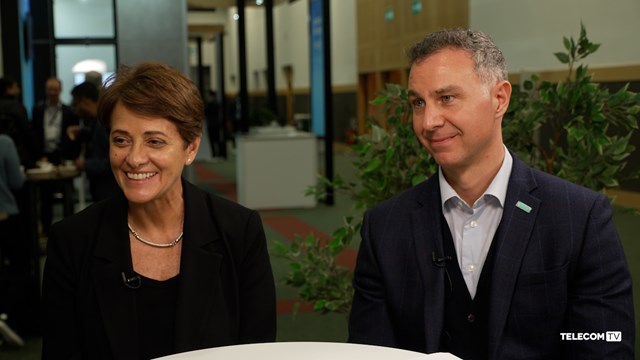
We are back in Barcelona. It's MWC 25. I'm here with Kerry Small. She is the COO at the BT business. Carrie, thanks so much for joining us. Hope you are enjoying MWC 25.
Kerry Small, COO, BT Business (00:19):
I am. It's absolutely pleasure to be here with you as well so far.
Ray Le Maistre, TelecomTV (00:21):
Okay, great. So tell us about recent changes at BT business because you've got a new CEO, right?
Kerry Small, COO, BT Business (00:28):
We have, yeah, John James has just joined us and we've talked about basically splitting the organizations and the business so we can refocus on building a UK business and building for growth and also looking at opportunities for our international business where there's real consolidation happening in the market and we want to capitalize on that opportunity. So yeah. John has literally just started this week?
Ray Le Maistre, TelecomTV (00:47):
Yes. Okay. Where is he? Where is it? But we'll find him another day Now. One of the things that everybody is still talking about now and trying to figure out is how telcos can drive new profitable growth. And there was always an expectation that this would come from the enterprise sector. Do you think it's possible for telcos to drive that profitable growth from B2B?
Kerry Small, COO, BT Business (01:12):
Yeah, I do. And I'm here living proof that we are going to do that. See, I do. I think we've got to tackle both the bottom line and the top line for us. We've got a big modernization program that we're running and that is really about how do we move from our legacy to future brief networks to very much our copper to fiber. We've obviously closed down the 3G network, announced the 2G, we're pushing across to 5G. We've also got a big product application piece underway as well. So how do we really slim down the portfolios? We meet our customer needs and enable our Salesforce to really be able to articulate the outcomes and the benefits for our customers. And we're also moving all of this onto a new stack. And so being able to basically have that modern IT infrastructure that we can deliver a customer's. So it really is seamless, frictionless, and great digital journey. So a lot of that is how do we make sure we've got a cost base that's under control, but then the growth comes from being able to bundle some of those products together, take some of the new technology that we're seeing and hearing a lot about and enable the out for our customers in solutions and outcomes as we go forward to really strive and stimulate that top line growth.
Ray Le Maistre, TelecomTV (02:14):
Okay. Now of course the B2B sector is pretty broad, lots of different types of customers. To what extent is it possible for a company like BT to specifically target the SME or SMB sector with differentiated offerings? I mean, is it even worth trying to do that?
Kerry Small, COO, BT Business (02:34):
Yeah, it really is. You're right, it's very broad. So we've got over a million small businesses. We've also got the large organizations. We've got nine out of the 10 of the biggest banks, nine out of 10 of the biggest airlines. What's really interesting is their needs are really similar. So they are all looking for speed in terms from the network. They want to make sure they've got an underpinned rock solid network. So speeds, scalability, sustainability, they're common. The thing that we see very much, and I talk to our small businesses a lot is how do we scale that down to make it really simple? They don't have big IT teams who can come and take that complex deal away for them. So it is really about still got similar outcomes. They need a secure business, they need to make sure that their cash payments can be taken on their EPOS machines, but how do we make sure that's really easy for them and so they can take the solutions, plug them in and make them work from day one without needing a big IT infrastructure and IT department to make that work. So it is about ease of use, it's about scaling down those solutions, but we are really confident these organizations, they are the backbone of our economy. Enabling these businesses to make sure that they can thrive is what will make our whole economy shift. And that's important from a UK perspective for us.
Ray Le Maistre, TelecomTV (03:42):
And this revamp of the IT stack, is that something that's making it possible to actually make it easy for those SMEs?
Kerry Small, COO, BT Business (03:48):
Yeah, you're spot on. Being able to make sure that when they are buying something, it's really easy to consume and activate there and them. So that having the stack enables to be a much more digital journey, which means it is about being able to buy, consume, and activate those services without needing a huge amount of support structure around it, but also being able to come in and find ways to get more advice in terms of us as a trusted friend, how do they look at what they're trying to solve those business outcomes? So there's an advisory piece around it that we can put through videos, we can put through new digital sources when they are buying the solutions from us as well as we have to make the activation really easy. So education and ease of use really key for the SMBs.
Ray Le Maistre, TelecomTV (04:27):
Okay, excellent. Now, I don't know if you have noticed, but this artificial intelligence thing seems to be pretty popular around here, but how is the increasing use of AI impacting your service developments and the business opportunities that you have with enterprise customers?
Kerry Small, COO, BT Business (04:45):
There is no AI without the network. So for us it really is about making sure that network is enabled and we are really open and honest and direct with our customers. They need to be on an AI enabled network. What does it mean those download uploads speeds need to be there so that we can enable the AI solutions. We do need to make sure they're scalable. So for us it's about having the cloud-based networks now so you can actually interchange some of those components. The sustainability is really key because as we're pushing through the ai, as you say, lots of talk around how power energy at Hungary, these large language monitors are going to be. So we have those conversations with our customers. It's about having an AI ready network first. We are deploying solutions out there. A couple of different examples. We've got the most amount of patents in the UK anyway already in the network.
(05:29):
Been doing AI for quite some time. Howard Watson talks a lot about this. So it's not new for BT. Some of the new areas where we're playing in our contact centers that we're offering out to our customers, RingCentral by example, that's now got AI types of where we summarize scripts instead of the agents having to take all that data down, summarizing up the end of pause, making that available back to our customers, feeding it back through ticketing platforms. We've got that in place. We've also started to put a lot of AI through our sales organizations as well. So how do we really make sure our sales force are equipped with who to talk to about what, based on a lot of data that's out there, who's looking at white papers, who's in the buying center in terms of who wants that information and any given point in time being able to surface that up to a sales organization so they've got the latest information at the time that's relevant to a customer feel free importer as well.
Ray Le Maistre, TelecomTV (06:18):
So in that respect, BT business is not only helping its customers, but it's also using AI itself to increase its efficiency in operations. I mean, any other examples about how you as a company, as a team are using AI to move things on yourselves?
Kerry Small, COO, BT Business (06:37):
Yeah, I think the other big place we're looking at really is very much in the service arena because that's a space for us. There's a big opportunity to really transform that service. So there's a layer of re-platforming. So then how do you use AI in some of those large language models? And I think telco's quite unique. So we do need large language models that have got a telco element to them. So we're looking at how do we use in some of the SaaS platforms that we are using via ServiceNow, our sales scores, how to expose a lot of the native AI capability that's in there already in order to help our sales or our service people to be able to augment the work they do. So it's not a replace, it is about how do you enable them to have that data at their fingertips, be it the sales agent or the service agent.
(07:18):
So we will carry on, we're playing, we're experimenting, and we're seeing some really good traction in some of those use cases in our agents, that genix agenda, I think it's going to be amazing. I think that will drive it. We need to make sure the networks are fit to handle that, but ultimately I think that'll make a really big difference to how we service our customers and how our own people could do their job in a way that's quite frankly, far more about spending valuable time with the customer rather than doing transactional with customer way.
Ray Le Maistre, TelecomTV (07:46):
Yes, absolutely. Let's hope. That's how it turns out with that time efficiency is really key there. Now switching away from AI for a minute. I mean all service providers are looking to get a better return from their 5G investments, which have been absolutely massive. But how is BT business doing that? How are you innovating with 5G to not only deliver what customers want but help to have that ROI model for 5G?
Kerry Small, COO, BT Business (08:13):
Yeah, I think that we've got a brilliant 4G network. So to your point, finding the scope then to find use cases for 5G has been slow, but we are seeing a new wave of it coming through. And for us we always start with what is the outcome? What's the problem do customers looking to solve? It's easy to talk technology connectivity is the product, but it's not a story. The story is what do you want to change in your business? And we spend a lot of time with customers really forcing that conversation saying, let's not look at a technology solution. Let's look at an outcome to solve. And those use cases, that's where we do get into some really good conversations. A great example, Belfast Christmas market is a really good example of effectively you bring a whole load of those SMBs that are our economy together in one place where it's a fabulous trading opportunity for them.
(09:00):
Ultimately 4G network shrinks lots of people in place. So actually their one opportunity to do one of their biggest trading days if first cash all cash to society now they can't take payments, kill their business. And so for us, what it was about was where we looked at 5G, we put in a slice that we can then say and guarantee to a couple of the organizations that were there. One was basically at the pub, the local pub was in there and say, you wouldn't spell a guarantee to trade and take those payments all day long without a glitch in your payment system not chasing through payments afterwards. They've been lost in some kind of a revenue assurance activity. And for me they're really examples. That's one where for the trader, it made a huge difference for the council. They came back and said, look, this is what we need to do in terms of really digitizing the economy and our communities.
(09:48):
So I think they're good examples. We've got a number of others where we've got, partly when you have crowds together is the obvious space where we're seeing particularly the opportunity for slicing. So whether it is outdoor events, you get five bars. We haven't got a data connection. So we've got a number of those where we looking at how do we make sure we can enable that through the 5G slicing. Those use cases are becoming more and more relevant where people are seeing the opportunity to make sure they can have that data and they can guarantee in that communication line. And it could be for events where people are just trying to converse or it could be where we need to keep a secure part of the network available in the event of having infrastructure community, we need to better support.
Ray Le Maistre, TelecomTV (10:28):
Okay. Now speaking of security, I mean are there any conversations that BT business has with its customers where security doesn't crop up? I mean, is that an absolute sort of guaranteed thing to turn up in conversations?
Kerry Small, COO, BT Business (10:43):
A hundred percent guaranteed generally starts with that,
Ray Le Maistre, TelecomTV (10:45):
Right?
Kerry Small, COO, BT Business (10:46):
I think it's what keeps most people up at night be the CIO, CEO, CTO, and actually across the board the business units as well. So it is a number one, sorry, number one concern for most of our customers. I think to your point, one of the other areas actually that we've infused AI, it's a large number of attacks. We know it costs on average 13,000 pounds to effectively rectify the average attack that's coming across as an average number. Clearly they scale up massively. We see 2000 potential attacks going across the network every day from BT perspective where we can see across the span of what we can see over the networks, but how do you actually respond to that? And we've infused AI a lot into how do we look at those events and how do we then start to do a lot of the rectifying that work to be able to put protection back in place. So conversations start there, but I think it's another really good example of where use cases, AI strive, that automation to deal with the scale of the problem with confidence is another really big use case for that. We're deploying and we've been deploying for quite some time.
Ray Le Maistre, TelecomTV (11:49):
Yeah. Okay. Excellent. Well, I'm sure you want to get out and see what else is happening here at MWC 25. But before you go, Kerry, probably the most important question that anybody's going to ask you all day, I really need to know, what is your favorite film of all time?
Kerry Small, COO, BT Business (12:09):
I a sheet slightly, not of all time, but the one I've most recently thoroughly enjoyed, conclave, fascinating, timely, obviously with what's going on at the moment with the Pope, the politics, really seeing that play out in its own right. Actually, I thought it was just in terms of the actors in there, it was an amazing show of the excellence that we have in terms of what we saw and in terms of how they brought that to life. So yeah, for me it was a fantastic film I've watched just recently.
Ray Le Maistre, TelecomTV (12:41):
Okay, well, a great choice coming back into the cinemas, at least in the UK now because it's an award winner. So hopefully if people will get a chance to see that. But great recommendation. Kerry, thanks so much for joining us today. Great to hear what's going on at BT business and enjoy the rest of the show.
Kerry Small, COO, BT Business (12:57):
Brilliant. Thank you very much.
We are back in Barcelona. It's MWC 25. I'm here with Kerry Small. She is the COO at the BT business. Carrie, thanks so much for joining us. Hope you are enjoying MWC 25.
Kerry Small, COO, BT Business (00:19):
I am. It's absolutely pleasure to be here with you as well so far.
Ray Le Maistre, TelecomTV (00:21):
Okay, great. So tell us about recent changes at BT business because you've got a new CEO, right?
Kerry Small, COO, BT Business (00:28):
We have, yeah, John James has just joined us and we've talked about basically splitting the organizations and the business so we can refocus on building a UK business and building for growth and also looking at opportunities for our international business where there's real consolidation happening in the market and we want to capitalize on that opportunity. So yeah. John has literally just started this week?
Ray Le Maistre, TelecomTV (00:47):
Yes. Okay. Where is he? Where is it? But we'll find him another day Now. One of the things that everybody is still talking about now and trying to figure out is how telcos can drive new profitable growth. And there was always an expectation that this would come from the enterprise sector. Do you think it's possible for telcos to drive that profitable growth from B2B?
Kerry Small, COO, BT Business (01:12):
Yeah, I do. And I'm here living proof that we are going to do that. See, I do. I think we've got to tackle both the bottom line and the top line for us. We've got a big modernization program that we're running and that is really about how do we move from our legacy to future brief networks to very much our copper to fiber. We've obviously closed down the 3G network, announced the 2G, we're pushing across to 5G. We've also got a big product application piece underway as well. So how do we really slim down the portfolios? We meet our customer needs and enable our Salesforce to really be able to articulate the outcomes and the benefits for our customers. And we're also moving all of this onto a new stack. And so being able to basically have that modern IT infrastructure that we can deliver a customer's. So it really is seamless, frictionless, and great digital journey. So a lot of that is how do we make sure we've got a cost base that's under control, but then the growth comes from being able to bundle some of those products together, take some of the new technology that we're seeing and hearing a lot about and enable the out for our customers in solutions and outcomes as we go forward to really strive and stimulate that top line growth.
Ray Le Maistre, TelecomTV (02:14):
Okay. Now of course the B2B sector is pretty broad, lots of different types of customers. To what extent is it possible for a company like BT to specifically target the SME or SMB sector with differentiated offerings? I mean, is it even worth trying to do that?
Kerry Small, COO, BT Business (02:34):
Yeah, it really is. You're right, it's very broad. So we've got over a million small businesses. We've also got the large organizations. We've got nine out of the 10 of the biggest banks, nine out of 10 of the biggest airlines. What's really interesting is their needs are really similar. So they are all looking for speed in terms from the network. They want to make sure they've got an underpinned rock solid network. So speeds, scalability, sustainability, they're common. The thing that we see very much, and I talk to our small businesses a lot is how do we scale that down to make it really simple? They don't have big IT teams who can come and take that complex deal away for them. So it is really about still got similar outcomes. They need a secure business, they need to make sure that their cash payments can be taken on their EPOS machines, but how do we make sure that's really easy for them and so they can take the solutions, plug them in and make them work from day one without needing a big IT infrastructure and IT department to make that work. So it is about ease of use, it's about scaling down those solutions, but we are really confident these organizations, they are the backbone of our economy. Enabling these businesses to make sure that they can thrive is what will make our whole economy shift. And that's important from a UK perspective for us.
Ray Le Maistre, TelecomTV (03:42):
And this revamp of the IT stack, is that something that's making it possible to actually make it easy for those SMEs?
Kerry Small, COO, BT Business (03:48):
Yeah, you're spot on. Being able to make sure that when they are buying something, it's really easy to consume and activate there and them. So that having the stack enables to be a much more digital journey, which means it is about being able to buy, consume, and activate those services without needing a huge amount of support structure around it, but also being able to come in and find ways to get more advice in terms of us as a trusted friend, how do they look at what they're trying to solve those business outcomes? So there's an advisory piece around it that we can put through videos, we can put through new digital sources when they are buying the solutions from us as well as we have to make the activation really easy. So education and ease of use really key for the SMBs.
Ray Le Maistre, TelecomTV (04:27):
Okay, excellent. Now, I don't know if you have noticed, but this artificial intelligence thing seems to be pretty popular around here, but how is the increasing use of AI impacting your service developments and the business opportunities that you have with enterprise customers?
Kerry Small, COO, BT Business (04:45):
There is no AI without the network. So for us it really is about making sure that network is enabled and we are really open and honest and direct with our customers. They need to be on an AI enabled network. What does it mean those download uploads speeds need to be there so that we can enable the AI solutions. We do need to make sure they're scalable. So for us it's about having the cloud-based networks now so you can actually interchange some of those components. The sustainability is really key because as we're pushing through the ai, as you say, lots of talk around how power energy at Hungary, these large language monitors are going to be. So we have those conversations with our customers. It's about having an AI ready network first. We are deploying solutions out there. A couple of different examples. We've got the most amount of patents in the UK anyway already in the network.
(05:29):
Been doing AI for quite some time. Howard Watson talks a lot about this. So it's not new for BT. Some of the new areas where we're playing in our contact centers that we're offering out to our customers, RingCentral by example, that's now got AI types of where we summarize scripts instead of the agents having to take all that data down, summarizing up the end of pause, making that available back to our customers, feeding it back through ticketing platforms. We've got that in place. We've also started to put a lot of AI through our sales organizations as well. So how do we really make sure our sales force are equipped with who to talk to about what, based on a lot of data that's out there, who's looking at white papers, who's in the buying center in terms of who wants that information and any given point in time being able to surface that up to a sales organization so they've got the latest information at the time that's relevant to a customer feel free importer as well.
Ray Le Maistre, TelecomTV (06:18):
So in that respect, BT business is not only helping its customers, but it's also using AI itself to increase its efficiency in operations. I mean, any other examples about how you as a company, as a team are using AI to move things on yourselves?
Kerry Small, COO, BT Business (06:37):
Yeah, I think the other big place we're looking at really is very much in the service arena because that's a space for us. There's a big opportunity to really transform that service. So there's a layer of re-platforming. So then how do you use AI in some of those large language models? And I think telco's quite unique. So we do need large language models that have got a telco element to them. So we're looking at how do we use in some of the SaaS platforms that we are using via ServiceNow, our sales scores, how to expose a lot of the native AI capability that's in there already in order to help our sales or our service people to be able to augment the work they do. So it's not a replace, it is about how do you enable them to have that data at their fingertips, be it the sales agent or the service agent.
(07:18):
So we will carry on, we're playing, we're experimenting, and we're seeing some really good traction in some of those use cases in our agents, that genix agenda, I think it's going to be amazing. I think that will drive it. We need to make sure the networks are fit to handle that, but ultimately I think that'll make a really big difference to how we service our customers and how our own people could do their job in a way that's quite frankly, far more about spending valuable time with the customer rather than doing transactional with customer way.
Ray Le Maistre, TelecomTV (07:46):
Yes, absolutely. Let's hope. That's how it turns out with that time efficiency is really key there. Now switching away from AI for a minute. I mean all service providers are looking to get a better return from their 5G investments, which have been absolutely massive. But how is BT business doing that? How are you innovating with 5G to not only deliver what customers want but help to have that ROI model for 5G?
Kerry Small, COO, BT Business (08:13):
Yeah, I think that we've got a brilliant 4G network. So to your point, finding the scope then to find use cases for 5G has been slow, but we are seeing a new wave of it coming through. And for us we always start with what is the outcome? What's the problem do customers looking to solve? It's easy to talk technology connectivity is the product, but it's not a story. The story is what do you want to change in your business? And we spend a lot of time with customers really forcing that conversation saying, let's not look at a technology solution. Let's look at an outcome to solve. And those use cases, that's where we do get into some really good conversations. A great example, Belfast Christmas market is a really good example of effectively you bring a whole load of those SMBs that are our economy together in one place where it's a fabulous trading opportunity for them.
(09:00):
Ultimately 4G network shrinks lots of people in place. So actually their one opportunity to do one of their biggest trading days if first cash all cash to society now they can't take payments, kill their business. And so for us, what it was about was where we looked at 5G, we put in a slice that we can then say and guarantee to a couple of the organizations that were there. One was basically at the pub, the local pub was in there and say, you wouldn't spell a guarantee to trade and take those payments all day long without a glitch in your payment system not chasing through payments afterwards. They've been lost in some kind of a revenue assurance activity. And for me they're really examples. That's one where for the trader, it made a huge difference for the council. They came back and said, look, this is what we need to do in terms of really digitizing the economy and our communities.
(09:48):
So I think they're good examples. We've got a number of others where we've got, partly when you have crowds together is the obvious space where we're seeing particularly the opportunity for slicing. So whether it is outdoor events, you get five bars. We haven't got a data connection. So we've got a number of those where we looking at how do we make sure we can enable that through the 5G slicing. Those use cases are becoming more and more relevant where people are seeing the opportunity to make sure they can have that data and they can guarantee in that communication line. And it could be for events where people are just trying to converse or it could be where we need to keep a secure part of the network available in the event of having infrastructure community, we need to better support.
Ray Le Maistre, TelecomTV (10:28):
Okay. Now speaking of security, I mean are there any conversations that BT business has with its customers where security doesn't crop up? I mean, is that an absolute sort of guaranteed thing to turn up in conversations?
Kerry Small, COO, BT Business (10:43):
A hundred percent guaranteed generally starts with that,
Ray Le Maistre, TelecomTV (10:45):
Right?
Kerry Small, COO, BT Business (10:46):
I think it's what keeps most people up at night be the CIO, CEO, CTO, and actually across the board the business units as well. So it is a number one, sorry, number one concern for most of our customers. I think to your point, one of the other areas actually that we've infused AI, it's a large number of attacks. We know it costs on average 13,000 pounds to effectively rectify the average attack that's coming across as an average number. Clearly they scale up massively. We see 2000 potential attacks going across the network every day from BT perspective where we can see across the span of what we can see over the networks, but how do you actually respond to that? And we've infused AI a lot into how do we look at those events and how do we then start to do a lot of the rectifying that work to be able to put protection back in place. So conversations start there, but I think it's another really good example of where use cases, AI strive, that automation to deal with the scale of the problem with confidence is another really big use case for that. We're deploying and we've been deploying for quite some time.
Ray Le Maistre, TelecomTV (11:49):
Yeah. Okay. Excellent. Well, I'm sure you want to get out and see what else is happening here at MWC 25. But before you go, Kerry, probably the most important question that anybody's going to ask you all day, I really need to know, what is your favorite film of all time?
Kerry Small, COO, BT Business (12:09):
I a sheet slightly, not of all time, but the one I've most recently thoroughly enjoyed, conclave, fascinating, timely, obviously with what's going on at the moment with the Pope, the politics, really seeing that play out in its own right. Actually, I thought it was just in terms of the actors in there, it was an amazing show of the excellence that we have in terms of what we saw and in terms of how they brought that to life. So yeah, for me it was a fantastic film I've watched just recently.
Ray Le Maistre, TelecomTV (12:41):
Okay, well, a great choice coming back into the cinemas, at least in the UK now because it's an award winner. So hopefully if people will get a chance to see that. But great recommendation. Kerry, thanks so much for joining us today. Great to hear what's going on at BT business and enjoy the rest of the show.
Kerry Small, COO, BT Business (12:57):
Brilliant. Thank you very much.
Please note that video transcripts are provided for reference only – content may vary from the published video or contain inaccuracies.
Kerry Small, COO, BT Business
BT Business chief operating officer (COO) Kerry Small discusses the growth opportunities in the enterprise services sector, the impact and potential of AI, getting the most out of 5G and the timeliness of Conclave.
Recorded March 2025