Entel Peru accelerates towards Autonomous Network L4 with Huawei’s Agentic MBB Network
To embed our video on your website copy and paste the code below:
<iframe src="https://www.youtube.com/embed/c4r6zAMSGGs?modestbranding=1&rel=0" width="970" height="546" frameborder="0" scrolling="auto" allowfullscreen></iframe>
Tony Poulos, TelecomTV (00:05):
Hello and welcome to this Win-Win Live. I'm Tony Poulos, contributing editor at TelecomTV. Today we focus on the global digital and intelligent transformation of wireless networks. We are honoured to welcome Fernando Angulo, CTO of Entel Peru, and also Yun Ruhe, who is the president of Huawei Wireless Single RAN product line. As I noticed yesterday, Huawei had launched a Agentic MBB network. As mobile networks accelerate into this intelligent era, how can operators reconstruct network competitiveness through digitalisation and intelligence? Let's begin today's conversation. What are Entel's challenges in advancing network digitalisation and intelligence? What is Entel's strategy in its digital intelligent network?
Speaker 2 (00:54):
Thank you for your question. As you know, Entel is an operator with a very strong focus on our customer's experience. And for Entel across all areas of the company, it's very important for us to focus on ensuring that our customers have a distinctive experience when they access our network or use our services. From the network side, we need to maintain a positive experience for our customers when they interact directly with it in terms of availability, efficiency, and so on. However, our network is also under strong pressure in terms of cost management. In this regard, we have designed a digital transformation strategy that initially involves establishing a transformation office to support us throughout the entire process of implementing this new digital transformation in a professional, structured, and orderly manner. It is supported by several pillars. Among the key pillars of the software is the BEST framework, which is structured around intelligent pillars.
(02:06):
Entel Peru's intelligent transformation strategy is based on the BEST framework, which is structured around four pillars: business success, evolution customisation, service delivery, technology innovation. Through the integration of artificial intelligence and 5G, we aim to drive significant improvements in operational efficiency through intelligent network planning, energy consumption optimisation, and collaboration within the digital ecosystem. Huawei is a key strategic partner for Entel. In Peru, we have deployed a wireless network using Meta AAU equipment with dual band, tri-band, and deep band configurations, which enables us to deliver premium connectivity experiences to our customers. As I mentioned earlier, our focus is to ensure that our customers have a distinctive experience when they interact with our network. Huawei's intelligence solutions are accelerating and helping us in our evolution towards high levels of network autonomy, significantly improving the efficiency of operations and maintenance. Likewise, its new intelligence solutions and platforms are helping optimise the energy efficiency of our network. The geography of our country and the environment of Peru means that in some areas, the energy supply is not always simple or readily available, and we need multiple backup systems, greater autonomy, and more intelligent energy management.
(03:47):
For this reason, we expect to continue deepening our digital and intelligent collaboration with Huawei during this year.
Tony Poulos, TelecomTV (03:55):
And Mr. Yun, Entel's strategy is clear, a common demand among operators, of course, and Huawei recently launched this Agentic MBB network solution. How does it help operators achieve their digital intelligence strategies?
Speaker 3 (04:10):
As mentioned by our Entel partner, operators have three universal challenges: energy consumption, user experience and O&M. As more 5G applications emerge, experience requirements from MBB became diversified. Different users have different network needs. To address these needs, we have introduced the Agentic MBB network to fully release the network potential. At the network element level, to meet new requirements such as uplink experience, latency, and energy efficiency, we bring adaptive AI solutions. On one hand, with our new adaptive algorithms, we achieved active experience and energy saving. On the other hand, by combining our new advanced baseband with intelligent algorithms, we can make sure users enjoy consistent experience and quality across all scenarios. All these workflows are powered by our innovative hardware and intelligent algorithms. At the network layer, we believe that simplified O&M is critical for network efficiency. We launched the industry's first agent built on our telecom foundation model and digital twin.
(05:39):
To enable the digital twin, we have developed Ambient Site, which digitalises the physical site to build an intelligent network foundation. By integrating these innovations, the Agentic MBB network delivers three key values. One is intelligent experience. Second is intelligent energy efficiency, and the third is intelligent simplified O&M.
Tony Poulos, TelecomTV (06:07):
And the Ambient Site that you mentioned is impressive. Could you share more information about it?
Speaker 3 (06:13):
When we talk about network automation, we not only need smart brains, such as large models and digital twins, but we also need a system that can sense information to provide data to agents and to also execute the instructions from these agents. Huawei's Ambient Site is the digital intelligence solution, which upgrades the physical site, changing them from passive to active sites that are visible, manageable, and controllable. At the visibility level, we digitalise the power and device to capture key parameters, such as power consumption, internal temperature and tower location. With this data, digital twins can predict optimal strategy and identify potential problems. This greatly enhances the network efficiency. At the control level, the system enables intelligent upgrades, including antenna, energy, internal and transmission systems. This upgraded system not only supports rapid remote structured deployment, but also enables multi-system cooperation.
(07:24):
For example, when the traffic is busy, the sleeping modules can be remotely woken up and antennas can automatically adjust to the hot spot. When traffic decreases, the RF modules will automatically shut down for energy saving. That way we can perfectly balance the power consumption and user experience. In conclusion, Ambient Site creates a closed loop of decision and execution. This transforms networks from passive to proactive.
Tony Poulos, TelecomTV (07:56):
And this solution aligns closely with Entel's strategy. We hear Entel's achieved breakthrough deployment in 2025. Could you elaborate for us?
Speaker 2 (08:05):
Of course. With Huawei, Entel has deployed the world's first large scale commercial solution, our Power RAN collaborative adaptive energy backup. Currently, nearly 50 sites are already in operation with an expansion plan for approximately 1,000 additional sites. Sites located in rugged or geographically challenging areas of our country sometimes face power supplies that don't behave in the most optimal way. Many times, there are prolonged power outages that can impact the customer experience. As I mentioned before, we are a company that focuses on the experience of our customers when they interact with our network. Previously, to resolve these issues, we had to manually coordinate the use of mobile generators and move people around, which meant increasing our operating costs and facing major logistical challenges because we have to move these support groups that aren't exactly close to urban areas. With Huawei's solution, we have managed to reduce reliance on these generators and have guaranteed the continuity of the services we provide.
(09:17):
A clear example: we have a site that previously had seven hours of backup autonomy. In that case, without the need for having added any additional battery backup, it's managed to increase it from seven to 11 hours with the system. That backup represents an improvement of around 60% in site availability when faced with a power problem. This proves that intelligent digital sites are already generating tangible benefits today, generating value for our company through a distinctive experience for our customers, strengthening network resilience, and reducing those operating costs that are so important for us to manage.
Tony Poulos, TelecomTV (10:00):
Entel's results are remarkable. What are Entel and Huawei's next steps for digital intelligence strategy over the next three years?
Speaker 2 (10:08):
Well, thank you very much for your words. Indeed, we have made significant progress in recent times. Looking ahead to the coming years, Entel and Huawei are going to continue deepening our mutual collaboration to accelerate the evolution toward fully autonomous digital networks. Our goal is to move progressively toward an ANL4 network to strengthen automation, predictive modelling, intelligent decision-making for network transformations, moving from a very reactive network to a predictive and proactive one, closing the loop of perception, decision, and execution. As I mentioned before, we have also implemented in our office the digital transformation office that will allow us to move forward in this process toward autonomous networks in a structured, orderly, and professional way. It's a very important strategic step, as you can see. We are in the process and it's going to allow us to reach, as I said, these important levels of autonomy in the coming years.
(11:18):
We will continue expanding the energy solutions, RAN energy toward more complex scenarios that integrate generators, solar energy, and batteries, strengthening the resilience of our networks in critical areas. As I mentioned, sometimes our geography doesn't allow us to act immediately in certain zones. Our commitment to the customer experience forces us to have a network with high availability, and we need to keep those objectives clear. This roadmap aligned with our strategic framework and the BEST process we have initiated consolidates business success, innovation, and service excellence, where Huawei supports us and contributes in a powerful way, the experience and expertise in digital and intelligent networks. We are building the bridge that is going to lead us toward digitalisation throughout all of Peru supported by Huawei's digital experiences. And our goal, as I said, is to have a distinctive experience for our customers while maintaining the value of our company.
Speaker 3 (12:29):
As we move into the mobile AI era, Huawei's Ambient Site will keep helping Agentic MBB network evolution. To support this project into the future, we are focused on three key upgrades to make this happen. The first is scenario expanding. Right now, RAN power and site monitoring works with unstable power grids. Moving forward, we will support more complex scenarios. This includes systems with generators, solar power, and batteries. The second is the capability enhancement. We will continue to improve our modelling and digital twin capabilities. This will simplify the O&M much further and support Entel to evolve to ANL4. And the third is value maximisation. We can now provide real-time assurance for uplink and downlink rates, as well as latency. This improves user experience by over 30% and achieves 30% energy saving.
Tony Poulos, TelecomTV (13:36):
Thank you for your cutting edge insights. Today, we witnessed how Ambient Site empowers base stations with perception and thinking, evolving MBB networks from data pipes toward intelligent autonomy. Huawei and Entel's collaboration sets an industry benchmark, redefining network value through digital intelligence. We look forward to more innovations next time round.
Hello and welcome to this Win-Win Live. I'm Tony Poulos, contributing editor at TelecomTV. Today we focus on the global digital and intelligent transformation of wireless networks. We are honoured to welcome Fernando Angulo, CTO of Entel Peru, and also Yun Ruhe, who is the president of Huawei Wireless Single RAN product line. As I noticed yesterday, Huawei had launched a Agentic MBB network. As mobile networks accelerate into this intelligent era, how can operators reconstruct network competitiveness through digitalisation and intelligence? Let's begin today's conversation. What are Entel's challenges in advancing network digitalisation and intelligence? What is Entel's strategy in its digital intelligent network?
Speaker 2 (00:54):
Thank you for your question. As you know, Entel is an operator with a very strong focus on our customer's experience. And for Entel across all areas of the company, it's very important for us to focus on ensuring that our customers have a distinctive experience when they access our network or use our services. From the network side, we need to maintain a positive experience for our customers when they interact directly with it in terms of availability, efficiency, and so on. However, our network is also under strong pressure in terms of cost management. In this regard, we have designed a digital transformation strategy that initially involves establishing a transformation office to support us throughout the entire process of implementing this new digital transformation in a professional, structured, and orderly manner. It is supported by several pillars. Among the key pillars of the software is the BEST framework, which is structured around intelligent pillars.
(02:06):
Entel Peru's intelligent transformation strategy is based on the BEST framework, which is structured around four pillars: business success, evolution customisation, service delivery, technology innovation. Through the integration of artificial intelligence and 5G, we aim to drive significant improvements in operational efficiency through intelligent network planning, energy consumption optimisation, and collaboration within the digital ecosystem. Huawei is a key strategic partner for Entel. In Peru, we have deployed a wireless network using Meta AAU equipment with dual band, tri-band, and deep band configurations, which enables us to deliver premium connectivity experiences to our customers. As I mentioned earlier, our focus is to ensure that our customers have a distinctive experience when they interact with our network. Huawei's intelligence solutions are accelerating and helping us in our evolution towards high levels of network autonomy, significantly improving the efficiency of operations and maintenance. Likewise, its new intelligence solutions and platforms are helping optimise the energy efficiency of our network. The geography of our country and the environment of Peru means that in some areas, the energy supply is not always simple or readily available, and we need multiple backup systems, greater autonomy, and more intelligent energy management.
(03:47):
For this reason, we expect to continue deepening our digital and intelligent collaboration with Huawei during this year.
Tony Poulos, TelecomTV (03:55):
And Mr. Yun, Entel's strategy is clear, a common demand among operators, of course, and Huawei recently launched this Agentic MBB network solution. How does it help operators achieve their digital intelligence strategies?
Speaker 3 (04:10):
As mentioned by our Entel partner, operators have three universal challenges: energy consumption, user experience and O&M. As more 5G applications emerge, experience requirements from MBB became diversified. Different users have different network needs. To address these needs, we have introduced the Agentic MBB network to fully release the network potential. At the network element level, to meet new requirements such as uplink experience, latency, and energy efficiency, we bring adaptive AI solutions. On one hand, with our new adaptive algorithms, we achieved active experience and energy saving. On the other hand, by combining our new advanced baseband with intelligent algorithms, we can make sure users enjoy consistent experience and quality across all scenarios. All these workflows are powered by our innovative hardware and intelligent algorithms. At the network layer, we believe that simplified O&M is critical for network efficiency. We launched the industry's first agent built on our telecom foundation model and digital twin.
(05:39):
To enable the digital twin, we have developed Ambient Site, which digitalises the physical site to build an intelligent network foundation. By integrating these innovations, the Agentic MBB network delivers three key values. One is intelligent experience. Second is intelligent energy efficiency, and the third is intelligent simplified O&M.
Tony Poulos, TelecomTV (06:07):
And the Ambient Site that you mentioned is impressive. Could you share more information about it?
Speaker 3 (06:13):
When we talk about network automation, we not only need smart brains, such as large models and digital twins, but we also need a system that can sense information to provide data to agents and to also execute the instructions from these agents. Huawei's Ambient Site is the digital intelligence solution, which upgrades the physical site, changing them from passive to active sites that are visible, manageable, and controllable. At the visibility level, we digitalise the power and device to capture key parameters, such as power consumption, internal temperature and tower location. With this data, digital twins can predict optimal strategy and identify potential problems. This greatly enhances the network efficiency. At the control level, the system enables intelligent upgrades, including antenna, energy, internal and transmission systems. This upgraded system not only supports rapid remote structured deployment, but also enables multi-system cooperation.
(07:24):
For example, when the traffic is busy, the sleeping modules can be remotely woken up and antennas can automatically adjust to the hot spot. When traffic decreases, the RF modules will automatically shut down for energy saving. That way we can perfectly balance the power consumption and user experience. In conclusion, Ambient Site creates a closed loop of decision and execution. This transforms networks from passive to proactive.
Tony Poulos, TelecomTV (07:56):
And this solution aligns closely with Entel's strategy. We hear Entel's achieved breakthrough deployment in 2025. Could you elaborate for us?
Speaker 2 (08:05):
Of course. With Huawei, Entel has deployed the world's first large scale commercial solution, our Power RAN collaborative adaptive energy backup. Currently, nearly 50 sites are already in operation with an expansion plan for approximately 1,000 additional sites. Sites located in rugged or geographically challenging areas of our country sometimes face power supplies that don't behave in the most optimal way. Many times, there are prolonged power outages that can impact the customer experience. As I mentioned before, we are a company that focuses on the experience of our customers when they interact with our network. Previously, to resolve these issues, we had to manually coordinate the use of mobile generators and move people around, which meant increasing our operating costs and facing major logistical challenges because we have to move these support groups that aren't exactly close to urban areas. With Huawei's solution, we have managed to reduce reliance on these generators and have guaranteed the continuity of the services we provide.
(09:17):
A clear example: we have a site that previously had seven hours of backup autonomy. In that case, without the need for having added any additional battery backup, it's managed to increase it from seven to 11 hours with the system. That backup represents an improvement of around 60% in site availability when faced with a power problem. This proves that intelligent digital sites are already generating tangible benefits today, generating value for our company through a distinctive experience for our customers, strengthening network resilience, and reducing those operating costs that are so important for us to manage.
Tony Poulos, TelecomTV (10:00):
Entel's results are remarkable. What are Entel and Huawei's next steps for digital intelligence strategy over the next three years?
Speaker 2 (10:08):
Well, thank you very much for your words. Indeed, we have made significant progress in recent times. Looking ahead to the coming years, Entel and Huawei are going to continue deepening our mutual collaboration to accelerate the evolution toward fully autonomous digital networks. Our goal is to move progressively toward an ANL4 network to strengthen automation, predictive modelling, intelligent decision-making for network transformations, moving from a very reactive network to a predictive and proactive one, closing the loop of perception, decision, and execution. As I mentioned before, we have also implemented in our office the digital transformation office that will allow us to move forward in this process toward autonomous networks in a structured, orderly, and professional way. It's a very important strategic step, as you can see. We are in the process and it's going to allow us to reach, as I said, these important levels of autonomy in the coming years.
(11:18):
We will continue expanding the energy solutions, RAN energy toward more complex scenarios that integrate generators, solar energy, and batteries, strengthening the resilience of our networks in critical areas. As I mentioned, sometimes our geography doesn't allow us to act immediately in certain zones. Our commitment to the customer experience forces us to have a network with high availability, and we need to keep those objectives clear. This roadmap aligned with our strategic framework and the BEST process we have initiated consolidates business success, innovation, and service excellence, where Huawei supports us and contributes in a powerful way, the experience and expertise in digital and intelligent networks. We are building the bridge that is going to lead us toward digitalisation throughout all of Peru supported by Huawei's digital experiences. And our goal, as I said, is to have a distinctive experience for our customers while maintaining the value of our company.
Speaker 3 (12:29):
As we move into the mobile AI era, Huawei's Ambient Site will keep helping Agentic MBB network evolution. To support this project into the future, we are focused on three key upgrades to make this happen. The first is scenario expanding. Right now, RAN power and site monitoring works with unstable power grids. Moving forward, we will support more complex scenarios. This includes systems with generators, solar power, and batteries. The second is the capability enhancement. We will continue to improve our modelling and digital twin capabilities. This will simplify the O&M much further and support Entel to evolve to ANL4. And the third is value maximisation. We can now provide real-time assurance for uplink and downlink rates, as well as latency. This improves user experience by over 30% and achieves 30% energy saving.
Tony Poulos, TelecomTV (13:36):
Thank you for your cutting edge insights. Today, we witnessed how Ambient Site empowers base stations with perception and thinking, evolving MBB networks from data pipes toward intelligent autonomy. Huawei and Entel's collaboration sets an industry benchmark, redefining network value through digital intelligence. We look forward to more innovations next time round.
Please note that video transcripts are provided for reference only – content may vary from the published video or contain inaccuracies.
Pilar Puerta Galvan, Transmission Director of MasOrange
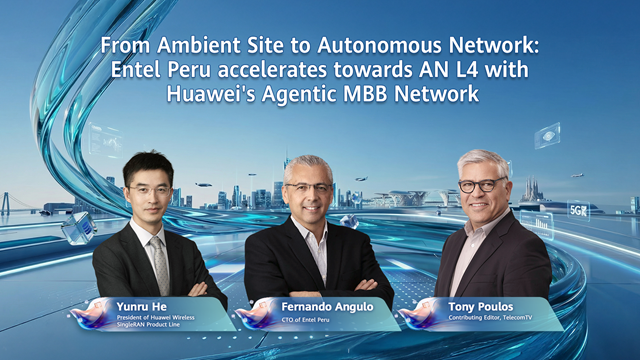
Entel Peru and Huawei discuss the deployment of the world's first large-scale commercial Agentic MBB network solution, featuring Ambient Site technology that transforms passive base stations into intelligent, autonomous networks.
Featuring:
- Fernando Angulo, CTO, Entel Peru
- Yunru He, President of Huawei Wireless SingleRAN Product Line
Recorded March 2026
Email Newsletters
Sign up to receive TelecomTV's top news and videos, plus exclusive subscriber-only content direct to your inbox.