To embed our video on your website copy and paste the code below:
<iframe src="https://www.youtube.com/embed/cNGsiKgWzT4?modestbranding=1&rel=0" width="970" height="546" frameborder="0" scrolling="auto" allowfullscreen></iframe>
Charlotte Kan, TelecomTV (00:06):
Hello and thank you for joining us here in Barcelona for MWC 2026, where we are going to discuss the future of TMT industries in the era of AI with Anil Ganjoo. Anil is Chief Growth Officer for TMT industries and technology at HCLTech. Anil, thank you for joining us.
Anil Ganjoo, HCLTech (00:27):
My pleasure to be with you.
Charlotte Kan, TelecomTV (00:29):
And congratulations on this impressive booth here at MWC. I also noticed your very impressive advertisements at the airport on the way here. Lovely. So I'm very interested to hear more from you on the next era of TMT as AI is developing fast. So first of all, tell us about what you understand or mean by the next era for TMT, how AI is affecting it, and what you believe are the shifts that will most matter to telco leaders going forward, let's say in the next three to five years.
Anil Ganjoo, HCLTech (01:00):
Sure, sure. So now what we mean by the new era for TMT is I think with not just AI, but 5G, edge, data, everything we believe is being transformed. So it's highly disruptive and all the forces coming together are really making every company in this industry rethink, not just renovate, but rebuild the organisation. It's that disruptive. And really what we mean is everything that was being assumed or taken for granted may no longer be true, but then everything that was not possible or thought to be way, way behind or too many years ahead is today possible. And that is what we believe is the new era for TMT, endless possibilities and opportunities for every organisation. But what it means is completely rethinking and thereby rebuilding their organisations, business models, customers, and the way they need to engage with them.
Charlotte Kan, TelecomTV (02:10):
So there's a whole new world of opportunities here. How are advances in connectivity, cloud, AI, semiconductors converging to reshape the telecom value chain as well as TMT industries?
Anil Ganjoo, HCLTech (02:25):
The convergence was always being talked about, but there is no better time than now where convergence, we are actually seeing it happen. In fact, all of us carry a phone in our pockets 24 by 7 these days. That's a great example of convergence of all technologies, one of them being silicon. So the customised silicon taking place, connectivity of 5G and more data as something that's available for you throughout and a platform-based approach for everything where anything is not searchable, it's also being recommended to you. All of these forces and finally AI coming together, converging for a consumer level individual is what we are already seeing taking place. Now take it at an enterprise level for an enterprise organisation leveraging all these things from customised silicon and AI at a silicon level all the way to infrastructure, which is becoming an intelligent infrastructure connectivity wherein everything is connected all the way at an edge level so that you can have deep personalisation wherever you are, whenever.
(03:43):
And then finally, AI is running throughout the whole backbone. This is what is making large enterprises look at convergence to really leverage new business models and new ways to engage, to create new business opportunities for them across the full stack from data, silicon, to platforms, infrastructure, and all the way to applications at a consumer and enterprise level.
Charlotte Kan, TelecomTV (04:11):
So Anil, based on your experience, what are the challenges that TMT organisations are facing to enable AI across their full organisations?
Anil Ganjoo, HCLTech (04:20):
That's a great question because AI, when it started, was being seen just as a bolt-on technology to existing organisations. Now, very soon it's been realised that that's not how you need to be implementing AI. You need to have it across the whole fabric, the backbone of the organisation. Organisations that are now building in the complete fabric of the organisation, AI, which is a generative AI, not just for basically building products, but also across the operations. For a telco, it is across the network to really translate it into network operations, autonomous network operations, which are self-healing, which are network programmed and sliced to be monetised data across available of these networks to really drive hyperpersonalisation. For a media company, it is not just digitisation of content, but also making it easily searchable, highly personalised so that you are now focusing on customer engagement. How do you reduce the churn?
(05:32):
And how do you monetise by upselling and cross-selling based on the consumer's requirement? These are the ways new technologies are basically ensuring that the organisations will implement it. So it means significant change management right at the highest level of management, as well as talent management change, because this requires completely new talent, new thinking, and highly innovative way across the whole fabric of the organisation. That's what needs to be implemented, AI from start all the way to the end, and not just as a bolt-on, but an integral part of the DNA of the organisation.
Charlotte Kan, TelecomTV (06:14):
That's a very important point indeed. It's not just about architecture and operations, but that culture change and change management indeed. Thank you very much for that. So when it comes to implementing AI beyond legacy platforms, how should telecom and technology leaders think maybe differently about talent, as you've mentioned, than change management in order to keep pace with all this change happening around us?
Anil Ganjoo, HCLTech (06:38):
Yeah. So I think the modern organisations are looking at these technologies available as something which needs to be leveraged for completely rethinking the business rather than just implementing it in a patchwork model so that just to make it a little bit more efficient. We've seen that wherever AI has been implemented in a manner which is only incremental, it is having very different results rather than helping and rethinking the whole business, focusing on what their end customers are looking for, what will make them engage with them better, what will help them keep them better, what will improve the customer experience, or just include onboarding customers smoothly. Let's take product launches, typical product launches, new product launches for a telco can go all the way sometimes to six months to even nine months. Using newer technologies and modern technologies, you can now launch products in a few days.
(07:43):
In fact, when you come up with rethinking of new technologies-based products, platforms, and offerings, you can actually launch things in a few hours, and that is how you are keeping pace with market needs as well as market segmentations. You want to target Gen Z. They're not going to be making phone calls to call centres, or maybe not even going to web mobile for ordering products or services. You can catch them at Instagram, for example, or social media platform. That's how you target, and that's possible on very short cycle of products rollout. Thereby, you need to have real-time marketing, you need to have real-time billing systems, you need to have data which is providing you access. That's what you need to be implementing in organisations of today for a better tomorrow.
Charlotte Kan, TelecomTV (08:41):
So you really need to be adaptable and forward thinking here. You need to use the right platform in order to reach out to the right customers here. Looking ahead, maybe to wrap up, what bold moves or mindset shifts will be important for TMT companies that are looking to survive in this era of great change and what will make a difference compared to those who will not survive or at least or struggle?
Anil Ganjoo, HCLTech (09:07):
Sure. I think I'll take one by one. If you think about a telco company, I think the moment a telco company starts thinking of themselves really as a tech company, it's a big change. They're not just a connectivity company. They're an intelligence company. They're not somebody who's just providing a pipe. They are actually providing a consumer experience which is always available and providing access to whatever they want wherever they want. So it's a very product-centric mindset. It's a very tech-centric mindset and whatever legacy and tech debt that exists, now you have technologies which can completely bypass things and make them essentially translate significant cost reductions, having newer technologies as a part of the fabric of the organisation, thinking highly innovatively, and building skills where everyone can basically easily innovate, bring things to market much faster in real time. And so everything is all about customer experience, customer engagement, deep personalisation, which is really what a media company also is looking at doing.
(10:26):
Again, thinking of themselves as more of a tech company rather than an erstwhile historic media company. So you're monetising what you have, that is your asset for a customer's experience and thereby something that will have them stay with you for life. That's a new modern TMT company. Well,
Charlotte Kan, TelecomTV (10:49):
Thank you very much, Anil. Some great pointers and insights here for TMT industries wishing to succeed in the era of AI. Many thanks to you.
Anil Ganjoo, HCLTech (10:58):
Thank you very much. It's a pleasure talking to you.
Hello and thank you for joining us here in Barcelona for MWC 2026, where we are going to discuss the future of TMT industries in the era of AI with Anil Ganjoo. Anil is Chief Growth Officer for TMT industries and technology at HCLTech. Anil, thank you for joining us.
Anil Ganjoo, HCLTech (00:27):
My pleasure to be with you.
Charlotte Kan, TelecomTV (00:29):
And congratulations on this impressive booth here at MWC. I also noticed your very impressive advertisements at the airport on the way here. Lovely. So I'm very interested to hear more from you on the next era of TMT as AI is developing fast. So first of all, tell us about what you understand or mean by the next era for TMT, how AI is affecting it, and what you believe are the shifts that will most matter to telco leaders going forward, let's say in the next three to five years.
Anil Ganjoo, HCLTech (01:00):
Sure, sure. So now what we mean by the new era for TMT is I think with not just AI, but 5G, edge, data, everything we believe is being transformed. So it's highly disruptive and all the forces coming together are really making every company in this industry rethink, not just renovate, but rebuild the organisation. It's that disruptive. And really what we mean is everything that was being assumed or taken for granted may no longer be true, but then everything that was not possible or thought to be way, way behind or too many years ahead is today possible. And that is what we believe is the new era for TMT, endless possibilities and opportunities for every organisation. But what it means is completely rethinking and thereby rebuilding their organisations, business models, customers, and the way they need to engage with them.
Charlotte Kan, TelecomTV (02:10):
So there's a whole new world of opportunities here. How are advances in connectivity, cloud, AI, semiconductors converging to reshape the telecom value chain as well as TMT industries?
Anil Ganjoo, HCLTech (02:25):
The convergence was always being talked about, but there is no better time than now where convergence, we are actually seeing it happen. In fact, all of us carry a phone in our pockets 24 by 7 these days. That's a great example of convergence of all technologies, one of them being silicon. So the customised silicon taking place, connectivity of 5G and more data as something that's available for you throughout and a platform-based approach for everything where anything is not searchable, it's also being recommended to you. All of these forces and finally AI coming together, converging for a consumer level individual is what we are already seeing taking place. Now take it at an enterprise level for an enterprise organisation leveraging all these things from customised silicon and AI at a silicon level all the way to infrastructure, which is becoming an intelligent infrastructure connectivity wherein everything is connected all the way at an edge level so that you can have deep personalisation wherever you are, whenever.
(03:43):
And then finally, AI is running throughout the whole backbone. This is what is making large enterprises look at convergence to really leverage new business models and new ways to engage, to create new business opportunities for them across the full stack from data, silicon, to platforms, infrastructure, and all the way to applications at a consumer and enterprise level.
Charlotte Kan, TelecomTV (04:11):
So Anil, based on your experience, what are the challenges that TMT organisations are facing to enable AI across their full organisations?
Anil Ganjoo, HCLTech (04:20):
That's a great question because AI, when it started, was being seen just as a bolt-on technology to existing organisations. Now, very soon it's been realised that that's not how you need to be implementing AI. You need to have it across the whole fabric, the backbone of the organisation. Organisations that are now building in the complete fabric of the organisation, AI, which is a generative AI, not just for basically building products, but also across the operations. For a telco, it is across the network to really translate it into network operations, autonomous network operations, which are self-healing, which are network programmed and sliced to be monetised data across available of these networks to really drive hyperpersonalisation. For a media company, it is not just digitisation of content, but also making it easily searchable, highly personalised so that you are now focusing on customer engagement. How do you reduce the churn?
(05:32):
And how do you monetise by upselling and cross-selling based on the consumer's requirement? These are the ways new technologies are basically ensuring that the organisations will implement it. So it means significant change management right at the highest level of management, as well as talent management change, because this requires completely new talent, new thinking, and highly innovative way across the whole fabric of the organisation. That's what needs to be implemented, AI from start all the way to the end, and not just as a bolt-on, but an integral part of the DNA of the organisation.
Charlotte Kan, TelecomTV (06:14):
That's a very important point indeed. It's not just about architecture and operations, but that culture change and change management indeed. Thank you very much for that. So when it comes to implementing AI beyond legacy platforms, how should telecom and technology leaders think maybe differently about talent, as you've mentioned, than change management in order to keep pace with all this change happening around us?
Anil Ganjoo, HCLTech (06:38):
Yeah. So I think the modern organisations are looking at these technologies available as something which needs to be leveraged for completely rethinking the business rather than just implementing it in a patchwork model so that just to make it a little bit more efficient. We've seen that wherever AI has been implemented in a manner which is only incremental, it is having very different results rather than helping and rethinking the whole business, focusing on what their end customers are looking for, what will make them engage with them better, what will help them keep them better, what will improve the customer experience, or just include onboarding customers smoothly. Let's take product launches, typical product launches, new product launches for a telco can go all the way sometimes to six months to even nine months. Using newer technologies and modern technologies, you can now launch products in a few days.
(07:43):
In fact, when you come up with rethinking of new technologies-based products, platforms, and offerings, you can actually launch things in a few hours, and that is how you are keeping pace with market needs as well as market segmentations. You want to target Gen Z. They're not going to be making phone calls to call centres, or maybe not even going to web mobile for ordering products or services. You can catch them at Instagram, for example, or social media platform. That's how you target, and that's possible on very short cycle of products rollout. Thereby, you need to have real-time marketing, you need to have real-time billing systems, you need to have data which is providing you access. That's what you need to be implementing in organisations of today for a better tomorrow.
Charlotte Kan, TelecomTV (08:41):
So you really need to be adaptable and forward thinking here. You need to use the right platform in order to reach out to the right customers here. Looking ahead, maybe to wrap up, what bold moves or mindset shifts will be important for TMT companies that are looking to survive in this era of great change and what will make a difference compared to those who will not survive or at least or struggle?
Anil Ganjoo, HCLTech (09:07):
Sure. I think I'll take one by one. If you think about a telco company, I think the moment a telco company starts thinking of themselves really as a tech company, it's a big change. They're not just a connectivity company. They're an intelligence company. They're not somebody who's just providing a pipe. They are actually providing a consumer experience which is always available and providing access to whatever they want wherever they want. So it's a very product-centric mindset. It's a very tech-centric mindset and whatever legacy and tech debt that exists, now you have technologies which can completely bypass things and make them essentially translate significant cost reductions, having newer technologies as a part of the fabric of the organisation, thinking highly innovatively, and building skills where everyone can basically easily innovate, bring things to market much faster in real time. And so everything is all about customer experience, customer engagement, deep personalisation, which is really what a media company also is looking at doing.
(10:26):
Again, thinking of themselves as more of a tech company rather than an erstwhile historic media company. So you're monetising what you have, that is your asset for a customer's experience and thereby something that will have them stay with you for life. That's a new modern TMT company. Well,
Charlotte Kan, TelecomTV (10:49):
Thank you very much, Anil. Some great pointers and insights here for TMT industries wishing to succeed in the era of AI. Many thanks to you.
Anil Ganjoo, HCLTech (10:58):
Thank you very much. It's a pleasure talking to you.
Please note that video transcripts are provided for reference only – content may vary from the published video or contain inaccuracies.
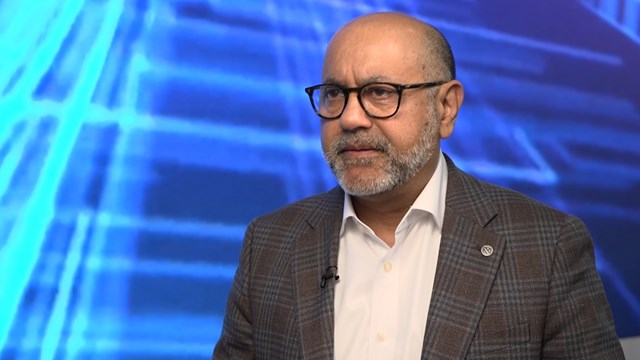
Anil Ganjoo, Chief Growth Officer, Global TMT, HCLTech
At MWC26 in Barcelona, Anil Ganjoo, chief growth officer for global TMT at HCLTech, discusses how AI, 5G and technology convergence are transforming technology, media and telecommunications (TMT) industries. He highlights the need for organisational change and new approaches to talent and business models.
Recorded March 2026
Email Newsletters
Sign up to receive TelecomTV's top news and videos, plus exclusive subscriber-only content direct to your inbox.