To embed our video on your website copy and paste the code below:
<iframe src="https://www.youtube.com/embed/slTajhBJykU?modestbranding=1&rel=0" width="970" height="546" frameborder="0" scrolling="auto" allowfullscreen></iframe>
Thomas Lips, Deutsche Telekom (00:11):
What you see, adoption across the world. Nobody doubted in the beginning that it will be easy for greenfield operators to go full blown on ORAM, but everybody was saying, wow, how those big networks, big customer bases, high quality demands, how they are transforming. And I can tell you, we all figured it out because it is not a one shot in all. Everybody is adapting step by step. Some have started with the cloudification journey. All cloud automation, commercial of the shelf hardware, employing this one, decoupling hardware from software. Others have started to go open frontal, making understood how an integration works, how to bring different suppliers together. Really important one, but not everybody. Others again, focusing on the intelligence journey, intelligence automation. So all SMO, Rick, and all those elements. There's no one fits all, but we are all on a journey in implementing this across the world and adoption is really happening at scale.
Sudhakar Pandey, Rakuten Mobile (01:33):
In network now, we are running around 350,000 cells with different suppliers in ecosystem. So what we can say that we have not only built the RN, but also build the ecosystem. And in terms of if you're following Rakuten, last month, Rakuten as a group announced for 2025 financial results. And I'm proud to share that Rakuten Mobile has achieved annual EBITDA profitability within five years of launch. That means what it converts masses that it's transformative. We have taken a bold decision, which was not easy. It was tough journey, but finally it was rewarded. So it's transformative as well as sustainable. In December, what we have announced that we have got 10 million plus subscriber, which we targeted. And while we speak, we are somewhere around 10.2 million subscriber. So thanks to all the customers who believes on Rakuten mobile network and to the team that they've taken a path which transformation and innovation, and today we are able to set the example and lead the Path in Orland.
Rob Soni, AT&T (02:45):
SMO has become, again, a platform for us for innovation, a real opportunity. What we also see though is as we mix and match hardware and software, we see the partners and the ecosystem evolving very rapidly to provide different types of capability for orchestration and for automation, for applications like dynamic sensing of spectrum and spectrum utilization. This was part of our bigger project. The bigger project for us was really about modernizing and refreshing our network and allowing us to exercise all the spectrum that we had purchased, and we just bought more. And this has been a fantastic impact overall for our subscribers, seeing significant improvements in what their actual user experience is. So it's not just about introducing programmability or operational costs, but it's also about touching user experience for us. And that's really the core of it.
Yigal Elbaz, AT&T (03:35):
The pace on which we are doing things in our industry needs to accelerate. We live in a world in which the pace of technology around us is moving crazy fast. There's a new foundational model that is drop on us every three to four weeks. We cannot allow ourself to spend weeks, months, and years on agreeing on a specification. So that's in the heart of what I would describe as things that we probably need to do a little bit differently.
Changsoon Choi, Deutsche Telekom (04:11):
When it comes to how we're going to bring the more AI enabled to run intelligence into the commercial network, it is actually true that it is not really scalable with multiple AI use case. And this is something that we are also now thinking to implement as an RAP, and that is the situation. And in addition, we also see that it is not also easy to have the full observability when it comes to the order, and particularly from, let's say, all cloud side and AI run side. And also in the meantime, we clearly see that there are lots of divisions demand on, okay, how are we going to provide the dynamic slicing, which actually requires that this all of the Lako Dynamics, let's say, run domain orchestration functionality. So putting all this region together, we eventually decide to go and try to implement the run domain orchestration and then go into the SMO.
(05:10):
And what makes the Deutsche Telecom a little bit unique compared with the other operator is that, like Thomas already mentioned, we decide to develop our own in our SMO, and this is at least the journey that we have started from the couples of months ago. And that was, I think, some part that we say that last, at least one year, that makes me very busy.
Warren Bayek, Wind River (05:35):
One thing I'll say is I'm always asked, what's the killer use case for this? What's the killer AI use case for RAN? And I can give you my answer. I think everyone on this panel can give you three or four, but it's a little flippant, but my answer's always the same. It's that when Apple developed this, they didn't know what the ultimate use case was going to be. They couldn't give you the killer. I say the same thing in RAN. I don't know what the ultimate AI use case is going to be that changes the world, but I will guarantee you this. In five or 10 years, your lives will be completely different because of the AI implementations that people in this room develop. Exactly what they're going to be, I'm not sure. But if we create an open ecosystem and let everyone in, a lot of really smart people are going to develop really cool applications in AI that will affect our lives using RAN in a way we can't even imagine today.
Rob Soni, AT&T (06:31):
I once heard our COO say in front of a very large audience in Sweden, "We don't want 6G." Did that wake anybody up? So this room feels a little quiet and a little stale, so I'm going to just try to see if I can't get you guys to wake up. It gets very technical, very deep, very quickly. And we always say to ourselves, "Why would somebody say they don't want 6G?" I spent a long time thinking about that on the plane back from Stockholm saying, "Why in the world did he say that? What was the reason for that? " Because operators are busy. What are they busy with? Modernizing and refreshing the network, adding new spectrum, layering on new services for the technologies they have today. And then every once in a while, our good friends around the world show up and say, "Hey, we got this shiny new box for you.
(07:23):
We want you to go and put it there." And that's called XG, whatever X is. And then we get into a situation where we say to ourselves, "Hey, we haven't finished deploying the spectrum that we want here. We haven't modernized and moved to cloud. Now we're being pressed to go to AI native or AI." How many different AI adjectives have you heard this week?
(07:44):
I didn't know that you could have AI integrated, AI native, AI sensed, AI built, AI born. I don't know. I heard everyone this week. So I think we're in a space where we're all being asked and challenged to figure out how AI can transform our network today. You heard it all say a new model gets dropped every four to six weeks. We see last year was the year of generative, this is the year of Agentic. What is next year? So when we have these discussions about 6G and about changing the mother code rate on LDPC, and I'm not picking on you, please don't think that way, even though we don't support that. Let's go. You know that, but your team knows that. But I think the simple thing is we are looking to be software driven, not because we want to choose a G, which is software driven, because we are moving the fundamental value stream away from hardware into software.
(08:39):
The telco world needs to embrace this and accept it, make things more programmable. And this is exactly what ORAN does for us. ORAN makes the network open and programmable. It allows us to bring assets best of class from different folks. So table stakes for us of 6G, of course, is open. Table stakes for us around 6G is it should be AI native. Table stakes for us is it should be a scalable interface.
What you see, adoption across the world. Nobody doubted in the beginning that it will be easy for greenfield operators to go full blown on ORAM, but everybody was saying, wow, how those big networks, big customer bases, high quality demands, how they are transforming. And I can tell you, we all figured it out because it is not a one shot in all. Everybody is adapting step by step. Some have started with the cloudification journey. All cloud automation, commercial of the shelf hardware, employing this one, decoupling hardware from software. Others have started to go open frontal, making understood how an integration works, how to bring different suppliers together. Really important one, but not everybody. Others again, focusing on the intelligence journey, intelligence automation. So all SMO, Rick, and all those elements. There's no one fits all, but we are all on a journey in implementing this across the world and adoption is really happening at scale.
Sudhakar Pandey, Rakuten Mobile (01:33):
In network now, we are running around 350,000 cells with different suppliers in ecosystem. So what we can say that we have not only built the RN, but also build the ecosystem. And in terms of if you're following Rakuten, last month, Rakuten as a group announced for 2025 financial results. And I'm proud to share that Rakuten Mobile has achieved annual EBITDA profitability within five years of launch. That means what it converts masses that it's transformative. We have taken a bold decision, which was not easy. It was tough journey, but finally it was rewarded. So it's transformative as well as sustainable. In December, what we have announced that we have got 10 million plus subscriber, which we targeted. And while we speak, we are somewhere around 10.2 million subscriber. So thanks to all the customers who believes on Rakuten mobile network and to the team that they've taken a path which transformation and innovation, and today we are able to set the example and lead the Path in Orland.
Rob Soni, AT&T (02:45):
SMO has become, again, a platform for us for innovation, a real opportunity. What we also see though is as we mix and match hardware and software, we see the partners and the ecosystem evolving very rapidly to provide different types of capability for orchestration and for automation, for applications like dynamic sensing of spectrum and spectrum utilization. This was part of our bigger project. The bigger project for us was really about modernizing and refreshing our network and allowing us to exercise all the spectrum that we had purchased, and we just bought more. And this has been a fantastic impact overall for our subscribers, seeing significant improvements in what their actual user experience is. So it's not just about introducing programmability or operational costs, but it's also about touching user experience for us. And that's really the core of it.
Yigal Elbaz, AT&T (03:35):
The pace on which we are doing things in our industry needs to accelerate. We live in a world in which the pace of technology around us is moving crazy fast. There's a new foundational model that is drop on us every three to four weeks. We cannot allow ourself to spend weeks, months, and years on agreeing on a specification. So that's in the heart of what I would describe as things that we probably need to do a little bit differently.
Changsoon Choi, Deutsche Telekom (04:11):
When it comes to how we're going to bring the more AI enabled to run intelligence into the commercial network, it is actually true that it is not really scalable with multiple AI use case. And this is something that we are also now thinking to implement as an RAP, and that is the situation. And in addition, we also see that it is not also easy to have the full observability when it comes to the order, and particularly from, let's say, all cloud side and AI run side. And also in the meantime, we clearly see that there are lots of divisions demand on, okay, how are we going to provide the dynamic slicing, which actually requires that this all of the Lako Dynamics, let's say, run domain orchestration functionality. So putting all this region together, we eventually decide to go and try to implement the run domain orchestration and then go into the SMO.
(05:10):
And what makes the Deutsche Telecom a little bit unique compared with the other operator is that, like Thomas already mentioned, we decide to develop our own in our SMO, and this is at least the journey that we have started from the couples of months ago. And that was, I think, some part that we say that last, at least one year, that makes me very busy.
Warren Bayek, Wind River (05:35):
One thing I'll say is I'm always asked, what's the killer use case for this? What's the killer AI use case for RAN? And I can give you my answer. I think everyone on this panel can give you three or four, but it's a little flippant, but my answer's always the same. It's that when Apple developed this, they didn't know what the ultimate use case was going to be. They couldn't give you the killer. I say the same thing in RAN. I don't know what the ultimate AI use case is going to be that changes the world, but I will guarantee you this. In five or 10 years, your lives will be completely different because of the AI implementations that people in this room develop. Exactly what they're going to be, I'm not sure. But if we create an open ecosystem and let everyone in, a lot of really smart people are going to develop really cool applications in AI that will affect our lives using RAN in a way we can't even imagine today.
Rob Soni, AT&T (06:31):
I once heard our COO say in front of a very large audience in Sweden, "We don't want 6G." Did that wake anybody up? So this room feels a little quiet and a little stale, so I'm going to just try to see if I can't get you guys to wake up. It gets very technical, very deep, very quickly. And we always say to ourselves, "Why would somebody say they don't want 6G?" I spent a long time thinking about that on the plane back from Stockholm saying, "Why in the world did he say that? What was the reason for that? " Because operators are busy. What are they busy with? Modernizing and refreshing the network, adding new spectrum, layering on new services for the technologies they have today. And then every once in a while, our good friends around the world show up and say, "Hey, we got this shiny new box for you.
(07:23):
We want you to go and put it there." And that's called XG, whatever X is. And then we get into a situation where we say to ourselves, "Hey, we haven't finished deploying the spectrum that we want here. We haven't modernized and moved to cloud. Now we're being pressed to go to AI native or AI." How many different AI adjectives have you heard this week?
(07:44):
I didn't know that you could have AI integrated, AI native, AI sensed, AI built, AI born. I don't know. I heard everyone this week. So I think we're in a space where we're all being asked and challenged to figure out how AI can transform our network today. You heard it all say a new model gets dropped every four to six weeks. We see last year was the year of generative, this is the year of Agentic. What is next year? So when we have these discussions about 6G and about changing the mother code rate on LDPC, and I'm not picking on you, please don't think that way, even though we don't support that. Let's go. You know that, but your team knows that. But I think the simple thing is we are looking to be software driven, not because we want to choose a G, which is software driven, because we are moving the fundamental value stream away from hardware into software.
(08:39):
The telco world needs to embrace this and accept it, make things more programmable. And this is exactly what ORAN does for us. ORAN makes the network open and programmable. It allows us to bring assets best of class from different folks. So table stakes for us of 6G, of course, is open. Table stakes for us around 6G is it should be AI native. Table stakes for us is it should be a scalable interface.
Please note that video transcripts are provided for reference only – content may vary from the published video or contain inaccuracies.
Highlights
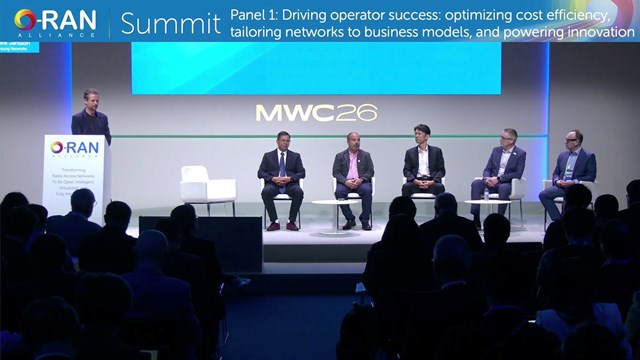
Leading telecom executives from Deutsche Telekom, Rakuten Mobile and AT&T join the O-RAN ALLIANCE on stage at MWC26 to share how they are using Open RAN and cloud-native network architectures to modernise infrastructure, improve operational efficiency, accelerate profitability, and lay the foundations for AI-native, programmable 6G networks.
First broadcast: March 2026
Email Newsletters
Sign up to receive TelecomTV's top news and videos, plus exclusive subscriber-only content direct to your inbox.