To embed our video on your website copy and paste the code below:
<iframe src="https://www.youtube.com/embed/uyiIEA2qQEg?modestbranding=1&rel=0" width="970" height="546" frameborder="0" scrolling="auto" allowfullscreen></iframe>
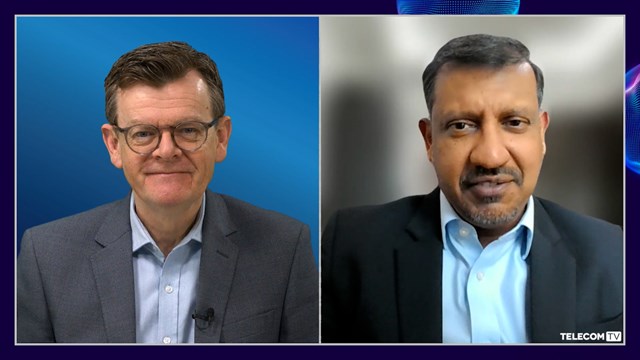
Hello, you're watching TelecomTV, I'm Guy Daniels. The NGMN Alliance has a new chairman. Deutsche Telekom's Arash Ashouriha has been the chairman of the influential industry body for more than four years, and now he hands over to Laurent Laboucher of Orange Innovation Networks. The perfect time then to reflect on the progress made over this period and look ahead to future challenges and opportunities. Arash, thank you so much for joining us today. Very good to see you again. Now, as I mentioned, you've been chairman of NGMN for over four years. What are your major takeaways from your time at the head of the Alliance?
Arash Ashouriha, Deutsche Telekom & NGMN (00:47):
Well, great to see you. Well, I took over the chairmanship during a quite challenging but exciting time post 5G. So I would say the first thing was as a operator driven alliance to really start looking for how to monetize 5G. What kind of additional use cases beyond the first release of just enhanced mobile broadband could be on the table. Then if you remember, we went through Covid, which means we had a big supply chain crisis across the board where it was important to also work on resilience. And the way we are setting up the new strategic pillars, which has been green future networks, operating desegregated networks as well as six G has been balanced between addressing operational needs and strategic trajectory of what CTOs and what the operating companies will need to address. What we have been seeing is that it has been a challenging time within our industry.
(01:58):
Some of the innovation, particularly when it comes to ization and cloud, came at the different pace than maybe anticipated, and we had to permanently look for the right balance of priorities and making sure that despite geopolitical challenges, which also something which started to emerge during my chairmanship, we keep one global voice and the whole success of any mobile, the whole mobile industry to be honest, has been that we had one standard from GSM time war and we have been able to drive scale. And during my chairmanship, I did my upmost bet together with my colleagues and fellow board members to keep basically one voice towards the industry and work close with our entire ecosystem to maneuver ourselves through this change, changing times, challenging times, as well as paving the wave for six G.
Guy Daniels, TelecomTV (02:57):
Well, it has indeed been challenging times. And you referenced there the three key strategic pillars set up during your time as chairman. If we can go over those now. The first one you mentioned was Green Future Networks. Has the NGMN's focus on this critical topic had a real impact on the industry?
Arash Ashouriha, Deutsche Telekom & NGMN (03:17):
I would say absolutely yes. We picked up this topic honestly already four years ago when it was clear that there are multiple facets of the challenge. First is there is the immediate challenge, which was how to save energy. We have been, I always say we are competing on customer experience on commercials, but we should share experience and go through the learning curve together. So there's been a lot of interworking and in fact, my company, Deutsche Telecom, has been together with Orange pushing a lot best practice sharing on smart metering, on addressing a lot of low hanging fruits, how to measure scope one to scope three, how to reduce emission, how to drive efficiency, understand the whole supply chain. And we had many, many successful publication. And to me, successful publication is not just producing something and then observing how many clicks and how many people read it, but how the impact has been for the ecosystem.
(04:23):
When leading suppliers come back to us and ask, okay, what about this? How can we implement that? Can we contribute? And I think we have been fundamental to a topic which we remain. We have to do something about the environment we have to make our business more sustainable. And for us at Deutsche Telecom, and I'm sure for many other operators, leading operators around the world, improving resiliency also means building a sustainable business model. And it closes everything we put into NGMN, and I'm happy that we had good traction so far and the journey will continue.
Guy Daniels, TelecomTV (05:02):
Yeah, absolutely. I just say this is a topic that will remain and will continue in the years ahead, no doubt. Another pillar was operating disaggregated networks. What has the NGMN's membership learned with regards to disaggregation during these past years then, and what would you say are the benefits and challenges of operating such new architectures? Are they clearer now than they were before?
Arash Ashouriha, Deutsche Telekom & NGMN (05:28):
I think we have to face a couple of realities, which is, and I mentioned that in my opening statement, the pace of innovation and the pace of our industry, particularly our suppliers, to be ready to provide cloud native was slower than originally anticipated. And then based upon where you operate, which markets you are in and how mature you are in terms of your architecture and network and what is your thinking, you are at the different stages of that transformational journey. And the aim in NGMN was, okay, again, let's do the learning curve together. And one of the things which I'm very, very proud in this program is actually the cloud native manifesto, which for the first time in the history of our industry, the leading operators are laying down some fundamental requirements based on existing experiences, what cloud native means, and how the ecosystem should support us in a cloud native operating model.
(06:34):
Now, having said that, again, each company has to choose for itself what type of route they want to take. Some will rely on on-prem own cloud, some will try their utmost to work and leverage hyperscaler, public and tramp. And again, regulatory environment play a role, the data protection and security. But ultimately the path is well-defined by our program. And all the experiences throughout the globe, from Asia to Europe to the US or North America, basically have been laid down so that we are very clear what it takes, what the operating model look like, what does it mean from organizational skill procedures, how to actually write RF Qs, how to require cloud native. Also to give a clear guidance to the suppliers who want to support us on that path. So I think, again, work has been done and this is something where going forward, I think only incremental pieces have to be addressed because actually we have laid down everything which we envisaged four years ago.
Guy Daniels, TelecomTV (07:48):
Yes, great work done there. And the third pillar, six G, the third strategic pillar, how has the NGMN helped its members prepare for the coming years as we head towards 6G standardization?
Arash Ashouriha, Deutsche Telekom & NGMN (08:03):
As you know, every mobile generation comes within decades. So we had GSM, we had 3G 10 years later, then 4G another 10 years later, and then 5G. And normally the time between two standardization cycles, it's the time where you should learn from all the rollouts and all the implementation you have with the previous generation and then articulate the learnings as well as try to see what is next. And what we have been doing in NGMN in the last four years is first spend a lot of time on the learnings of 5G. 5G was announced with a big promise that we're going to transform industries. And I think it's fair to say that we didn't have so far the success as an industry which was anticipated, or the expectation which we set with 5G. So there was a lot of learning into what can be improved, what worked well, what didn't work well, and also the way standardization was done on 5G, which was pieces in order to achieve something pull forward the NSA not delivered on the real 5G, which is standalone.
(09:20):
And to be fair, in some of the markets, we still have not rolled out standalone. And therefore we spent quite a bit of time talking to the whole ecosystem, from vendors to operators, to service integrators, and to some of the customers getting the learnings and the feedback and then looked into, okay, what comes next? So far until 5G, every single network was mainly designed primarily for consumers. And with 5G was the first attempt to also address businesses. But I think six G would fundamentally change the game. So we spend that time with the industry associations from car manufacturers into logistic and manufacturing in general, understanding their needs and what comes next. And as all in all, with six G, we are leaving the traditional classical networks. We'll have terrestrial and non-terrestrial network fully integrated into one cohesive connectivity. And with AI, I think these abilities are limitless and we've done the first bit. And now with Lauren taking over and us all operators contribute, I think 25, 26 going to be the critical time where we've shape standardization, which going to take then a bit of time before we see then first commercial outcome in the next three years, three to four years.
Guy Daniels, TelecomTV (10:52):
Well, that leads really nicely into my next question. How important is industry collaboration to making effective change? Is there a way to foster even greater collaboration within the industry?
Arash Ashouriha, Deutsche Telekom & NGMN (11:07):
Absolutely. Again, I cannot repeat myself. The mobile industry's greatest success. And in my personal opinion, and I'm sure many people would agree to me, the biggest achievement was collaboration, one standard, and through that standard delivering scale, now we have lot of challenges. The IT and NT networks and it, the software and the classical hardware and software industry are merging. We have geopolitical tension and of course we have to keep it all together. And this can go through continuous collaboration. We have no, meanwhile, if you compare 10 years ago, we have much more new entities addressing things. We have the Linux Foundation, we have the TM forum, we have GSMA continue to do great work. We have the tip, we have NGMN, and I think there is more collaboration needed. And we started that under my chip to have regular exchange on where we want to address which part of the challenge, and then have the full picture always in mind, and we can do better.
(12:17):
There's always room for improvement. And again, particularly when it comes to six G, we have to listen also more to industry. All the networks pre 5G, were basically designed for consumers. With 5G was the first attempt to also address businesses and industries. And with six G, we are now living the earth. We will even have terrestrial and non-terrestrial. So we have to look more holistic, more exchange with industry association from businesses, from manufacturing, logistic, and bring it all together. We are going to go more software, so we are going to work closer with the likes of TM Forum and Linux Foundation to make sure we have a cohesive approach towards the next generation network. So we can never do enough collaboration.
Guy Daniels, TelecomTV (13:06):
Ara, what final message would you give to the industry as you hand over the chairmanship of the NGMN?
Arash Ashouriha, Deutsche Telekom & NGMN (13:15):
In times of economical pressure, geopolitical tension, we need to collaborate more than ever. I always say let us operators compete when it comes to customer experience, product innovation, and of course commercials. But let's collaborate where collaboration makes sense, which is let's go through this learning curve together, let's shape the industry, avoid fragmentation, and bring the whole ecosystem, vendors, partners, service integrators, alongside the journey.
Guy Daniels, TelecomTV (13:51):
Great message. Well, we must leave it there. Arash, good talking with you. It's been a successful four years and you've given us plenty to debate here on TelecomTV.
Arash Ashouriha, Deutsche Telekom & NGMN (13:58):
Thank you. My pleasure.
Please note that video transcripts are provided for reference only – content may vary from the published video or contain inaccuracies.
Arash Ashouriha, SVP Group Technology, Deutsche Telekom and outgoing chairman of the NGMN board
Deutsche Telekom’s Arash Ashouriha, who has been chairman of the NGMN Alliance for more than four years, is handing over the reins to Laurent Leboucher, group CTO and SVP of Orange Innovation Networks. The perfect time, then, for Arash to reflect on the progress that has been made during his period at the helm and to look ahead to future challenges and opportunities. He covers the three major strategic pillars that were established during his tenure – Green Future Networks, Operating Disaggregated Networks and 6G – and emphasises the need for ongoing industry collaboration.
Recorded: March 2025
Email Newsletters
Sign up to receive TelecomTV's top news and videos, plus exclusive subscriber-only content direct to your inbox.