From Ambient Site to Autonomous Network: Entel Peru accelerates towards AN L4 with Huawei's Agentic MBB Network
Entel Peru’s target toward future intelligent network
Peru’s telecom service provider Entel is accelerating its transition toward Level 4 autonomous networks as part of its broader strategy to improve network resilience, operational efficiency and quality of service across one of Latin America’s most geographically challenging markets.
Across the telecom industry, operators face the universal challenges of how to reduce operating expenses, improve customer experience, and optimize performance in a complex, multi-domain environment. Technologies such as intelligent radio networks, digital twins and automated O&M are emerging as key enablers for operators seeking to reduce operating costs while improving network performance and reliability. For operators like Entel, these capabilities are becoming crucial as they work toward higher levels of network autonomy.
Peru’s telecom sector has expanded steadily over the past decade. According to the country’s telecom regulator OSIPTEL, Peru had around 43.7 million mobile connections by the end of June 2025. Mobile broadband has become the primary means of internet access for millions of users, placing growing demands on network performance and reliability.
Entel and Huawei’s joint digital-intelligent network strategy
Entel is taking several initiatives to realise its goal of achieving L4 autonomous networks. The service provider has adopted a digital-intelligent transformation strategy built around what it refers to as B.E.S.T. framework, focusing on four pillars: Business success, evolution customisation, service delivery and technology innovation.
Under this strategy, the operator is integrating AI and 5G technologies to achieve operational efficiency by improving network planning accuracy, optimising energy consumption and collaborating with other ecosystem players. With four major service providers competing in the market, improving network performance has become critical for Entel to maintain a competitive edge. Recently, Entel’s network was judged as the best network in the country by OpenSignal.
Huawei, a long-term technology partner of Entel, is supporting this effort through the deployment of advanced wireless infrastructure and intelligent network management capabilities.
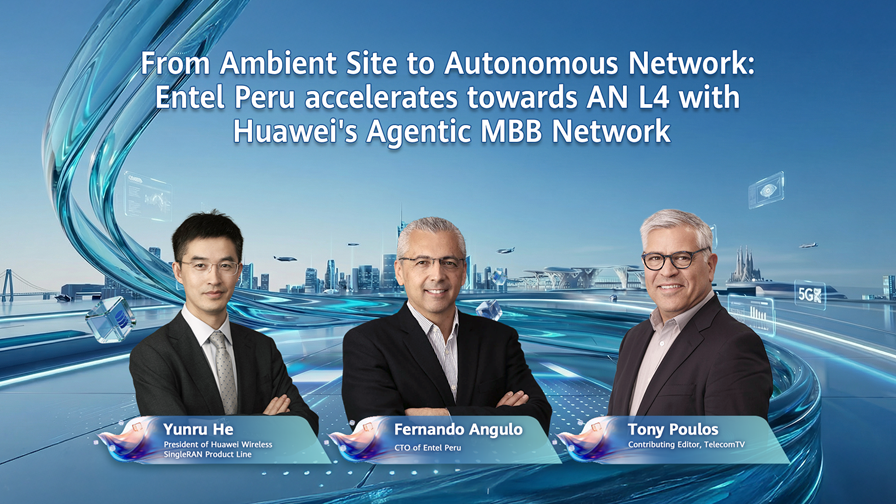
“Today, digital-intelligent network has become a reality. Entel and Huawei are working together to create a unique experience for customers. Huawei provides the ‘digital-intelligent foundation,’ while Entel builds the ‘intelligent bridge’ to bring digital world to every person, home and organization in Peru!” said Fernando Angulo, CTO at Entel Peru, in conversation with He Yunru, President of Huawei SingleRAN Product Line.
Entel has already started implementing intelligent network capabilities across its network infrastructure. Last year, the operator deployed the world’s first large-scale Power-RAN collaborative adaptive power backup solution in partnership with Huawei. Around 50 sites are currently live, with plans to expand deployment to some 1,000 locations.
The service provider faces the challenge of managing the network in difficult terrains where the cost of running the network operations is high. In addition, the electricity supply in these sites depends on erratic power grids.
“Earlier, maintaining service continuity required manual coordination of mobile generators, was costly and logistically complex. The new Huawei solution reduces reliance on generators while ensuring service continuity during power disruptions. At a site in Parque Cocharcas, the system extended backup service time from seven hours to eleven hours without adding additional battery capacity, a 1.6-times improvement,” explained Fernando.
Now, Entel plans to use Huawei’s Ambient Site solution to achieve L4 autonomous networks this year. “As we move into the Mobile AI era. Huawei’s Ambient Site will help Agentic MBB Network evolve and fully support Entel’s future strategy,” said Yunru. “Ambient Site reshapes physical sites. It makes sites visible and controllable, building a foundation for Agentic MBB Network, which brings intelligence into wireless networks to capture the opportunities and create value in a fully connected intelligent world,” explained Yunru.
Huawei brings intelligence into wireless networks
Huawei recently introduced its Agentic Mobile Broadband (MBB) Network to help operators, like Entel, transition towards more autonomous network operations. The solution integrates intelligence across multiple layers of the wireless network, enabling operators to optimise network performance dynamically.
At the network element layer, Huawei brings Adaptive Air Solution to meet new requirements such as uplink experience, latency, and energy efficiency. At the network layer, Huawei has developed Ambient Site, which digitizes physical sites, and builds an intelligent network foundation to simplify O&M and improve network efficiency.
Huawei’s Ambient Site platform is designed to digitise wireless infrastructure by connecting power systems, transmission equipment and antennas with base station components, such as baseband units (BBUs) and remote radio units (RRUs). This allows operators to monitor site conditions in real time and manage network resources more efficiently, improving energy efficiency and helping accelerate the transition toward autonomous network operations. This is particularly relevant for Entel, which faces the costly challenge of maintaining networks in challenging terrain.
The platform also enables automated coordination between different site subsystems. For example, when network traffic increases, idle radio modules can be remotely activated and antenna configurations adjusted automatically to improve coverage in high-demand areas. When traffic decreases, equipment can power down to reduce energy consumption.
As part of providing support to Entel, Huawei is focusing on three key upgrades: Scenario expansion, capabilities enhancement, and value maximisation.
While the radio access network (RAN) is currently being supported by unstable power grids, in the future, generators, solar power and batteries will provide support to make the system more reliable. “In addition, Huawei will also improve its modelling and digital twin capabilities to simplify operations and maintenance to support Entel in its journey to reach L4. Huawei will also provide real-time assurance for uplink and downlink rates as well as latency to help Entel improve user experience by over 30% while achieving up to 30% energy savings,” explained Yunru.
Email Newsletters
Sign up to receive TelecomTV's top news and videos, plus exclusive subscriber-only content direct to your inbox.