DSP Leaders Industry Vision 2026 Report: Results Panel

By Ray Le Maistre
Mar 9, 2026
To embed our video on your website copy and paste the code below:
<iframe src="https://www.youtube.com/embed/txVhd6ygGNM?modestbranding=1&rel=0" width="970" height="546" frameborder="0" scrolling="auto" allowfullscreen></iframe>
All right, good afternoon everybody. We are on the show floor in hall two at the Rakuten Booth at MWC26 in Barcelona. We are here for the DSP Leaders Vision Report 2026 Results Panel. My name is Rayla Matron, the editorial director at Telecom TV. I'm the moderator for this panel. So we are going to meet our speakers. We've got a great lineup here. We're going to start at the far end with Terrier. If you want to introduce yourself.
Terje Jensen, Telenor (00:33):
Yeah. So good afternoon everyone. So I'm Terje Jensen. in Telenor. I'm heading up global business security.
Neil McRae, CityFibre (00:41):
Hi, good afternoon. I'm Neil McRae. I run technology at CityFibre.
Geoffrey Hollingworth, Rakuten Symphony (00:46):
Hey, I'm Geoff Hollingworth. I work with marketing at Rakuten Symphony.
Darrell Jordan-Smith, Wind River (00:50):
Hello, I'm Darrell Jordan-Smith. I'm the revenue officer at Wind River.
Ray Le Maistre, TelecomTV (00:55):
Okay, fantastic. Well, this panel is going to examine and discuss some of the key takeaways from the recently published DSP Leaders Industry Vision Report, which is based on a survey of the DSP Leaders Council members conducted earlier this year in 2026. You can see who is on the council on the Telecom TV website, and you can download that report for free from the Telecom TV website as well. So we're going to dive into a few topics here, and we're going to start with the hottest topic in town, which of course is telco AI strategies. I don't think there is a bigger topic right now in the industry. AI is seemingly linked to pretty much everything that the companies are doing, whether they're operators, vendors, or partners. So we asked our council members what should be the single main focus of telco AI strategies. And you can see the results on the screen here now.
(01:56):
And you can see that by far the most popular choice of our admittedly limited options, and we did ask everybody to pick out a single main focus. The most popular choice was improve operational efficiency, which attracted support from 52% of the councilors while just 10% selected the cut the costs option. But 34% actually chose to generate new revenue streams, which is much higher than I thought it was going to be. So Daryl, is that a surprise in any way? Would you expect that generating new revenue streams to be higher, lower?
Darrell Jordan-Smith, Wind River (02:36):
No, I think it would be higher. And the reason I say that is that the operators in general are trying to make money out of the existing infrastructure. So there's a real focus on how do they leverage AI to do inference and open up new business cases to enter new areas of business. The challenge they have is they haven't figured out what that might be. And that's part of the challenge I think the industry has. How do we actually monetize leveraging AI, inferencing at the edge maybe, and also in the networks in order to deliver differentiated value? Okay.
Ray Le Maistre, TelecomTV (03:10):
Jeff, what are you thinking?
Geoffrey Hollingworth, Rakuten Symphony (03:12):
So I suggest, it's just a suggestion this, but I suggest that the industry perhaps should focus on how are we going to create something that customers want, that customers will pay for. And then let's look at whether AI can help us enhance that experience and whether AI can help us lower the operational costs for that. I think it'd be nice to actually think about the customers a little bit.
Ray Le Maistre, TelecomTV (03:37):
Okay. Neil.
Neil McRae, CityFibre (03:40):
He's taking all my standard sense. So look, I think it's a great thing that we're thinking of revenue because I know this is old fashioned, but making money is what we're here to do and serving our customers is the best way of making money. I kind of look at this as kind of a two-pronged fork, which is, yeah, I want to make money with it, but I also want to save money. And if I can demonstrate with AI or with any other use case for that matter that I can save money, then I think it's an easier discussion to have with a customer to see how what you've built would fit in their environment. And I do think there's many use cases like that where we have telecoms operators that have got big field forces. Well, they're not the only one with that and AI is helping there.
(04:20):
So I think it's a really good sign that we're starting to pivot to think about selling and driving value for customers.
Terje Jensen, Telenor (04:28):
Yeah.
Ray Le Maistre, TelecomTV (04:30):
Teya.
Terje Jensen, Telenor (04:31):
Yeah. So in my mind, it's probably two thoughts we need to balance. And the first thought is on the quality efficiency. So we asked 5,000 other Taylor employees, how are you actually using AI just to get a reality check? And the answer was by far by becoming more efficient myself. And then you could say that's part of the small step embracing Copilot and generative AI and those kind of things. But that's where reality I think we are as an organization, these small improvements and those small steps. Then of course, I wouldn't call it wishful thinking, but there are of course initiatives on say AI factories, GPU as a service. We are doing that as well. So there is money in that. We are proven that with commercial contracts, but I would expect a bit more on efficiency probably where we are as today. Yeah,
Ray Le Maistre, TelecomTV (05:24):
No, and I agree with that. But actually in the weeks between finishing the survey and coming here to MWC, we're actually starting to see more real world cases of AI-based services that are being offered, usually by the B2B side, enterprise side of the service providers. But I mean, any more thoughts on whether the service provider opportunities, whether there's a lot of innovation to be had then, does it mainly going to come from the enterprise side or are there consumer opportunities here as well? I mean, Teria, from a Teleno point
Terje Jensen, Telenor (06:03):
Of view. Yeah. So from the internal side, of course, we are using on the network side, we are using towards customer personalizing. For example, I think you mentioned the customer experience, definitely something there on personalizing the customer experience. And that of course will turn it to our revenue, hopefully, but not seeing the revenue from the day number one, but coming on the longer term SEC.That's of course in the improvement side. But the very concrete thing is, of course, to also to automate a lot of the internal processes, which then goes on becoming more efficient and that track. And then we could say that the AI factories are basically on the enterprise side, so that I fully agree. But there are also also something on the consumer side on how you can be exactly coming back to the personalization and providing more what's the next you want to buy from us, for example, and those kind of things.
(06:55):
So there's definitely something there. Yeah.
Geoffrey Hollingworth, Rakuten Symphony (07:04):
The personalization is what's underneath. I mean, we are monetizing this today because the personalization translates into revenue generation through the ecosystem that we have. So the data processing from the network is getting translated into offers into other businesses that are not viewed as advertising, they're viewed as actual value.
Ray Le Maistre, TelecomTV (07:26):
Okay. You're talking here about at Rakuten mobile as part
Geoffrey Hollingworth, Rakuten Symphony (07:29):
Of that
Ray Le Maistre, TelecomTV (07:29):
Broader
Geoffrey Hollingworth, Rakuten Symphony (07:29):
Ecosystem
Ray Le Maistre, TelecomTV (07:30):
In Japan.
Geoffrey Hollingworth, Rakuten Symphony (07:31):
And that's a little bit what we'd like to see from an education system design point of view to enable other operators to build an ecosystem that makes sense for them. There's real money in there. I mean, and it's because the value of the data in the quality is very, very high versus the quality of internet data.
Terje Jensen, Telenor (07:53):
Okay.
Neil McRae, CityFibre (07:54):
Neil.
(07:55):
So I kind of feel that the power of the network and how we engage with customers and how they engage with us is where there's a huge opportunity. Just simple things like here at CitiFiber, making sure your broadband's functioning as well as it can, understanding what the traffic is and optimizing it for that. And then as an operator, a lot of folks are looking at AI in the depth of process. Actually, what we're looking at AI for is actually, is this process able to be automated? Because quite often we've got processes that are so complicated, trying to automate them becomes too difficult. So actually, can you see pieces of that journey, that customer journey where automation makes sense? And then I look at around MWC and I say a lot of carriers using AI with voice, which is the forgotten application of telcos. I think there's definitely an opportunity there if I think specifically around elderly people or disabled people or special needs where voice can be a big win.
(09:02):
And also, just in terms of agents on the ground, instead of typing into a device using speech to say, "I've done this, I've done this, I've done this. " And it ticks off the checklist of things that you have to do during an install or during some other task that a customer might have. So I think that voice part of it, I think is super powerful and making it easy to do business with telcos and telcos leveraging that with their customers to make their customer's customers able to do business with them in an easy and simple way.
Ray Le Maistre, TelecomTV (09:34):
Okay. Excellent. Did you want to add more, Darrell, or should we move on to- We should move on. Yeah. Okay. Because actually the next topic is very closely related and we'll definitely be able to come back to you, Terry, from here because digital sovereign services, this is something that's really emerged as a major topic in the industry in the past year. It's become a strategic consideration for enterprises, governments, technology, developers, and digital service providers, and it's a massive topic for the telecom sector. So we asked our counselors, is the provision of digital sovereign services a meaningful opportunity for those service providers to generate incremental profitable revenues? Now, there's a big difference between incremental revenues and incremental profitable revenues. Now, the results were pretty positive. There were very few naysayers while 36% believe that all service providers should be developing these sovereign services, 54%, the majority suggested that this is a meaningful opportunity only for some service providers in particular markets, reflecting, I guess, the very different regulatory, political and operating environments to be found around the world.
(11:03):
Now, sovereign and AI related services, that is right in the Telenor wheelhouse. So we'll start with you, Taylor.
Terje Jensen, Telenor (11:12):
So again, I think you are pointing to the profitable, incremental profitable services. And that is the keyword as we see it. And that's all we are taking step by step by step. So get the confirmation, next step, confirmation next step. So we are actually putting this AI factory into the same track. We are also doing sovereign cloud, and then I know that Neil has an opinion about that. But where we are coming from in my mind is that many of the telcos are by nature sovereign. We are regulated as critical services becoming sovereign. That's from decades back in my mind. So that's the way we are running business. Of course, we can argue or with dependencies on number of partners, but still as a principle, we are expected to deliver services continuously, even cutting all the lines crossing the borders. So that's the kind of expectations from the different, even including voice messaging, basic broadband and so on.
(12:12):
So that's where we're coming from. Then we are thinking the same model could be applied on different areas. And then looking into, as I said, AI, cloud, there will be more coming in on the same track. Just to explore, is this something we are becoming a credible provider to a bigger market? Remember, not all telcos would be credible providers for this in my mind, and that's why I didn't answer. Yes, everyone should do it. I think you need to be very carefully thinking through where are you today? What capabilities do you have today? Do you depend on partners to do this? Will these partners become qualified to be sovereign and so forth? So there are a number of things you need to look through in order to pursue this approach, I would say.
Ray Le Maistre, TelecomTV (12:54):
And I get the feeling we're about to explore that bit of the topic by handing the microphone to Neil.
Neil McRae, CityFibre (13:00):
So I think, look, what does sovereign mean? Let me just leave that there. I'm not going to try and answer that. But in my mind, look, can an operator that operates in a jurisdiction easily add value to an existing service by ensuring that it's sovereign using network as a service or API-based network delivery? Absolutely. And I would encourage everybody to be thinking about that. Can everybody do it right away? Of course not. There's some work that they need to do, but I really think we need to be careful with what that word sovereign means because it's a super big word that means a lot of different things. Sovereign cloud, yes, if it's really able to operate in a world where we ... For me, if we disconnect everything, does everything still work? And I think that's a really difficult thing to achieve in today's marketplace, sovereign connectivity, ensuring that your traffic has no chance of leaving your jurisdiction.
(14:02):
I think that's absolutely possible with segment routing and other technologies. So I think there's some really simple services that we can do sovereign capability for. The great news is there are customers who are willing to pay for that. I have seen this. If you make it easy to consume and easy to understand, and also you're clear about where the borderlines are between what is sovereign and what isn't. We rely upon a huge amount of technology from different parts of the world, and that means that our ability to go what I would call full sovereign is kind of limited, but I do think that there is value in there. But sovereign can also mean a slightly different thing. I was presenting at an AI forum recently where 80% of the people in the room were lawyers and they were building what I would call as an industry sovereign solution for them to use AI in a way that made confidential documents still confidential.
(15:03):
They are building their own inferencing infrastructure, they're using it to process case data, and they know that they're not concerned about that going out into the wider world. That has become quite a significant business. And I think we will see other cases of that. So sovereign, not in the nature of national situations, but sovereign in the nature of I've got some really important data that I need to control and contain, and there's value in me doing that.
Ray Le Maistre, TelecomTV (15:31):
Okay. I mean, that's really interesting because I am definitely guilty of thinking about sovereign services in a geographic sense only. So that's a really interesting take on it. Jeff.
Geoffrey Hollingworth, Rakuten Symphony (15:44):
Yeah, I hate the word sovereign. So I'll go further. If we asked everyone this room what sovereign means, we'd get as many answers, plus maybe some multiples. I mean, in your monologue there, you gave us three or four that kind of moved and shape shifted somehow. I think we have to be very, very clear what the value is that we're representing when we talk about these words. And in my mind, what we're really talking about is do you have control over your business operations and can you cope with unplanned change? Do you have resiliency? Yeah. Because you can't control your supply chain, you're always dependent, but the only thing that you care about is if someone kind of leveled one of your buildings, how long would it take you to return to normal service? That's the business you are in. Now, I think if you approach it that way, then telecom can create unique services from many different perspectives.
(16:50):
But if you don't create it that way and you put labels on things just like cloud washing, if we go sovereign washing, I don't know what the service contracts look like in the indemnity when something goes wrong either. So I think it might get caught in legal.
Darrell Jordan-Smith, Wind River (17:07):
Okay. How can I follow all that? So sovereignty for us is around data and resiliency of data. So from our perspective, we do a lot of work with government agencies, defense, or probably for wrong reasons, but that's a large chunk of our business. And they're all worried about where's the data going to be and whether they can control that data for their citizens and all the constituents that they are trying to represent or protect. So we see a big opportunity around the use of sovereign data in that context. We also see a big use case around sovereignty in terms of the automobile industry, for example, in terms of factory recalls and warranty information. There's competitive sensitivities around where that data sits, who has access to that data. So sovereignty from that perspective is what's required. And cloud-based infrastructure can be designed both territorially, geographically and/or around specific data needs and requirements.
(18:15):
So from my perspective, I think that the sovereignty is a really key element, although I don't like the word, I agree with the other individuals here, but I'm really focused on how do we protect people's data and drive value from that.
Ray Le Maistre, TelecomTV (18:28):
Okay. I think I just wanted to come back on a point before we move on to security.
Terje Jensen, Telenor (18:33):
Yeah. And I was triggered by a couple of gentlemen in the middle here on the ... But just before I go there, I was thinking that if you really talk about service innovation, I think it's important not to start with a definition. You need to allow creativity, I think. But when it comes to sovereignty, there is actually a paper from the European Commission who's defining their review, one of those papers, and addressing technical, operational, legal, ownership, supply chain, all these kind of aspects. And you can hand out how are you on a scale from one to five, I think, and then you could add up a score on how sovereign you are. So there's a kind of definition there as well if you want to. I'm not saying we should definitely or we should apply this one, but at least an input to this. But it basically means that sovereignty is not either zero or one.
(19:25):
There's a number of aspects. I think you mentioned data, you mentioned it, and that it's important to incorporate. And the way we are, again, we are approaching it just to brag a bit. We are sitting down with customer cases. Some of them are starting with, "I need a sovereign kind of, but what do you really need?" "Okay, maybe I need some local data kind of thing. "And then you start there and then you build on that. And that I think is important. So
Geoffrey Hollingworth, Rakuten Symphony (19:49):
I thought that was a very good follow-up. I mean, maybe what we need to do is get all the marketing people and just tie their hands together behind the backs for a few years so that we can actually focus on the solutions that we actually need and get them out and then we can call them something afterwards.
Ray Le Maistre, TelecomTV (20:04):
I love to hear that from a marketing executive. That's fantastic.
Neil McRae, CityFibre (20:08):
Road of applause.
Ray Le Maistre, TelecomTV (20:09):
Yeah. So look, we're a little bit time constrained and there is another important topic we want to get to, and that is network security because this is a really big deal. It's becoming even bigger as the months go on, telecom operators appear to be targeted more and more by bad actors or whatever you want to call it. And the threat has never been bigger. So we asked in our survey, has the telco sector failed to invest enough in terms of financial, human and technical resources into network security during the past few years? So not just money, but human and technical resources as well into network security. Now, the results, which you can see on the slide here on the graph here, there isn't a clear consensus, but there appears to be growing concern. I mean, almost half of the respondents believe that network operators should have invested more and done more to protect their customers and their own assets during the past few years.
(21:21):
The vote for that this time was 48% this year. When we asked the same question a year ago, it was 40%. So it's gone up from 40 to 48. Meanwhile, the proportion of respondents believe that telcos have invested as much as they could and should have done decreased from 50% in 2025 to 38%. So there's a real sense within the council that not enough has been done across the board, and that's a pretty telling change. So Terrier, I mean, security now is a big part of your day-to-day job. What do you feel about the kind of threats that the operators are facing now and whether there's going to be a bit of a shock from those who haven't put enough time, effort, teams, resources, et cetera, into it?
Terje Jensen, Telenor (22:14):
Yeah, no, I think going back to the inputs here, I think clearly there have been cases in the last couple of years showing that not everyone has put enough effort or competency or skills or whatever into this. There have been successful attacks and major payouts and other things. So there have been ... But I think we also, there's a recognition that actually telcos are sitting on quite a huge data and valuable data for many. So there's just a recognition that there is something there. What we have seen across the board, I would say, is that the attackers are also getting more advanced. They are going for the weakest link in many cases, and the weakest link might not be the telcos directly. It could be through the suppliers, sorry for ... So there are a number of ways into this. I think they're getting more and more sophisticated doing this.
(23:08):
Then of course, also the human part of it, call it employees, call it contractors or whatever, also turns into a weaker link in many cases. So we see radically increasing attacks on all these areas. So to be up to date, of course, it's hard to say, I do enough, and then tomorrow I'm a weak team, but this is kind of the game, how it's on. So I believe we are working structurally through all these domains, but of course needs to also address clearly the human part of it and also what we call the third party or the supplier part of it. We also see in that we are addressing the customer into this as well, which is then talking about scams and frauds and those kind of things. And we can argue, are we just a channel? And to what extent are we responsible for what's in the channel or should we be someone else taking their roles into that?
(24:09):
So that's also an argument, I guess, into this. As a basic start, we think we are a channel, but we can also offer something on top of that. And that's what we are doing in some of the markets. So we are offering, protecting customers on scams and frauds. So we are doing quite a lot, and I think other telcos are doing similar.
Neil McRae, CityFibre (24:31):
Yeah. I mean, I was kind of disappointed by the results of this because I look at it through two lenses, which I do think telcos are more focused on this. I think there's been some recent incidents, and I don't know if a CIO or chief network officer or team in a telco that isn't security conscious. I think there was some complacency in our industry, and that drove, at least in the UK, that drove some regulation with the Telecom Security Act, which has driven a huge amount of effort across the UK market. And we see similar things happening in the US market, and I think we're going to see this in Europe soon.
(25:15):
I think we haven't done a good enough job of telling people what we are doing and how we're doing it and how it affects them. And I think we need to do more of that. And also, I think this is an area where, from my perspective, being the telco means we must be more secure than anybody else because without us, it doesn't matter what anybody else is secure as because secure is because there's no connectivity and the trust envelope that we have with our customers demands that we put effort into this. So I kind of feel that's an area where more telcos could collaborate more on best practice, on solutions and challenges. And it's a difficult thing, especially if you've been a victim to share the details of that. But the best way to learn is to understand what other mistakes people might have made or what things that they've learned and how you propose it.
(26:10):
So I'm always keen to understand what other operators are doing in this space and sharing best practice because I think the bad actors out there, if I think of Salt Typhoon and some of the other things that have happened in the last couple of years, they're only getting more organized. They're only using the technology in more ways. They can use AI in the way that everyone else uses AI, and it's a constant arms race where we need to up our game. I think Terry is very right on the social aspects of this. How are you testing your partners? How are you testing even what your customers are doing with the network to ensure that you are secure from them insider threat, the actual threat horizon, do you really understand it? Because I think that's often where I've seen where an operator says, "Well, we didn't know that was a risk." So is that threat intelligence that you've got good enough to really understand where the risks are?
Ray Le Maistre, TelecomTV (27:05):
Yeah. And that's where the sharing is so important, isn't it? Yeah.
Geoffrey Hollingworth, Rakuten Symphony (27:09):
Yeah. I'm a little bit surprised at this result, and I'm trying to equate it in my own head. I voted that we were investing enough, and what I'd really like to see is how we benchmark against every other industry, important industry, because I think the health industry, the banking industry, the energies industries, I've always felt quite proud about how well we have done. I earned the security is, again, I think you said it earlier, Terry, that security is not a one or zero black or white. In actual fact, to be safe, you just have to be more safe than the other people because everyone's going for the weak link. And if you actually look at the breaches, these aren't sophisticated breaches. They're usually getting in through a website portal that someone's left open or through some data bucket that you just haven't got a password on.
(28:06):
So my fear here is that we overinvest in the absolute sophistication and we're not actually looking at the broad sense where the attacks are identical to every other industry.
Darrell Jordan-Smith, Wind River (28:22):
So the results on this particular one don't really surprise me because of the context of the telecommunications industry. And I think my esteemed colleagues here touched on it. I think it's around trust. Individuals trust their service provider. There's been many years, hundreds of years of trust built between them and the users of that network. So I think the operators need to invest more, are investing more. The issue is, however, and I think my colleagues already said this, is that there's always someone that's going to figure a way around something, and it's how you actually mitigate as much risk as you can on the layers that you possibly can, because the weakest link that's going to be there is actually going to cost you a lot of expertise and time. The last thing around security that we see certainly is, going back to those two topics around data and AI, that you have to be more secure, you have to do things more rapidly, you have to innovate to protect.
(29:28):
And what we're seeing in just the Linux market space with Yocto Linux as an upstream project, there are 800% more CVEs, security CVEs every quarter on quarter for the last two years. Keeping up with that if you're manufacturing a medical device, for example, is almost insurmountable. So again, the more layers of security we can put around that, make it more difficult for people to access is the better solution. Okay.
Ray Le Maistre, TelecomTV (29:56):
And that was kind of a great point to end on because Because I feel that with a greater focus on finding what data is useful within the telecom domain and making better use of it, that's only going to enhance the potential to have more secure services and networks. I mean, that's just an opinion, but I feel that's the way it's going, especially what's happening with network APIs exposing certain capabilities to enable countrywide anti-fraud and verification services. So look, unfortunately, a bit constrained for time. We do need to wrap up. Thanks very much for the people here viewed us. Thank you very much to our panelists. Let's give them a round of applause, please, and say thank you to them. Really appreciate the time. Great insights and enjoy happy hour now at MWC. Thanks very much.
Terje Jensen, Telenor (30:52):
Thank you.
Please note that video transcripts are provided for reference only – content may vary from the published video or contain inaccuracies.
Panel discussion
Following the recent publication of the DSP Leaders Industry Vision 2026 Report, senior executives from CityFibre, Rakuten Symphony, Telenor and Wind River joined TelecomTV at MWC26 in Barcelona to discuss some of the key findings. Topics include telco AI strategies, the business potential of digital sovereign services, and network security investment levels
Featuring:
- Darrell Jordan-Smith, Chief Revenue Officer, Wind River
- Terje Jensen, Head of Global Business Security, Telenor
- Geoffrey Hollingworth, CMO, Rakuten Symphony
- Neil McRae, CTIO, CityFibre
Sponsored by:

Hot Trends For MWC26: A Barcelona Preview - published February 2026
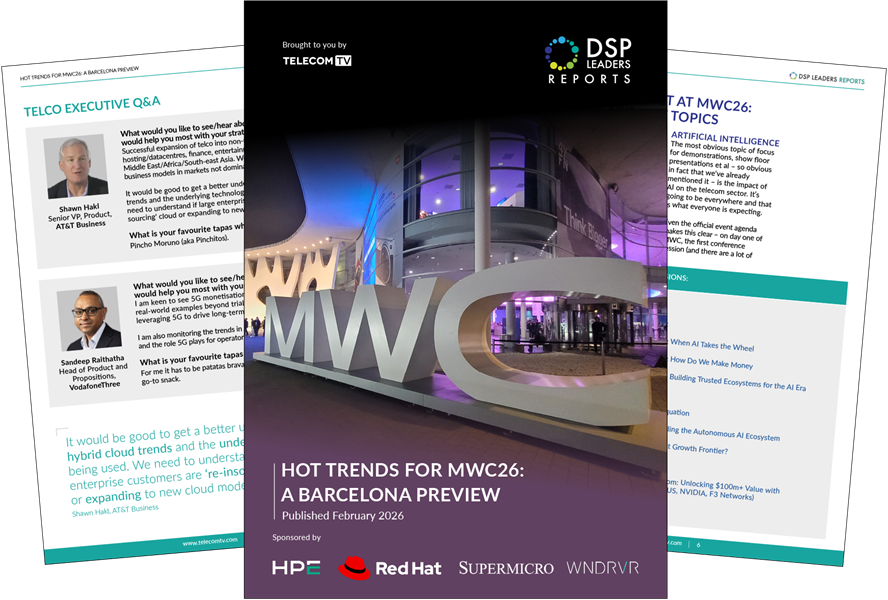
This 29-page report looks at the hot trends expected to be discussed and demonstrated at the MWC26 show, including the broad impact of AI on network operator strategies, as well as sovereignty, satellite services, 6G and network APIs.
It also features insights from a dozen telecom operator executives from the likes of AT&T, BT, Deutsche Telekom, KPN, Orange, Veon, Verizon and more, who disclose what they would like to hear about at the event and identify their favourite tapas. In addition, a number of key technology companies share what they are planning at MWC26 and provide their recommendations for a memorable Barcelona experience.