Samsung and KT Corp ‘validate AI-RAN’ on live network

By Ray Le Maistre
Dec 11, 2025
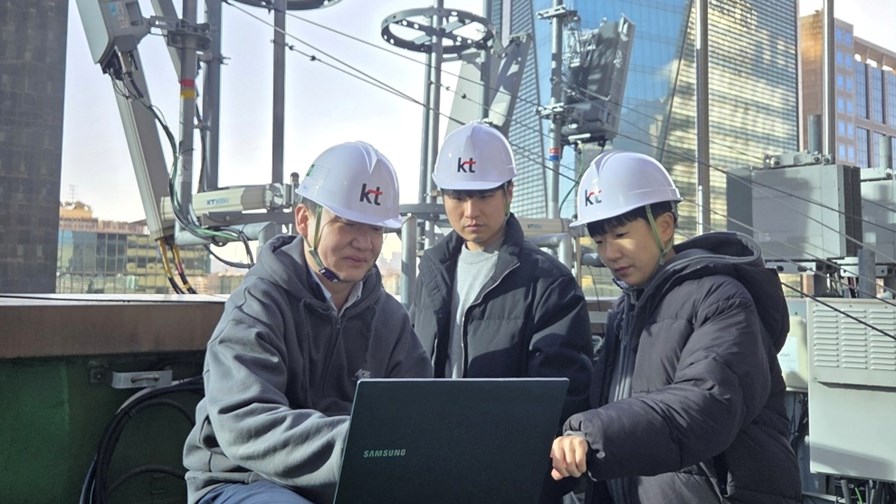
Researchers from Samsung Research and the Future Network Laboratory at KT Corp evaluate the results of AI-RAN optimisation technology.
- South Korean companies Samsung and KT Corp are both members of the AI-RAN Alliance
- They claim to have validated AI-RAN optimisation tech on KT’s commercial network
Following simulation tests conducted in June this year, Samsung and KT Corp say they have “successfully validated AI-based radio access network (AI-RAN) optimisation technology” on KT’s commercial network.
The South Korean partners, both of which are members of the AI-RAN Alliance, noted in this Samsung announcement that in traditional mobile networks, “the same network configuration has been applied to all user devices connected to a base station.” As a result, “when users move through weak-signal areas or travel at high speeds, the connection between their devices and the base station may weaken or drop.”
The AI-RAN optimisation technology verified by the partners “automatically applies optimal configurations for each user – rather than for the network as a whole – based on real-time wireless conditions,” stated Samsung. “The system leverages AI to learn from issues tied to a user’s movement paths and usage patterns, identifying recurring trends to predict potential problems. By proactively preventing disruptions, the technology helps users avoid the connectivity issues they experienced in the past.”
The technology was tested in select areas of Seongnam, Gyeonggi Province, “featuring varying environmental conditions” and involving about 18,000 KT customers.
The optimisation technology was “applied to users who had repeatedly experienced service disruptions, allowing the teams to identify recurring issue patterns and develop user-specific network configurations,” noted Samsung.
The partners “compared the number of disconnections before and after applying these configurations on the commercial network. The results showed a significant drop in connection failures among users who had faced frequent disruptions, as well as a notable decrease in issues for other users in the region,” though no specific numbers were provided.
Nor did the partners specify the exact technology used, how it was integrated into the network or when it might be deployed on an ongoing commercial basis.
But such developments are, of course, important to network operators as they seek to advance their network automation strategies and identify the technologies that can be used in advanced 5G and, ultimately, 6G networks.
Jong-Sik Lee, head of the future network laboratory at KT Corp, stated: “This achievement demonstrates that AI can transform network operations around users. Together with Samsung, we will continue developing customised optimisation technologies to deliver stable, uninterrupted service and drive core 6G capabilities that create new value for customers.”
JinGuk Jeong, head of Samsung Research’s Advanced Communications Research Center, added: “This is a major milestone that shows how AI can improve user experience on real-world commercial networks. Through close collaboration with KT, we will continue shaping and validating the next generation of AI-driven communication technologies.”
Samsung was one of the founding members of the AI-RAN Alliance, which was unveiled in early 2024, while KT joined in January 2025. The optimisation trial is an example of what the alliance calls ‘AI for RAN’, the use of AI tools to improve the performance and efficiency of radio access networks. This is the focus point of the alliance that attracts the most widespread support from the mobile operator community, while ‘AI and RAN’ – the integration of AI and RAN processes on the same underlying IT infrastructure – is still a proposition that has many sceptics in the mobile operator community.
But the alliance members are, naturally, pressing ahead with R&D work on all aspects of AI-RAN, with KT one of a number of South Korean companies (including its domestic operator rivals SK Telecom and LG Uplus) currently working with Nvidia on the development of “intelligent, low-power AI-RAN network technology that can reduce computing costs and extend device battery life by offloading GPU computation tasks to the network’s base station”.
Samsung also recently announced it is to jointly develop “core 6G technologies, with a primary focus on artificial intelligence-based radio access network (AI-RAN) technology” with SK Telecom – see SK Telecom and Samsung team up on AI-RAN, 6G.
- Ray Le Maistre, Editorial Director, TelecomTV
Email Newsletters
Sign up to receive TelecomTV's top news and videos, plus exclusive subscriber-only content direct to your inbox.