To embed our video on your website copy and paste the code below:
<iframe src="https://www.youtube.com/embed/7vzQ6IksSCk?modestbranding=1&rel=0" width="970" height="546" frameborder="0" scrolling="auto" allowfullscreen></iframe>
Ray Le Maistre, TelecomTV (00:05):
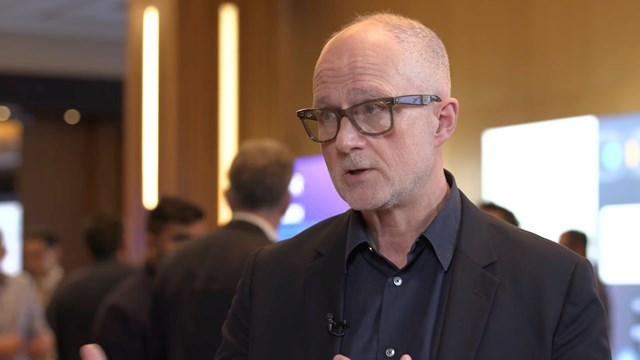
So we are in Dublin. We're at Fyuz 25. I'm here with Patrick Lopez. He is the founder of {Core Analysis}. But Patrick, before we get chatting, you are wearing a number of different hats these days, aren't you? Could you just tell us about that before we get into our discussion?
Patrick Lopez, Core Analysis & Pure Storage (00:19):
Certainly. Thanks for having me, Ray. I'm very fortunate to be able to work on a variety of projects with a lot of different clients. I've always worked at the intersection of telecom networks and cloud network, and that intersection is getting more and more blurry, if you will. So a lot of what I have learned in telecoms become applicable in cloud and vice versa. So as a result, I work with a variety of company. One of the companies with whom I devote most of my time these days is a company called Pure Storage that is basically leading the charge in deploying next generation storage architecture for the cloud. And incidentally, enterprise and telecoms. And then also I'm a member of the AI Run Alliance. I keep contributing to TIP and to the Open Run Alliance as well. So I try to keep busy.
Ray Le Maistre, TelecomTV (01:27):
Well, there's plenty going on there. So look at Fuse as ever. There's a lot of focus on the physical elements and network and the development of those, and that's all really important of course, and not only open ram, but disaggregated optical and open wifi and open land, et cetera. But we're reaching a point now where the considerations need to be kind of at a higher sort of almost macro level about what needs to happen next. And as the operators think, how does 5G evolve? How does six G come about? And how do I become an AI native telco essentially where this sector is going. So what are those considerations? What do operators need to be thinking about beyond the systems, the elements, the chips, the specific software sets?
Patrick Lopez, Core Analysis & Pure Storage (02:26):
It's a very complex question, right, because we're talking about an evolution, but I think the desire for six G is that the network is something different. I mean, networks were originally architected for one-to-one peer to peer communication, whether voice or texts. They evolve little by little to accommodate the internet and to allow users to first access the internet and then to access content from the internet. So that's been the two big steps in the architecture of the networks. If you want, making sure that you can call somebody any point anywhere on the planet with something that's interoperable. And then the second step has been making sure that anybody can access any type of content in any form, mostly video these days on any type of device. Now, if we're looking at the future and we're looking at AI native networks, that's altogether a different proposition where basically what you're saying is that your network is going to adapt and even anticipate in real time the demand is also going to be able to carry work workloads that are not necessarily pure telecom workloads, that are more infrastructure, that are more enterprise workload, that are not only consumer, but also governmental workloads.
Ray Le Maistre, TelecomTV (04:09):
Sure, sovereign is a big topic.
Patrick Lopez, Core Analysis & Pure Storage (04:12):
Certainly, certainly. And all of a sudden you need to have to take a step back because you need to examine the current blueprint that you have and see whether it can be adapted at all first to that purpose. And if it can, what are the steps? And that's hard because basically first you have to think, I think about data. You have to think about your data infrastructure. Everybody's talking about ai, but basically you need to be able to, let me take a parallel. In the past you had network elements and network functions that were producing data telemetry about traffic. That data was stored there and then eventually would find its way into a data lake and data warehouse and then even a public cloud. And then eventually it will be looked at either for troubleshooting or to display dashboards and analytic function. And that was fine, is if all you needed to do with the data is essentially archive it.
(05:30):
But now we're talking about something that's a little bit more dynamic or a lot more, which is basically you want to look at the data right away and detect right away whether a, it fits with the model that you have and if it doesn't, whether you need to correct something and whether it means that the near future is going to require even more corrections, so need to predict. So that's just for the telecom network. And then if on top of that you say, well, look, I might not be as a telecom operator of hyperscaler, but I do have an asset which is my network that does or that will have capacity to host AI processing, and I like to offer that to my customers.
Ray Le Maistre, TelecomTV (06:25):
Yeah, AI factories are becoming more popular now with,
Patrick Lopez, Core Analysis & Pure Storage (06:29):
And what that means is that basically you will have capacity in computing, networking, storage that you will be able to abstract and that you'll be able to offer to enterprise and government to run their workload on. So that's very different from the model where I call you, which is basically even we're on the same network, the same country. My call is going to route through Canada, then back here and call the UK and then back here to you. So that's the model. Or I'm on my phone and I'm going on Netflix and the content is in California probably. But here what we're saying is basically the network here in Dublin in this environment is going to be linked to a compute storage networking capacity. And I'm going to be able to use it. Maybe I will have augmented glasses and maybe those glasses are going to display in real time a layer that will be, I don't know, as a consumer maybe for gaming as an enterprise, I've always dreamt I have very bad memory. I mean Apache memory, but I can recognize people, but I don't always get their name. If I had LinkedIn on my glasses in those kind of shows, that would be just a God I would buy that app. So that's just an example. But basically, and to do these kind of things well, you need capacity that are probably not going to be all on your glasses unless your glasses are going to be like three pounds. Then if you want to keep those glasses light, and if you want to get the battery life good,
(08:29):
Et cetera, et cetera, some of the computation is going to take place in the network. And in all likeliness, the closer that computation to the user is the better the user experience. And in some cases it's going to necessitate it. If we're talking about, I don't know, collaborating robots or whatever. Anyways, having said all of that, when you think about six G, or without talking about the label, but the evolution of the,
(08:56):
You're going to think that in the past, the data that was necessary to manage a network, again was mostly produced at the edge and would find its way all the way to centralized location, all the cloud for processing. And you would look at it later, half a day later, two hours later, time was really no object. But in a world where you want to have a network that is as automated as possible and a network that is able to carry ai, it's a different proposition because what it means is that you need to extract the data as fast as possible from the different network functions, different parts of the networks, and put that data in a state where it can be read by the algorithm as fast as possible. And that's not simple. That's not simple because today's architecture is a lot of different, again, cascading storage that have different performance, different and not adequate for that work. So that's why I've been working with people like Pure Storage because basically you have to throw away your spinning disc and move to flash as a technology. You have to move to data that are objects with metadata, so you can tag them so you can decide. That's another aspect of it. Not all data is going to stay in the same area or in the same space.
Ray Le Maistre, TelecomTV (10:23):
Some
Patrick Lopez, Core Analysis & Pure Storage (10:23):
Data set are going to be produced and stored and managed at the edge. Some of it is going to go back to the public cloud, some of it is going to go into an intermediary state. So it's going to be really important and imperative for the network operator to be able to tag the different dataset and to decide which data set should live well,
Ray Le Maistre, TelecomTV (10:46):
A long answer, but it's so interesting that especially that last element there, I mean, these are discussions that have been ongoing for years and years and haven't been sorted out, but that's probably because there hasn't been the underlying IT infrastructure to enable it to be addressed properly. So with that in mind, what kind of foundational IT platform might telcos need to install next so that they don't make their next big CapEx move and then a few years time think now we need to do it again because that's what all these operators want to avoid. But more and more at this event in particular, people are saying, well, another hardware refresh is inevitable. Nothing can be achieved without it. And that's not what the operators want to hear.
Patrick Lopez, Core Analysis & Pure Storage (11:40):
No, and that's why I'm at fuse and that's why I'm collaborating with tip. At the end of the day, none of that is possible if your network is not disaggregated and using open interfaces. If your network is essentially functions that are jumbled together and that are vertically integrated, you're not going to be able to do what we just described, which is essentially manage like compute storage, networking as separate layers. You're going to have to manage the compute in the open ran for that vendor and the storage in the core for that vendor, but you're not going to be able to have the horizontal and to end view, right? So the first thing is a aggregate. So breaking telecom function into discrete functions. And the second thing is openness. Open interfaces. You have to follow standards, you have to have all these disaggregating element being able to interact, interact and integrate with each other in a plug and play fashion with open interface to minimize cost of integration and to maximize your capacity to manage, again, your network from edge to cloud in layers. So that's an important part, right? And that's why I spend a little bit of time a lot these days with Pure Storage, because they actually have, for their category, for the storage category, they've been able to demonstrate that you can indeed look at data pipeline from edge to cloud, and you can manage data pipeline from edge to cloud. And we talked about data mobility that was not possible before. Yes, we've been talking about it for a long time,
(13:37):
But that wasn't possible until your network was as cloud native as possible, which means commercial of the shelf hardware with a CAS virtualization layer on top, and then network function on top so they can move things around. That wasn't possible. But now that it's possible, what you emerging, what is emerging on top of that is another layer of disaggregation, which is even within the commercial of the shelf hardware, you disaggregating the compute, the storage, and the networking so that you can manage them more recently as well. And that's what brings you the economy of scale that hyperscalers have been enjoying
Ray Le Maistre, TelecomTV (14:20):
And also gives you the flexibility to introduce new services without having to wait for one company to catch up with your requirements as well.
Patrick Lopez, Core Analysis & Pure Storage (14:30):
Absolutely. And there are companies out there that are not coming from the telecom world. They're working, they're coming from the IT world, but they've been able to create products, even hardware based products where the hardware part lasts in your network for like 10, 15 years. And all you do is changing software, or when you're changing hardware, you don't change the whole thing. You change just small elements, controllers, modules, so that you actually, when you look at your assets, you have an infrastructure that purs and all that changes is how efficient you are on top of it.
Ray Le Maistre, TelecomTV (15:14):
Okay, well, I do feel that this, it might seem like an obvious thing to focus on, but it's completely fundamental, and I feel that this is a conversation that's really going to come to the fore, especially as more people start to think, okay, how will GPUs play a role in future telecom infrastructure? What is happening with FPGAs and other elements and the advances there? Lots of different moving parts. Nothing standing still, but that's keeping us in a job at the end of the day, Patrick.
Patrick Lopez, Core Analysis & Pure Storage (15:49):
Indeed. Indeed.
Ray Le Maistre, TelecomTV (15:50):
So look forward to having this conversation moving forward, and happy that you've joined our DSP Leaders Council and that we'll be able to get your insights from now and through 2026 and beyond. So great to talk to you. Thanks very much for joining us today and see you in Barcelona, if not before.
Patrick Lopez, Core Analysis & Pure Storage (16:07):
Absolutely. Thanks a lot for inviting me and having me on this segment.
So we are in Dublin. We're at Fyuz 25. I'm here with Patrick Lopez. He is the founder of {Core Analysis}. But Patrick, before we get chatting, you are wearing a number of different hats these days, aren't you? Could you just tell us about that before we get into our discussion?
Patrick Lopez, Core Analysis & Pure Storage (00:19):
Certainly. Thanks for having me, Ray. I'm very fortunate to be able to work on a variety of projects with a lot of different clients. I've always worked at the intersection of telecom networks and cloud network, and that intersection is getting more and more blurry, if you will. So a lot of what I have learned in telecoms become applicable in cloud and vice versa. So as a result, I work with a variety of company. One of the companies with whom I devote most of my time these days is a company called Pure Storage that is basically leading the charge in deploying next generation storage architecture for the cloud. And incidentally, enterprise and telecoms. And then also I'm a member of the AI Run Alliance. I keep contributing to TIP and to the Open Run Alliance as well. So I try to keep busy.
Ray Le Maistre, TelecomTV (01:27):
Well, there's plenty going on there. So look at Fuse as ever. There's a lot of focus on the physical elements and network and the development of those, and that's all really important of course, and not only open ram, but disaggregated optical and open wifi and open land, et cetera. But we're reaching a point now where the considerations need to be kind of at a higher sort of almost macro level about what needs to happen next. And as the operators think, how does 5G evolve? How does six G come about? And how do I become an AI native telco essentially where this sector is going. So what are those considerations? What do operators need to be thinking about beyond the systems, the elements, the chips, the specific software sets?
Patrick Lopez, Core Analysis & Pure Storage (02:26):
It's a very complex question, right, because we're talking about an evolution, but I think the desire for six G is that the network is something different. I mean, networks were originally architected for one-to-one peer to peer communication, whether voice or texts. They evolve little by little to accommodate the internet and to allow users to first access the internet and then to access content from the internet. So that's been the two big steps in the architecture of the networks. If you want, making sure that you can call somebody any point anywhere on the planet with something that's interoperable. And then the second step has been making sure that anybody can access any type of content in any form, mostly video these days on any type of device. Now, if we're looking at the future and we're looking at AI native networks, that's altogether a different proposition where basically what you're saying is that your network is going to adapt and even anticipate in real time the demand is also going to be able to carry work workloads that are not necessarily pure telecom workloads, that are more infrastructure, that are more enterprise workload, that are not only consumer, but also governmental workloads.
Ray Le Maistre, TelecomTV (04:09):
Sure, sovereign is a big topic.
Patrick Lopez, Core Analysis & Pure Storage (04:12):
Certainly, certainly. And all of a sudden you need to have to take a step back because you need to examine the current blueprint that you have and see whether it can be adapted at all first to that purpose. And if it can, what are the steps? And that's hard because basically first you have to think, I think about data. You have to think about your data infrastructure. Everybody's talking about ai, but basically you need to be able to, let me take a parallel. In the past you had network elements and network functions that were producing data telemetry about traffic. That data was stored there and then eventually would find its way into a data lake and data warehouse and then even a public cloud. And then eventually it will be looked at either for troubleshooting or to display dashboards and analytic function. And that was fine, is if all you needed to do with the data is essentially archive it.
(05:30):
But now we're talking about something that's a little bit more dynamic or a lot more, which is basically you want to look at the data right away and detect right away whether a, it fits with the model that you have and if it doesn't, whether you need to correct something and whether it means that the near future is going to require even more corrections, so need to predict. So that's just for the telecom network. And then if on top of that you say, well, look, I might not be as a telecom operator of hyperscaler, but I do have an asset which is my network that does or that will have capacity to host AI processing, and I like to offer that to my customers.
Ray Le Maistre, TelecomTV (06:25):
Yeah, AI factories are becoming more popular now with,
Patrick Lopez, Core Analysis & Pure Storage (06:29):
And what that means is that basically you will have capacity in computing, networking, storage that you will be able to abstract and that you'll be able to offer to enterprise and government to run their workload on. So that's very different from the model where I call you, which is basically even we're on the same network, the same country. My call is going to route through Canada, then back here and call the UK and then back here to you. So that's the model. Or I'm on my phone and I'm going on Netflix and the content is in California probably. But here what we're saying is basically the network here in Dublin in this environment is going to be linked to a compute storage networking capacity. And I'm going to be able to use it. Maybe I will have augmented glasses and maybe those glasses are going to display in real time a layer that will be, I don't know, as a consumer maybe for gaming as an enterprise, I've always dreamt I have very bad memory. I mean Apache memory, but I can recognize people, but I don't always get their name. If I had LinkedIn on my glasses in those kind of shows, that would be just a God I would buy that app. So that's just an example. But basically, and to do these kind of things well, you need capacity that are probably not going to be all on your glasses unless your glasses are going to be like three pounds. Then if you want to keep those glasses light, and if you want to get the battery life good,
(08:29):
Et cetera, et cetera, some of the computation is going to take place in the network. And in all likeliness, the closer that computation to the user is the better the user experience. And in some cases it's going to necessitate it. If we're talking about, I don't know, collaborating robots or whatever. Anyways, having said all of that, when you think about six G, or without talking about the label, but the evolution of the,
(08:56):
You're going to think that in the past, the data that was necessary to manage a network, again was mostly produced at the edge and would find its way all the way to centralized location, all the cloud for processing. And you would look at it later, half a day later, two hours later, time was really no object. But in a world where you want to have a network that is as automated as possible and a network that is able to carry ai, it's a different proposition because what it means is that you need to extract the data as fast as possible from the different network functions, different parts of the networks, and put that data in a state where it can be read by the algorithm as fast as possible. And that's not simple. That's not simple because today's architecture is a lot of different, again, cascading storage that have different performance, different and not adequate for that work. So that's why I've been working with people like Pure Storage because basically you have to throw away your spinning disc and move to flash as a technology. You have to move to data that are objects with metadata, so you can tag them so you can decide. That's another aspect of it. Not all data is going to stay in the same area or in the same space.
Ray Le Maistre, TelecomTV (10:23):
Some
Patrick Lopez, Core Analysis & Pure Storage (10:23):
Data set are going to be produced and stored and managed at the edge. Some of it is going to go back to the public cloud, some of it is going to go into an intermediary state. So it's going to be really important and imperative for the network operator to be able to tag the different dataset and to decide which data set should live well,
Ray Le Maistre, TelecomTV (10:46):
A long answer, but it's so interesting that especially that last element there, I mean, these are discussions that have been ongoing for years and years and haven't been sorted out, but that's probably because there hasn't been the underlying IT infrastructure to enable it to be addressed properly. So with that in mind, what kind of foundational IT platform might telcos need to install next so that they don't make their next big CapEx move and then a few years time think now we need to do it again because that's what all these operators want to avoid. But more and more at this event in particular, people are saying, well, another hardware refresh is inevitable. Nothing can be achieved without it. And that's not what the operators want to hear.
Patrick Lopez, Core Analysis & Pure Storage (11:40):
No, and that's why I'm at fuse and that's why I'm collaborating with tip. At the end of the day, none of that is possible if your network is not disaggregated and using open interfaces. If your network is essentially functions that are jumbled together and that are vertically integrated, you're not going to be able to do what we just described, which is essentially manage like compute storage, networking as separate layers. You're going to have to manage the compute in the open ran for that vendor and the storage in the core for that vendor, but you're not going to be able to have the horizontal and to end view, right? So the first thing is a aggregate. So breaking telecom function into discrete functions. And the second thing is openness. Open interfaces. You have to follow standards, you have to have all these disaggregating element being able to interact, interact and integrate with each other in a plug and play fashion with open interface to minimize cost of integration and to maximize your capacity to manage, again, your network from edge to cloud in layers. So that's an important part, right? And that's why I spend a little bit of time a lot these days with Pure Storage, because they actually have, for their category, for the storage category, they've been able to demonstrate that you can indeed look at data pipeline from edge to cloud, and you can manage data pipeline from edge to cloud. And we talked about data mobility that was not possible before. Yes, we've been talking about it for a long time,
(13:37):
But that wasn't possible until your network was as cloud native as possible, which means commercial of the shelf hardware with a CAS virtualization layer on top, and then network function on top so they can move things around. That wasn't possible. But now that it's possible, what you emerging, what is emerging on top of that is another layer of disaggregation, which is even within the commercial of the shelf hardware, you disaggregating the compute, the storage, and the networking so that you can manage them more recently as well. And that's what brings you the economy of scale that hyperscalers have been enjoying
Ray Le Maistre, TelecomTV (14:20):
And also gives you the flexibility to introduce new services without having to wait for one company to catch up with your requirements as well.
Patrick Lopez, Core Analysis & Pure Storage (14:30):
Absolutely. And there are companies out there that are not coming from the telecom world. They're working, they're coming from the IT world, but they've been able to create products, even hardware based products where the hardware part lasts in your network for like 10, 15 years. And all you do is changing software, or when you're changing hardware, you don't change the whole thing. You change just small elements, controllers, modules, so that you actually, when you look at your assets, you have an infrastructure that purs and all that changes is how efficient you are on top of it.
Ray Le Maistre, TelecomTV (15:14):
Okay, well, I do feel that this, it might seem like an obvious thing to focus on, but it's completely fundamental, and I feel that this is a conversation that's really going to come to the fore, especially as more people start to think, okay, how will GPUs play a role in future telecom infrastructure? What is happening with FPGAs and other elements and the advances there? Lots of different moving parts. Nothing standing still, but that's keeping us in a job at the end of the day, Patrick.
Patrick Lopez, Core Analysis & Pure Storage (15:49):
Indeed. Indeed.
Ray Le Maistre, TelecomTV (15:50):
So look forward to having this conversation moving forward, and happy that you've joined our DSP Leaders Council and that we'll be able to get your insights from now and through 2026 and beyond. So great to talk to you. Thanks very much for joining us today and see you in Barcelona, if not before.
Patrick Lopez, Core Analysis & Pure Storage (16:07):
Absolutely. Thanks a lot for inviting me and having me on this segment.
Please note that video transcripts are provided for reference only – content may vary from the published video or contain inaccuracies.
Patrick Lopez, Founder & CEO, {Core Analysis} & CTO Telecom and Media, Pure Storage
Talking to TelecomTV on the show floor at the recent FYUZ25 event, Patrick Lopez, founder of {Core Analysis}, discusses the shift in underlying platforms that digital service providers (DSPs) need to consider and what this means for automated network operations and data management in the AI-native telco era.
Recorded November 2025
Email Newsletters
Sign up to receive TelecomTV's top news and videos, plus exclusive subscriber-only content direct to your inbox.