Nokia revamps for the AI era, axes mobile chief Tommi Uitto

By Ray Le Maistre
Nov 19, 2025
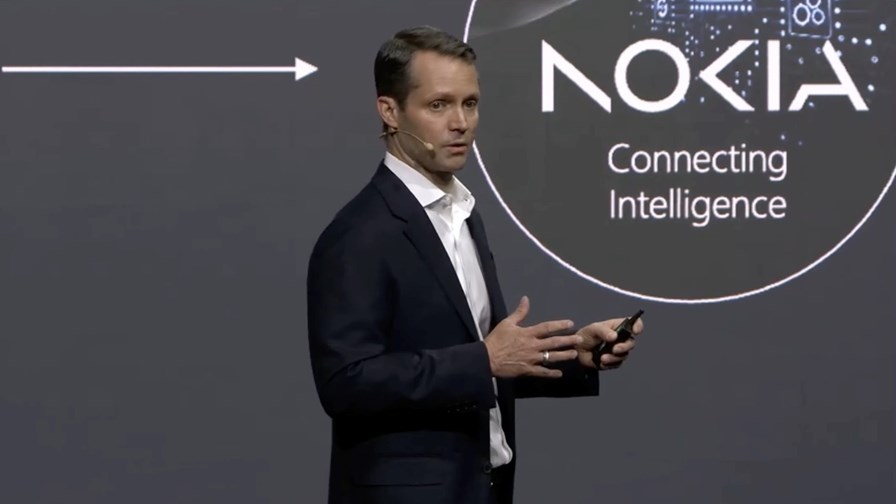
"We're going this way!" Nokia CEO Justin Hotard introduces the company's new strategy.
- Nokia has unveiled a new strategy to help it better address the ‘AI supercycle’
- It will focus on ‘connecting intelligence’ rather than ‘connecting people’
- The vendor is compressing its portfolio into two operating units, half the current number
- CEO Justin Hotard is taking temporary control of the new Mobile Infrastructure unit as current mobile network chief Tommi Uitto has been shown the exit door
- Investors don’t like the initial look of the plan, as Nokia’s share price took a 8.8% hit
Nokia CEO Justin Hotard, who took the vendor’s top executive role in April this year, just stamped his authority on the company, using its capital markets day event to unveil a new strategy designed to address the networking potential linked to the ‘AI supercycle’ (of which more later). The plan will see the Finnish vendor, starting at the beginning of next year, revamp its operating model and be run by a new-look management team that no longer includes one of the company’s biggest personalities, mobile networks chief Tommi Uitto, who has been axed as part of Hotard’s reshuffle.
Nokia’s new operating model hinges on just two primary operating units – Network Infrastructure and Mobile Infrastructure – down from the current four. Hotard is taking, on an interim basis, the lead role at the new mobile division until a successor for Uitto is hired.
The new strategy builds on what the company has been saying for a while – the company’s growth prospects lie in delivering the technology that connects all kinds of datacentres and other facilities (including businesses) as well as providing the products that enable optimal networking performance within datacentres. In his opening capital markets day address, Hotard identified the Network Infrastructure division as the “near-term growth engine”.
The Network Infrastructure unit will continue to be led by David Heard and consists of three business units – Optical Networks, IP Networks and Fixed Networks (broadband access). No real change, then, for the part of the Nokia portfolio that has been propping up the vendor’s financials for some time already. In the past 12 months, this segment generated revenues of €7.8bn and an operating profit of €800m.
Hotard noted that Network Infrastructure is “the near-term growth engine” that is “sitting at the centre of the AI supercycle” and lies at the heart of the company’s change of motto from ‘connecting people’ to ‘connecting intelligence’ (more on this later too).
The Mobile Infrastructure division, led by Hotard for the time being, brings together the vendor’s core network and radio access network (RAN) portfolios, as well as the company’s Technology Standards unit (which manages its valuable intellectual property/patents portfolio) that has recently operated as a standalone unit called Nokia Technologies. In the past 12 months, this segment (assessed as if it had been created a year ago) generated revenues of €11.6bn and an operating profit of €1.5bn (much of that coming from the patents licensing unit, which has very high margins).
Mobile Infrastructure, Hotard hopes, will “lead the industry to AI-native networks and 6G”. And while Network Infrastructure is the near-term growth driver, the CEO is positioning Mobile Infrastructure as the part of Nokia that is “focused on the next wave of innovation”.
Nokia’s current Cloud and Network Services (CNS) division is essentially disbanded, with the head of that business, Raghav Sahgal, being given a new top-table role starting on 1 January 2026 as chief customer officer, “driving a seamless customer experience for Nokia’s customers”.
Also retaining his seat at the vendor’s group leadership team table is Patrik Hammarén, as president of Technology Standards. Uitto is the only big-name casualty of the revamp.
Hotard noted that he believes he now has the “right team” to execute the new strategy and that the company is working hard to develop a new culture that the CEO calls “Team Nokia”, which is all about “winning together”. That togetherness is not just internal but also refers to the growing importance of collaboration with customers and key partners, as much of the future innovation opportunities for Nokia will come from partnerships, such as the one forged recently with Nvidia – see Nvidia lights a fire under AI-RAN partner Nokia with $1bn investment.
The changes don’t stop there, though. While Network Infrastructure and Mobile Infrastructure are the primary business segments, the vendor will also have what it calls the Portfolio Businesses segment, which will comprise the product lines that, following a business review, didn’t make the strategic cut and are now effectively in line for divestment or closure.
This segment comprises: Fixed wireless access CPE (currently part of the fixed networks portfolio); site implementation and outside plant (also currently part of the fixed networks portfolio); enterprise campus edge (currently in Cloud and Network Services); and microwave radio (currently part of the Mobile Networks division). Nokia notes that between then, these product lines generated revenues of €900m in the past 12 months and recorded an operating loss of about €100m.
For further details, including the vendor’s long-term financial targets and strategic key performance indicators (KPIs), see Nokia’s official announcement.
The company’s investors took an initial look at the numbers and the strategy and weren’t very impressed, as Nokia’s share price dropped by 8.8% to $6.06 on the New York Stock Exchange in early trading on Wednesday.
While the Portfolio Business segment houses the parts of the Nokia empire that are on the wane, others show significant promise. As a result, Nokia is launching a new incubation unit, Nokia Defense, “to serve as the central go-to-market and R&D hub for Nokia’s defence portfolio. Building on the strong foundation of Nokia Federal Solutions in the US, the company sees further opportunities in the US, Finland and other allied countries to deliver defence-grade solutions based on Nokia’s core technologies in network and mobile infrastructure,” the vendor stated.
Hotard talked more about this in his opening capital markets day address, which tells us a lot about where he sees Nokia now and where he is hoping it will go. Here is a good chunk of what he had to say (buckle up because it’s not short…):
“When I talk about the AI supercycle, I'm not just talking about what is happening today – ubiquitous deployment of large language models and deployment of AI agents. I'm talking about a multi-wave structural transformation that will raise new opportunities, reshape industries, transform economies, and ultimately advance human progress. And as intelligence moves beyond the datacentre into the physical world, it will transform how devices interact, how industries operate, and how people live and experience technology. And for companies like Nokia, it's a moment of disruption and a tremendous moment of opportunity, because it's an opportunity when new leaders can emerge.”
Hotard noted that the shift towards people using AI to generate text, images, video and to automate workflows and use AI agents “is already visible in the network. We’re seeing far more intensity and actually far more variability in traffic patterns and entirely new demands on latency, reliability, security and throughput. In fact, our researchers at Bell Labs have done analysis that shows that as inference workloads expand and token exchanges multiply, consumer AI traffic across mobile and fixed networks is set to grow at over 20% annually through the next decade, with enterprise and industrial AI traffic accelerating at nearly 50% annually, driven by more distributed and more real time applications.
“The reality is, if you think about every generation of technology boom, connectivity has become more critical. Bandwidth is more essential, and interruptions… cannot be accepted. This is only the beginning of the AI supercycle, and what this means for Nokia as a trusted Western provider of connectivity is clear – the AI supercycle is an opportunity for us to lead again and to seize that opportunity. We also recognize that Nokia needs to evolve, and that's exactly what we're doing. And today, the company that used to be known for connecting people is now the company known for connecting intelligence.
“Connecting intelligence is critical because it flows directly from our North Star as a company which is advancing connectivity to secure a brighter world. The first wave of the AI supercycle is already reshaping demand across our industry. AI adoption is scaling faster than any technology in history, and that impact is already showing up in the network, because the network isn't just carrying bits of traffic, it's increasingly carrying tokens, the currency of intelligence. And these tokens represent everything from the prompts and responses flowing through LLMs to real time sensor data used by intelligent agents and applications. And this is only the beginning, when you think about autonomous vehicles, robotics, delivery drones, and more and more adoption of augmented and virtual reality applications. We're already seeing the beginnings of this transformation, because across the world, AI factories are being built at an unprecedented pace. Datacentre construction is accelerating, optical network transport requirements are increasing, and IP networks are being re-architected to move AI workloads.
“AI infrastructure is also evolving rapidly as compute and memory fabrics become bottlenecks, creating demand for the kind of high performance optics and switching that Nokia is known for. In fact, in optical and IP networking, we're already capturing this opportunity, and we're serving as the backbone of many of the world's AI factories… We enable hyperscale connectivity across continents and within the datacentre, and as inference workloads expand beyond centralised clusters, our networks are enabling data and compute to move closer to the users and the devices that rely on them.”
This is creating the growth opportunity for Nokia’s Network Infrastructure segment, reckons Hotard, as the addressable market for that segment is “forecasted to grow from €48bn in 2025 to €60bn in 2028, and we see meaningful upside beyond that, as AI workloads become more distributed, datacentre traffic becomes more optical, more coherent, and more performance intensive. The reality is today, this is a portfolio and a business that sits at the heart of the AI supercycle, and we're already capturing the early waves of this demand.”
Hotard continued: “However, the opportunity doesn't stop here. As AI moves into the real world – into physical AI into industrial. AI into autonomous systems, robotics, industrial automation, augmented reality, digital twins – access networks, both mobile and fixed, will need to evolve just as dramatically as optical and IP networks are today, because ultimately, to deliver intelligence everywhere, connectivity will need to be ubiquitous, trusted, performant and adaptable, and it won't be just enough to deliver it the way that we have – traditionally deterministic and static connectivity will need to be optimized in real time. It will need to be able to adapt. We'll need to be able to support the demands of tokens with the right bandwidth, the right latency and the right security for that specific token.
“That's why the next major opportunity for Nokia lies in AI-native mobility. While the mobile infrastructure market is stable today, we see long term growth coming, and it will follow the rise of AI-enabled devices and the demand for these intelligent applications at the edge.”
Hotard had a lot more to say and we’ll come to that in time. But there’s no doubt right now that Nokia is now on a new path and Hotard probably won’t have too long to prove that his new strategy is the right one.
- Ray Le Maistre, Editorial Director, TelecomTV
Email Newsletters
Sign up to receive TelecomTV's top news and videos, plus exclusive subscriber-only content direct to your inbox.