News Highlights:
- NTT has further advanced the semiconductor technology of aluminum nitride (AlN)1, and has succeeded, for the first time in the world, in operating AlN-based high-frequency transistors.
- The issues that have hindered high-frequency signal amplification in AlN-based transistors—high contact resistance and high channel resistance—have been overcome by designing a contact layer that reduces the energy barrier at the electrode-semiconductor interface and a channel structure that generates a high electron concentration.
- This work shows that AlN is promising not only for power devices but also as wireless-communication devices, indicating the possibility of further expanding its application.
Tokyo, Japan – NTT Inc. has achieved, for the first time in the world, amplification of high-frequency signals used in wireless communications in AlN-based transistors by designing a low-resistance structure. The AlN-based high-frequency transistors fabricated in this study are capable of amplification in the millimeter-wave band. With further development toward higher output power, improvements in wireless-communication services, such as expanded coverage areas and higher communication speeds, are expected in the post-5G era. NTT was the first in the world to successfully develop AlN as a semiconductor. Due to its excellent semiconductor properties, it is expected to be applied to power devices2 used in power conversion. In this study, the high-frequency operation of AlN-based transistors for wireless communication was demonstrated for the first time, indicating the potential for AlN to expand its range of applications.
The results of this research will be presented at the international conference "71st IEEE International Electron Devices Meeting (IEDM 2025)" to be held in San Francisco on December 10, 2025.
Background
High-frequency transistors are the core devices of high-frequency power amplifiers used in wireless communications, satellite communications, radar, and other applications. Higher output power and higher frequency of wireless signals lead to improved communication services such as expanded coverage areas and higher communication speeds. Therefore, high-frequency transistors require semiconductor materials with both a large breakdown field3 and high saturation electron velocity4. In current 5G communications, high-frequency transistors using gallium nitride (GaN), a wide-bandgap semiconductor5, are widely used. Toward post-5G, ultra-wide-bandgap semiconductors5, such as aluminum nitride (AlN), diamond, and gallium oxide (Ga2O3), which have even larger breakdown electric fields, are attracting attention to achieve further increases in output power of high-frequency transistors.
AlN is predicted to have one of the largest breakdown electric fields and saturation electron velocities among semiconductor materials, and its Johnson's Figure of Merit (FoM)6—a performance index for high-power, high-frequency transistors—is five times higher than that of GaN, the highest among ultra-wide-bandgap semiconductors (Figure 1). In aluminum gallium nitride (AlGaN), a compound of AlN and GaN, the performance index improves as the Al composition increases. Therefore, high-frequency transistors using high-Al-content AlGaN (AlN-based semiconductors) as the channel layer7- possess high potential as next-generation power amplifiers. NTT has been the first in the world to successfully grow AlN semiconductors and has demonstrated the operation of AlN transistors and Schottky barrier diodes, showing their potential as power-device semiconductors. However, when using AlN-based semiconductors for high-frequency transistors, increasing the Al composition leads to fundamental issues such as insufficient current injection from electrodes into the semiconductor and increased channel resistance. For this reason, high-frequency operation had long been considered difficult for high-Al-content AlN-based transistors with Al composition exceeding 75%.
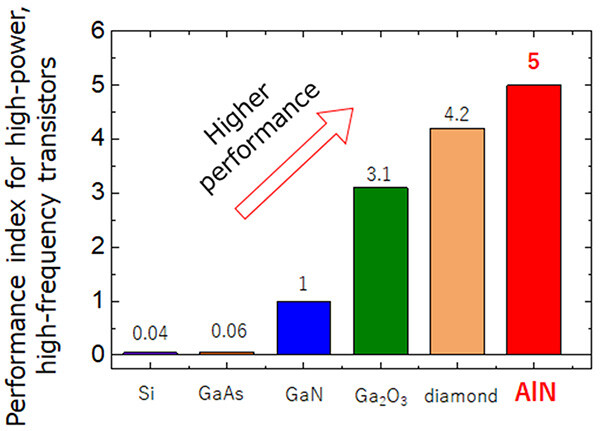
Figure 1. Predicted high-Power, high-frequency transistor-performance index of semiconductor materials based on material properties. Johnson's Figure of Merit (normalized to GaN).
Technology highlights
For this study, we developed the following two technologies to achieve high-frequency operation of AlN-based transistors (Figure 2).
- (1)Low-resistance Ohmic Contact Using an AlGaN Contact Layer
In conventional structures where electrodes are formed directly on the AlGaN channel layer, increasing the Al composition raises the energy barrier between the electrode and semiconductor, making it difficult to obtain Ohmic contact8 and limiting the drain current. To reduce this energy barrier, we developed a technique to form an AlGaN contact layer with graded Al composition between the electrode and channel layer. This enables the reduction in the Ohmic contact resistance. - (2)Low-resistance Channel via Polarization-Doped Structure
In conventional AlGaN channel structures with uniform Al composition, the two-dimensional electron gas formed at the interface between the AlN barrier layer and AlGaN channel layer is used as the current path. However, in high-Al-content AlGaN, the reduction in two-dimensional electron-gas density leads to increased channel resistance and limited drain current. The energy barrier for confining the electron gas within the channel is also low, making it difficult to achieve a high on/off current ratio. We developed a polarization-doped9 channel structure in which an AlGaN channel layer with graded Al composition is sandwiched between an AlN barrier layer and charge-control underlayer, enabling the formation of a high-density three-dimensional electron gas within the channel layer. This significantly reduces the channel resistance.
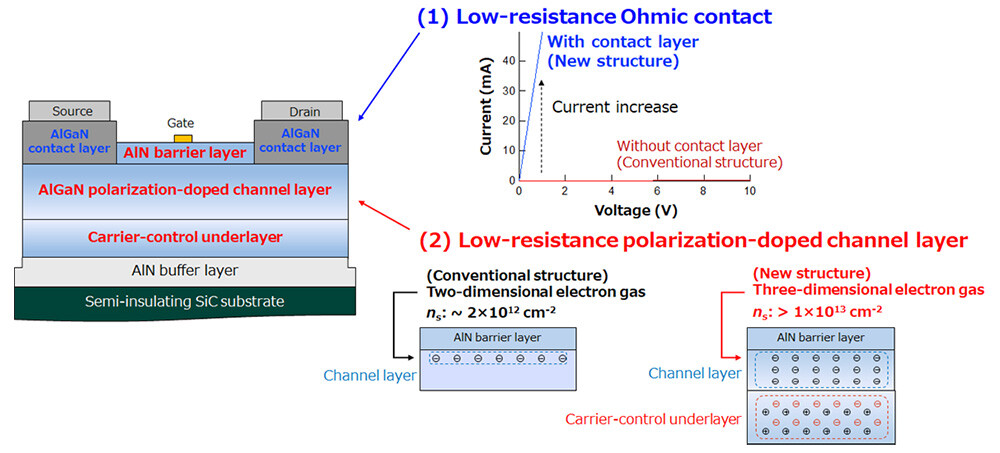 Figure 2. Schematic of the AlN-based transistor and key technical features.
Research Results
Using these technologies that reduce Ohmic contact resistance and channel resistance, we fabricated AlN-based transistors in the high-Al-composition range (Al compositions of 78, 85, and 89%). Even in the Al-composition region above 75%, where drain current had previously been severely limited, we confirmed large drain current and excellent current linearity in the linear region of the transistor. As one example, the transistor with 85% Al composition exhibited a high drain current exceeding 500 mA/mm and high on/off ratio exceeding 109 (Figure 3). With these improvements in transistor performance, we succeeded, for the first time in the world, in achieving RF-power amplification above 1 GHz in AlN-based transistors with Al composition exceeding 75%. The transistor with 85% Al composition also achieved a maximum frequency of oscillation (fmax)10 of 79 GHz in the millimeter-wave band (30-300 GHz)—the highest among AlN-based transistors reported to date (Figure 4). Since higher Al composition is advantageous for achieving higher output power in high-frequency transistors, the structure proposed in this study provides a design guideline for achieving the intrinsic potential of AlN, representing an important advancement toward the application of AlN-based high-power, high-frequency transistors.
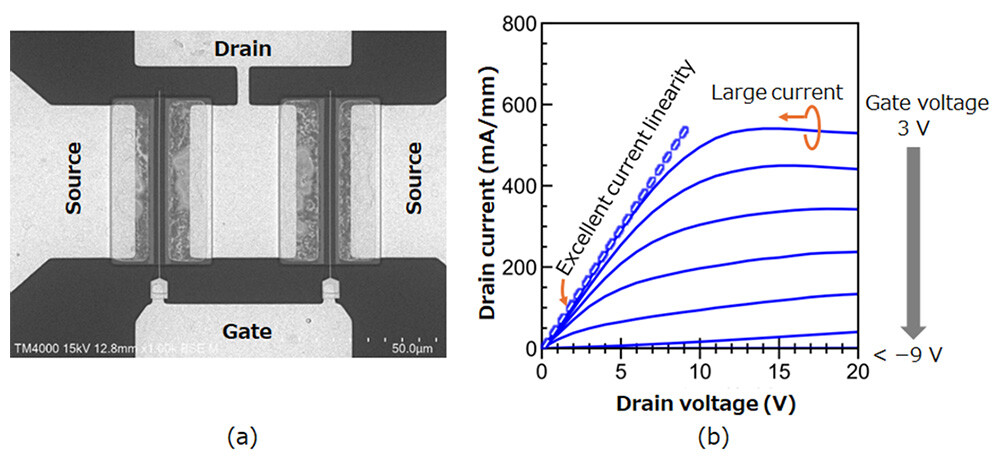 Figure 3. (a) Top-view scanning-electron-microscope image of the AlN-based transistor (Al composition: 85%), and (b) drain current‐voltage characteristics as the gate voltage varied from +3 to −9 V.
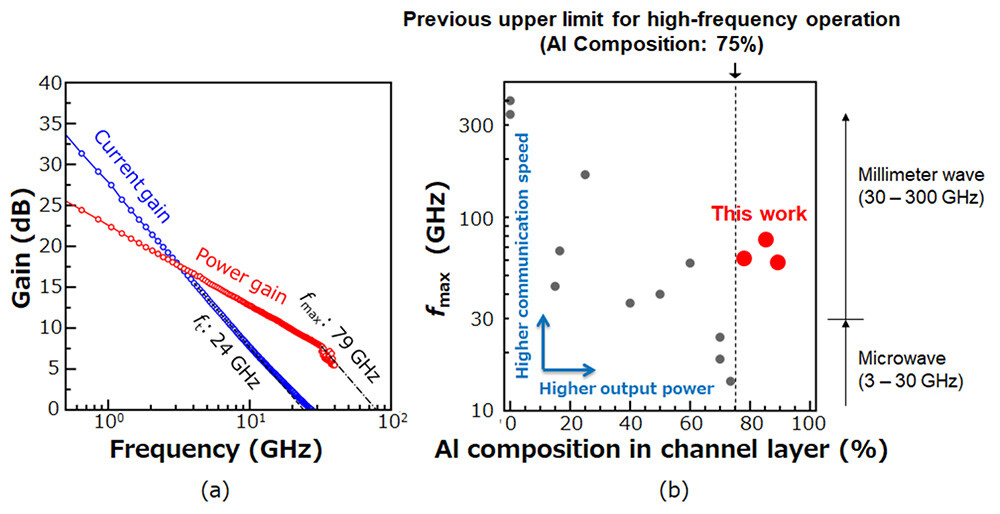 Figure 4. (a) High-frequency characteristics of the AlN-based transistor (Al composition: 85%), and (b) trend of fmax as a function of the Al composition in AlN-based transistors.
Future Outlook
We succeeded, for the first time in the world, in achieving millimeter-wave power amplification in AlN-based transistors with Al composition exceeding 75%. This marks an important first step toward the evolution of wireless-communication infrastructure in the post-5G era, including expanded communication coverage and higher communication speeds. Going forward, we will design device structures capable of higher current and voltage operation to demonstrate high-power operation of these high-frequency transistors and continue research and development toward the practical implementation of AlN-semiconductor technology from power conversion to wireless communications.
Related Press Releases
- -April 22, 2022: "World's First Realization of Aluminum Nitride Transistor — A Leading Candidate for Next-Generation Power Devices Contributing to Carbon Neutrality —"
- -December 10, 2024: "NTT Clarifies Current Transport Mechanism of Aluminum Nitride-Based Schottky Barrier Diodes — A Major Step Toward Realizing New Power Semiconductor Devices for a Low-Carbon Society —"
Conference Information:
- -Conference: 71st IEEE International Electron Devices Meeting (IEDM 2025)
- -Dates: December 6-10, 2025
- -Title: First RF Operation of AlGaN-channel Polarization-Doped FETs with Average Al-content Over 0.75
- -Authors: Seiya Kawasaki, Masanobu Hiroki, Kazuyuki Hirama, Yoshitaka Taniyasu
Glossary
1Aluminum Nitride (AlN)
A compound semiconductor consisting of aluminum (Al) and nitrogen (N). AlN-based semiconductors collectively refer to AlN and high-Al-content AlGaN alloys with Al compositions of 50% or more.
2Power Devices
Power-conversion devices with functions such as DC-AC conversion, voltage step-up/step-down in DC systems, and frequency conversion in AC systems. They are widely used in home appliances, electric vehicles, railways, industrial equipment, and power infrastructure.
3Breakdown electric field
The electric-field strength at which a semiconductor material can no longer maintain electrical insulation and a sudden increase in current occurs. A higher breakdown field enables operation at higher voltages and higher output power.
4Saturation electron velocity
The maximum velocity that electrons can reach under a strong electric field. Higher electron velocity enables operation at higher frequencies.
5Wide-bandgap semiconductors and Ultra-wide-bandgap semiconductors
The bandgap is a fundamental material property that determines the electrical characteristics of a semiconductor. Materials with larger bandgaps exhibit higher breakdown electric fields. Silicon (Si) has a bandgap of 1.1 eV. Semiconductors with bandgaps around 3 eV, such as silicon carbide (SiC) and gallium nitride (GaN), are classified as wide-bandgap semiconductors. Materials with even larger bandgaps—including gallium oxide (Ga2O3), diamond, and aluminum nitride (AlN)—are referred to as ultra-wide-bandgap semiconductors.
6Johnson's Figure of Merit (FoM)
A performance index for high-power, high-frequency transistors. It is proportional to the product of breakdown electric field and saturation electron velocity.
7Channel layer
The semiconductor layer inside a transistor that serves as the path for current flow. By controlling the electron concentration in the channel layer via the gate voltage, the transistor regulates or amplifies current.
8Ohmic Contact
A metal-semiconductor contact with low electrical resistance that enables current to flow easily in both directions.
9Polarization Doping
A technique in which the composition of AlGaN is spatially graded to create polarization charges, thus generating a three-dimensional electron gas or three-dimensional hole gas.
10Maximum frequency of oscillation (fmax)
The upper frequency limit at which a transistor can function as a power amplifier (the frequency where the power gain becomes 1). It is an important parameter for high-frequency amplifiers and wireless-communication circuits.
Email Newsletters
Sign up to receive TelecomTV's top news and videos, plus exclusive subscriber-only content direct to your inbox.