InterDigital CTO on how 6G can support AI-driven applications

By Charlotte Kan
Mar 12, 2026
To embed our video on your website copy and paste the code below:
<iframe src="https://www.youtube.com/embed/KKzZXs7Pb4E?modestbranding=1&rel=0" width="970" height="546" frameborder="0" scrolling="auto" allowfullscreen></iframe>
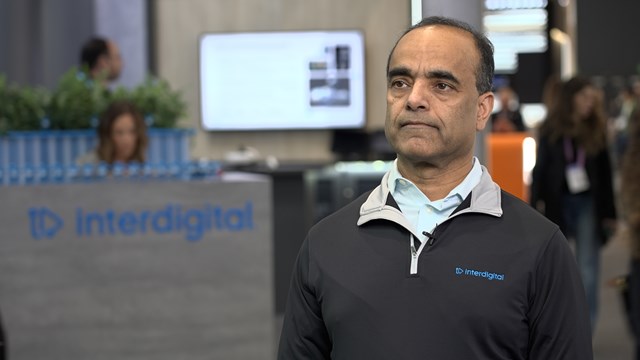
Thank you for joining us here in Barcelona for MWC Edition 2026, where we are joined by Rajesh Pankaj. Rajesh is CTO at InterDigital. Rajesh, thank you for joining us.
Rajesh Pankaj, InterDigital (00:21):
Thank you, Charlotte.
Charlotte Kan, TelecomTV (00:22):
So Rajesh, here at MWC this year, it is clear that AI is in all the conversations. We have generative AI, agentic AI, and even physical AI. AI is being embedded into everything. So let me ask you the obvious question. If AI is becoming the intelligence layer for the world, do we really need 6G?
Rajesh Pankaj, InterDigital (00:47):
Great question, Charlotte. Let us think about it. AI is the brain of the world, but this brain has to interact with sensors. It has to get information from somewhere. Then, when it does the computation, it has to give some order, do something. So it has to communicate with different parts of the world. That communication has to take place over some kind of networks and actually 6G, which will be the enhanced version of 5G and will have many more capabilities, is the right way to connect AI with the rest of the world. So 6G and AI are going to be complementary, not competing with each other. If you really think about it, AI can help 6G and 6G can help AI. AI is a capability that can make things smarter. It will make the next generation network also smarter.
(01:35):
But also, as AI needs to talk to different parts of the ecosystem, then 6G has to be designed in such a way that it can work with those AI computations or AI experiences. I'll give you an example.
(01:54):
When you're running something on your phone, it needs to upload data. If you run some kind of AI on your phone, then it has to upload a lot more data than you normally would in the previous generation of platforms. So suddenly the uplink requirement of the network is a lot higher than it was before. If you look at 5G, it has a lot of download capability, but not as much upload capability. 6G needs to make sure that the upload capability increases so that people can upload videos that need to be uploaded, for example, to the cloud so that AI can do its work, or it can generate different sensory data and upload to the cloud, or upload to wherever AI is running. All of that needs to happen. Finally, one of the ways that AI and 6G need to work together is that people are going to run these applications that will have different requirements.
(02:44):
Some would be very low latency, they may not be very heavy AI usage, but they require very low latency. Some could have very heavy AI need and there the latency requirements may not be as strong. In that case, you need to have some things that run very fast and some that require very much bandwidth, but maybe go much farther. So 6G has to make sure that it can work with all of those things as AI applications are running all around the world.
Charlotte Kan, TelecomTV (03:12):
So really AI and 6G are going to be supporting each other here. You're talking about immersive AI-powered experiences at scale, XR glasses, shared digital spaces, real-time AI services, but today's networks are already under strain from all this video traffic. So what makes 6G capable of supporting this explosion?
Rajesh Pankaj, InterDigital (03:38):
Well, you just made the case for 6G. As you said, today's networks are already straining and we will need more and more capacity in these networks. 6G is really the thing that is going to make all of those happen. One example, and something that we are demonstrating here at MWC, is extreme MIMO and near field. These are the ways to make the beamforming much tighter and much more intelligent, and that way you can increase the capacity of the network. The other thing that you can do in 6G networks is make sure that the service that 6G provides is compatible with what is needed. Once again, this is something that I talked about already, that when you are looking for something which is very latency sensitive, you need to make sure that the quality of service available to that particular service delivers much lower latency compared to something that has large bandwidth requirement, but perhaps latency requirement is not as strong.
(04:36):
So that's another thing that you can do. All of these techniques are needed to make sure that 6G can support these networks or these services that are going to be required, which are going to be much more intensive in terms of data rate and also much more intensive in terms of latency requirement and so on. All the different mix of services can be provided on a single 6G network.
Charlotte Kan, TelecomTV (04:58):
So there's a lot of excitement around consumer immersion. Where does 6G truly transform industries and how does it really change the world?
Rajesh Pankaj, InterDigital (05:09):
One of the best things that happens is that whenever we provide new bit rate or new G, people are able to figure out different ways to use it, which is the great thing about our business. Consumers will continue to use more bit rate. They will have more immersive services and so on. But if you really think about it, there are a couple of things that 6G is doing that are going to be important for different kinds of industry verticals. For example, one of the new verticals for 6G is integrated sensing and communication, or ISAC. What this does is turn the network into a sensor. With this sensing capability, which is going to be in everybody's pocket through their 6G devices, you are able to sense the environment around you and that can have applications for autonomous driving, manufacturing and other things.
(06:02):
If you go to our booth, you will see a demonstration in which we are showing how ISAC works. Particularly, you can use the cellular system, the 6G system with Wi-Fi to come up with better sensing. That's another demonstration that we are showing at MWC at our booth.
Charlotte Kan, TelecomTV (06:16):
Now, Rajesh, to finish with, all of this sounds very ambitious, but for 6G to succeed, it really needs global alignment and standards. What role are you playing at InterDigital to make sure that you can turn this vision into reality?
Rajesh Pankaj, InterDigital (06:34):
To make 6G a reality, I believe we need to have a single global standard, which may have some different flavours that can support some particular region or some particular application, but a single global standard that's deployed worldwide. In order to make that happen, we have already worked with the pre-standards bodies in ATIS in the US, in ETSI in Europe, and we have developed what 6G's architecture needs to be, what its requirements need to be, what kind of applications they need to support. Now the standardisation work has started in earnest in 3GPP, which is the worldwide standards-setting body for 6G. There, we are working with all the other companies to come up with a global standard that can be available a few years down the road and can be deployed worldwide.
Charlotte Kan, TelecomTV (07:19):
Thank you very much, Rajesh.
Rajesh Pankaj, InterDigital (07:22):
Thank you, Charlotte.
Please note that video transcripts are provided for reference only – content may vary from the published video or contain inaccuracies.
Rajesh Pankaj, CTO, InterDigital Inc
At MWC26, Rajesh Pankaj, CTO at InterDigital, explains how 6G and AI will complement each other rather than compete. He outlines the technical requirements for 6G to support AI-driven applications, such as increased uplink capacity and lower latency, and highlights the importance of global alignment and standardisation. He also shares InterDigital’s involvement in pre-standards bodies and 3GPP to help define and develop a single global standard for 6G.
Recorded March 2026
Email Newsletters
Sign up to receive TelecomTV's top news and videos, plus exclusive subscriber-only content direct to your inbox.